


TL;DR:
- Trace minerals such as zinc and magnesium are essential for maintaining oral tissue integrity, immune function, and preventing demineralization. Their optimal benefit depends on precise chemical forms and delivery methods in products, with formulation quality being more important than mineral quantity. Enamel acts as a permanent record of early mineral exposure, emphasizing the importance of adequate systemic mineral intake during development.
Trace minerals are defined as dietary micronutrients required in small quantities that govern structural integrity, immune competence, and tissue repair across oral hard and soft tissues. The role of trace minerals in oral health extends well beyond simple nutritional adequacy. Zinc, magnesium, iron, and strontium each participate in distinct biological mechanisms that determine enamel resistance, periodontal stability, and the oral microbiome’s composition. Mineral micronutrient deficiencies often manifest first in the mouth, making the oral cavity a reliable early indicator of systemic mineral status. Understanding these mechanisms allows dental health enthusiasts and natural oral care practitioners to make more precise, evidence-based decisions.
What is the role of trace minerals in oral health?
Trace minerals function across three interconnected domains in the oral environment: structural reinforcement of mineralized tissues, modulation of immune and inflammatory responses, and regulation of microbial activity. These domains are not independent. A deficit in one mineral can compromise all three simultaneously.

Zinc is the most extensively studied trace element in oral medicine. Zinc deficiency is associated with impaired wound healing, increased infection susceptibility, recurrent aphthous stomatitis, and xerostomia. This means that patients presenting with chronic oral ulceration or dry mouth should have their zinc status evaluated before attributing symptoms to other causes. Zinc also participates in DNA synthesis and cellular proliferation, processes that are indispensable for mucosal repair following injury or surgical intervention.
Magnesium occupies an equally significant position. Magnesium intake is inversely correlated with dental caries severity and periodontitis progression, and supplementation demonstrably improves periodontal status. With 60% of the body’s magnesium stored in bone and enamel-supporting alveolar structures, even subclinical deficiency can reduce the mineral density of hard tissues. Iron supports mucosal integrity and immune surveillance, while strontium, though less discussed, incorporates into hydroxyapatite and may influence enamel crystallinity.
The practical implication is direct: trace mineral status is not a peripheral concern in oral health assessment. It is a primary variable.
Zinc’s specific contributions to tissue repair and immunity
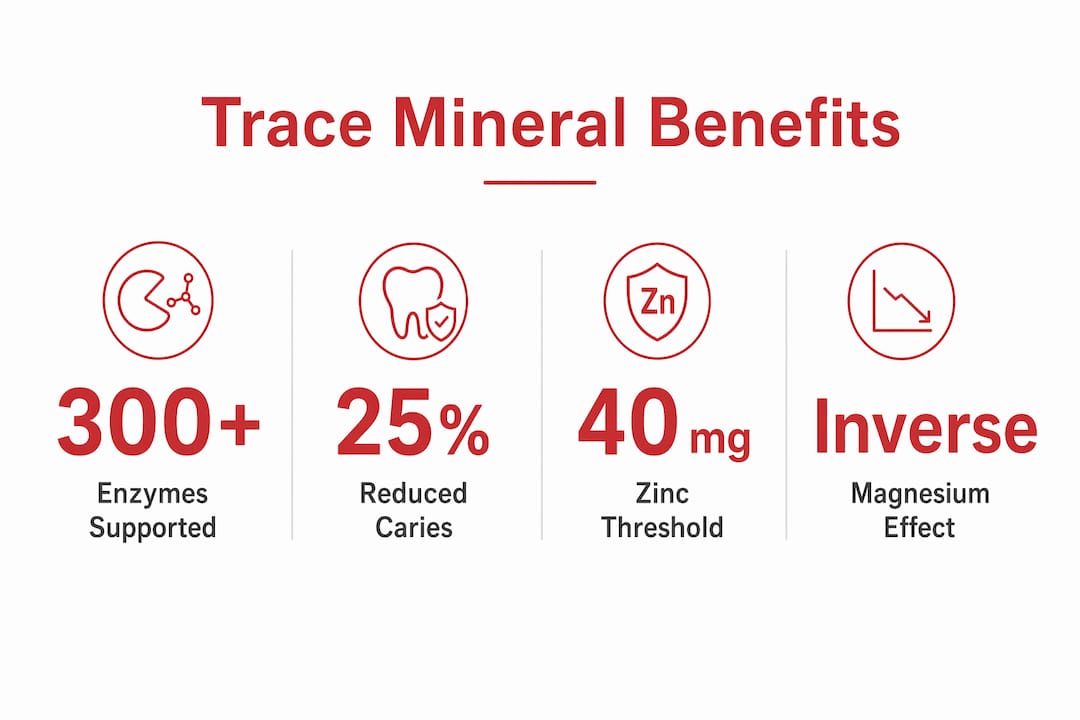
Zinc’s oral health benefits derive from several converging mechanisms. It supports the activity of over 300 enzymes involved in protein synthesis and cellular division, both of which are required for gingival tissue regeneration. It also modulates neutrophil and macrophage function, reducing the inflammatory burden in periodontal tissues. Clinically, zinc deficiency increases caries susceptibility by impairing salivary gland function and reducing the antimicrobial peptide activity in saliva.
Magnesium’s role in enamel and bone support
Magnesium modulates immune responses and oxidative stress pathways directly linked to periodontitis progression. Its presence in alveolar bone contributes to bone mass maintenance, and its absence accelerates the demineralization that precedes caries formation. Optimal magnesium consumption represents a cost-effective strategy for reducing both caries incidence and periodontal inflammation.
- Zinc: tissue repair, DNA synthesis, salivary antimicrobial activity, caries susceptibility reduction
- Magnesium: enamel hardening, alveolar bone density, anti-inflammatory modulation, periodontal protection
- Iron: mucosal immunity, epithelial integrity, resistance to oral candidiasis
- Strontium: hydroxyapatite incorporation, potential enamel crystallinity enhancement
Pro Tip: When evaluating persistent oral ulcers, gingival bleeding, or slow post-extraction healing, consider requesting a serum zinc and red blood cell magnesium panel before attributing symptoms to local factors alone.
How do trace minerals influence oral biofilms and dental materials?
The role of trace elements for teeth extends into the microbial and materials science domains in ways that are frequently underappreciated. Zinc, in particular, does not simply inhibit bacteria in a generalized sense. Its effects on oral biofilms are dose-dependent and structurally specific, which has significant implications for both natural oral care product formulation and restorative dentistry.
Zinc-modified glass ionomer cements (Zn-GICs) exhibit enhanced antibiofilm properties and reduced enamel and dentin demineralization compared to zinc-free formulations. The clinical relevance is substantial: restorative materials that release zinc ions at the tooth-restoration interface can actively suppress secondary caries formation. However, the method of zinc incorporation determines clinical performance. Conventional restorative Zn-GIC showed the greatest resistance to demineralization in laboratory testing, while other incorporation methods produced variable results.
The mechanism involves zinc’s ionic binding to hydroxyapatite. Zinc colocalizes with hydroxyapatite during biofilm mineralization, partially substituting calcium in the crystal lattice and altering mineralization dynamics. At low concentrations, this substitution inhibits pathogenic biofilm formation and reduces acid-driven mineral dissolution. At high concentrations, however, zinc can paradoxically promote biofilm aggregation. This dose-dependency is a critical formulation variable that distinguishes effective mineral-based oral care products from those that simply list zinc as an ingredient.
| Zinc form / application | Antibiofilm effect | Demineralization resistance | Key limitation |
|---|---|---|---|
| Conventional Zn-GIC (CR) | High | Highest in laboratory testing | Technique-sensitive placement |
| Zinc-modified GIC (other methods) | Moderate | Variable by incorporation method | Inconsistent ion release profiles |
| Topical zinc in oral rinses | Moderate at low dose | Limited structural effect | Dose-dependent aggregation risk |
| Dietary zinc (systemic) | Indirect via immunity | Supports salivary antimicrobials | Bioavailability varies by food source |
Pro Tip: When selecting mineral-based toothpastes or rinses, look for products that specify the zinc compound used (zinc citrate, zinc chloride, or zinc oxide) and its concentration. The compound form determines solubility and therefore bioavailability at the tooth surface.
The role of trace elements in toothpaste formulations follows the same principle. Zinc citrate is the most bioavailable form for topical oral applications because of its water solubility and capacity to bind enamel surfaces. Products that incorporate zinc alongside calcium phosphate compounds create a synergistic remineralization environment that neither mineral achieves independently.
What does enamel elemental analysis reveal about mineral exposure?
Tooth enamel is a non-remodeling tissue. Unlike bone, it does not undergo continuous turnover after formation, which makes it a permanent biochemical record of mineral exposure during tooth development. This property transforms enamel into a retrospective archive of dietary and environmental mineral history.
Tooth enamel conserves trace mineral signatures from developmental periods, with zinc, iron, and strontium identified as the most abundant trace elements. Elemental patterns vary by age cohort, reflecting early-life exposure rather than current accumulation. This finding has direct implications for understanding how prenatal and early childhood nutrition shapes lifelong oral disease risk.
| Trace element | Typical enamel presence | Developmental significance |
|---|---|---|
| Zinc | Abundant | Reflects maternal and infant dietary zinc status |
| Iron | Abundant | Correlates with systemic iron availability during crown formation |
| Strontium | Abundant | Indicates geographic and dietary mineral exposure patterns |
| Fluoride | Variable | Reflects topical and systemic fluoride exposure history |
The practical implication for natural oral care practitioners is that enamel quality is largely determined before a tooth erupts. Postnatal mineral supplementation and topical mineral application can support remineralization of the enamel surface, but they cannot alter the crystallographic structure established during amelogenesis. This underscores the importance of adequate mineral nutrition during pregnancy and early childhood, not only during adult dental maintenance.
Enamel elemental analysis also provides a non-invasive method for retrospective assessment of environmental mineral exposures, including heavy metal contamination, which can inform both individual patient care and population-level oral health research.
How can you apply trace mineral science to natural oral care?
Translating the biological evidence into practical oral care decisions requires attention to both dietary sources and product selection. The importance of trace minerals is best realized through a combined approach: adequate dietary intake to support systemic mineral status, and topical mineral delivery to reinforce enamel and suppress pathogenic biofilms at the local level.
Dietary sources of key oral health minerals include:
- Zinc: Oysters (the highest known dietary source), beef, pumpkin seeds, hemp seeds, and legumes
- Magnesium: Dark leafy greens, almonds, black beans, whole grains, and dark chocolate
- Iron: Red meat, lentils, spinach, and fortified cereals (note that non-heme iron from plant sources requires vitamin C for optimal absorption)
- Strontium: Seafood, whole grains, root vegetables, and mineral-rich water sources
The role of minerals in oral care products is distinct from dietary supplementation. Topical mineral delivery places ions directly at the enamel surface and within the gingival sulcus, where systemic circulation cannot reliably achieve therapeutic concentrations. This is why mineral-based toothpastes, mouthwashes, and oral sprays formulated with bioavailable mineral compounds offer a mechanistically different benefit than dietary intake alone.
Dead Sea minerals represent a particularly well-studied source for topical oral care applications. The Dead Sea mineral complex contains magnesium, calcium, potassium, and zinc in concentrations and ionic ratios that differ substantially from standard mineral supplements. Research into Dead Sea minerals in dentistry supports their use in fluoride-free formulations as a scientifically grounded alternative for individuals seeking natural oral care solutions.
Balancing mineral intake requires attention to potential interactions. High-dose zinc supplementation (above 40 mg per day in adults) can interfere with copper absorption, potentially creating secondary deficiencies. Magnesium and calcium compete for intestinal absorption when taken simultaneously in high doses. These interactions reinforce the principle that mineral dose and form greatly affect biological outcomes, and that precision in formulation matters as much in dietary supplementation as in restorative materials.
Key takeaways
Trace minerals govern enamel integrity, immune function, and biofilm dynamics simultaneously, making mineral status a primary variable in oral health assessment rather than a secondary nutritional consideration.
| Point | Details |
|---|---|
| Zinc and wound healing | Zinc deficiency impairs mucosal repair and increases infection risk; evaluate zinc status in chronic oral conditions. |
| Magnesium and enamel support | Magnesium intake is inversely correlated with caries and periodontitis; 60% is stored in bone and enamel-supporting structures. |
| Dose-dependent biofilm effects | Zinc inhibits biofilms at low concentrations but can promote aggregation at high levels; formulation precision is required. |
| Enamel as mineral archive | Enamel records early-life mineral exposure permanently, meaning adult oral disease risk is partly determined before eruption. |
| Topical vs. systemic delivery | Mineral-based oral care products deliver ions directly to enamel surfaces where systemic circulation cannot reliably reach. |
Why the formulation question matters more than the ingredient list
Most discussions of trace minerals and dental health stop at identifying which minerals matter. After years of reviewing the clinical and materials science literature, I find that the more consequential question is how those minerals are delivered and in what chemical form.
The zinc research illustrates this precisely. Two products can both list zinc as an active ingredient, yet one binds effectively to hydroxyapatite and inhibits demineralization while the other releases zinc at concentrations that promote biofilm aggregation. The difference is not the mineral. It is the formulation chemistry. The same logic applies to magnesium in oral care products: magnesium chloride and magnesium oxide have substantially different solubility profiles and therefore different capacities to deliver bioavailable ions to oral tissues.
I have observed a persistent misconception among natural oral care enthusiasts that more minerals in a product automatically means better outcomes. The evidence does not support this. What the evidence supports is precision: the right mineral, in the right chemical form, at the right concentration, delivered to the right tissue. Products that achieve this are genuinely differentiated. Products that simply add mineral names to their ingredient lists are not. When evaluating any mineral-based oral care product, the question to ask is not “does it contain zinc?” but “which zinc compound, at what concentration, and what is the evidence for its bioavailability at the enamel surface?”
— Veronica
Mineral-based oral care solutions worth exploring

Stop-oralcare formulates its fluoride-free oral care line around Dead Sea minerals and hemp-derived compounds, applying the same principle of mineral bioavailability and formulation precision that the clinical literature supports. The product range, including toothpaste, mouthwash, and oral sprays, is designed to deliver zinc, magnesium, and complementary minerals directly to oral tissues in bioavailable forms. For those seeking a comparison of mineral-based products grounded in current evidence, Stop-oralcare’s resource library provides detailed formulation rationale alongside product descriptions. Explore the full range at Stop-oralcare to identify options aligned with your oral health goals.
FAQ
What trace minerals are most important for oral health?
Zinc and magnesium are the most extensively documented trace minerals for oral health, with zinc supporting tissue repair and immunity and magnesium contributing to enamel hardness and periodontal stability. Iron and strontium also play measurable roles in mucosal integrity and enamel crystallinity, respectively.
Can trace mineral deficiencies cause dental problems?
Yes. Mineral deficiencies frequently manifest first in the oral cavity, with zinc deficiency linked to impaired wound healing, increased caries susceptibility, and recurrent oral ulceration. Magnesium deficiency is associated with accelerated enamel demineralization and greater periodontitis severity.
How do trace elements in toothpaste benefit teeth?
Trace elements in toothpaste, particularly zinc citrate and calcium phosphate compounds, bind to enamel surfaces and inhibit acid-driven demineralization at the local level. This topical delivery mechanism provides a direct protective effect that dietary mineral intake alone cannot replicate.
Does more zinc in oral care products mean better results?
Not necessarily. Zinc’s antibiofilm effect is dose-dependent: low concentrations inhibit pathogenic biofilm formation, while high concentrations can promote biofilm aggregation. Effective formulations specify the zinc compound and its concentration rather than simply maximizing zinc content.
Are Dead Sea minerals effective for natural oral care?
Dead Sea minerals contain magnesium, calcium, potassium, and zinc in ionic ratios that support remineralization and anti-inflammatory activity in oral tissues. They are used in fluoride-free oral care formulations as a scientifically supported alternative to conventional mineral sources, with nutritional allies for teeth research confirming the broader role of mineral nutrition in dental strength.