

Coconut oil can help manage gum inflammation and reduce plaque as an adjunct to brushing and flossing, but it does not cure gum disease or regenerate lost periodontal tissue. That distinction matters for anyone weighing coconut oil for gums as a serious part of an oral care routine rather than a folk remedy. Randomized controlled trials and at least one systematic review report measurable reductions in inflammatory biomarkers like IL-6 and TNF-α, along with some reductions in bacterial counts, after regular use.
- Primary benefits: anti-inflammatory and antimicrobial activity, plaque reduction, and biofilm disruption when used consistently.
- Primary limitation: no evidence supports reversing gum recession or rebuilding tissue lost to periodontitis.
Key Takeaways
Coconut oil reduces gum inflammation and plaque as a supportive adjunct, but mechanical cleaning and professional treatment remain essential for anything beyond mild gingivitis.
| Point | Details |
|---|---|
| Evidence is real but limited | RCTs show reduced IL-6, TNF-α, and bacterial counts, but trials are small and short. |
| Technique determines results | Swish for 10 to 20 minutes daily; brief rinsing won’t trigger the same biofilm removal. |
| Compare fairly to chlorhexidine | Chlorhexidine reduces bacteria faster but causes staining; coconut oil is gentler with milder effects. |
| Know the limits | Coconut oil cannot reverse gum recession or regenerate lost periodontal tissue. |
| Formulated options improve compliance | Stop-oralcare’s hemp and Dead Sea mineral mouthwash offers a daily-use alternative to plain oil pulling. |
Table of Contents
- What Oil Pulling With Coconut Oil Actually Does
- The Evidence on Plaque, Gingivitis, and Bacterial Counts
- How to Use Coconut Oil on Gums, Step by Step
- Choosing the Right Coconut Oil and How It Stacks Up
- What Coconut Oil Won’t Fix
- Safety Notes Before You Start
- Frequently Asked Questions
- Sources
What Oil Pulling With Coconut Oil Actually Does
Oil pulling means swishing oil in the mouth for several minutes to loosen debris and bacteria before spitting it out. With coconut oil pulling for gums, the typical amount is one tablespoon of the oil, swished gently for 10 to 20 minutes, though shorter sessions of five minutes still trigger the mechanical action researchers care about.
The mechanism has two parts. Lauric acid, which makes up roughly half of coconut oil’s fatty acid content, disrupts bacterial cell membranes. Meanwhile, saliva causes the oil to emulsify and saponify during swishing, a chemical shift that increases its surface area and helps dislodge biofilm and inhibit bacterial co-aggregation.
What you’ll likely notice right away isn’t clinical, it’s sensory:
- Temporarily looser plaque and a “cleaner” feeling along the gumline
- Fresher breath immediately after rinsing
- A moisturizing effect on dry oral tissue
Pro Tip: Swish gently rather than gargling hard. Vigorous gargling risks swallowing the oil and doesn’t improve the emulsification process, it just tires your jaw.
The Evidence on Plaque, Gingivitis, and Bacterial Counts
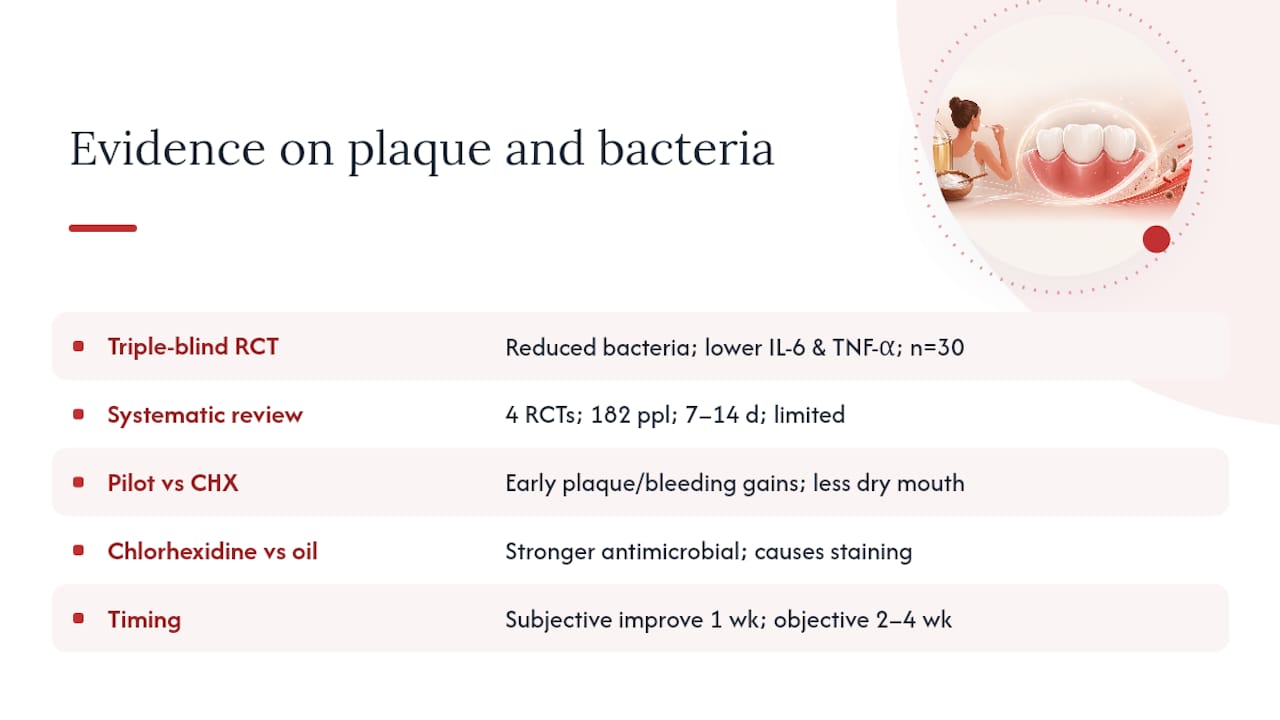
The strongest data point comes from a triple-blind randomized clinical trial that found coconut oil rinses significantly reduced pathogenic subgingival bacteria and lowered IL-6 and TNF-α compared with placebo. That trial had a small sample size of 30 participants, a limitation the study’s own authors flagged, but the biomarker shifts were statistically real, not just anecdotal.
A broader systematic review pooling four randomized trials totaling 182 participants found consistent reductions in plaque index and some bacterial outcomes. The catch: those trials ran just 7 to 14 days, and the review authors rated overall evidence quality as limited, with a high risk of bias across the pool. This is a case where the direction of the science is encouraging while the certainty is not yet strong.
Improvements in plaque index, bleeding on probing, and probing depth appeared at early timepoints in a pilot trial, alongside a notably better dry-mouth profile compared with chlorhexidine, though the study’s small sample size means it needs replication before anyone calls it definitive.
On the chlorhexidine comparison specifically: chlorhexidine tends to reduce bacterial load slightly more in head-to-head measures, but it also causes tooth staining, taste disturbance, and mucosal irritation with regular use. Coconut oil’s trade-off runs the other direction. It’s gentler on tissue and doesn’t stain, but the antimicrobial punch is milder and the supporting trial base is thinner. Most people notice subjective changes, less bad breath, smoother-feeling gums, within the first week, while measurable reductions in plaque index or bleeding on probing tend to show up over two to four weeks of daily use.
How to Use Coconut Oil on Gums, Step by Step
Technique matters more than most people assume. Clinicians researching this practice note that the benefit depends on sustained swishing, not a quick rinse, because the emulsification process that dislodges biofilm needs time to develop.
- Scoop about one tablespoon of coconut oil (it liquefies quickly at body temperature).
- Swish slowly and steadily for 10 to 20 minutes, working the oil between teeth and along the gumline.
- Spit the oil into a trash can, never a sink, since it can solidify and clog pipes over time.
- Rinse your mouth with warm water.
- Brush and floss as usual afterward, not before, so oil pulling clears debris that brushing then finishes removing.
- Repeat once daily, ideally in the morning before eating.
Pro Tip: If straight oil feels unpleasant or takes too long to build into a habit, a flavor-enhanced coconut oil mouthwash solves the palatability problem without abandoning the active ingredient. You can find formulation guidance in this natural mouthwash usage guide.
Avoid swallowing the oil, since it carries the bacteria and debris you just pulled from your mouth. Skip this practice if you have any difficulty controlling liquids in your mouth, and supervise or substitute for young children who tend to swallow reflexively.
Choosing the Right Coconut Oil and How It Stacks Up
Look for virgin or cold-pressed coconut oil with minimal processing, since higher lauric acid content correlates with the antimicrobial activity seen in trials. Refined coconut oil works too, but virgin varieties typically retain more of the compound. You’ll find it in two practical formats: solid, scoopable jars for traditional oil pulling, or preformulated mouthwashes that blend coconut oil with flavoring agents for easier daily compliance.
| Factor | Coconut Oil (Plain) | Sesame Oil | Chlorhexidine |
|---|---|---|---|
| Effectiveness for plaque/gingivitis | Moderate, supported by small RCTs | Comparable to coconut oil in head-to-head trials | Strong, faster bacterial reduction |
| Side effects | Minimal; rare allergy | Minimal; rare allergy | Staining, taste disturbance, mucosal irritation |
| Palatability / compliance | Low for plain oil, better with flavoring | Lower, stronger taste | High compliance short-term, poor long-term due to taste |
| Cost & accessibility | Low, widely available | Low, widely available | Prescription or pharmacy purchase |
| Quality of evidence | Small RCTs, short duration | Single comparative trial | Extensive long-term trials |
If plain oil pulling feels tedious, a formulated mouthwash bridges the gap between compliance and efficacy, worth exploring in this comparison of natural mouthwash options.
What Coconut Oil Won’t Fix
Coconut oil does not reverse gingival recession, regenerate lost periodontal tissue, or replace mechanical debridement for existing gum disease. Trials test short-term plaque and gingivitis markers, not long-term tissue regrowth, so treat it as maintenance support rather than treatment for advanced disease.
Watch for these signs that call for a dentist, not more oil pulling:
- Bleeding that persists beyond two weeks of consistent home care
- Increasing gum pocket depth noticed at a checkup
- Loose or shifting teeth
- Visible pus near the gumline
- Pain that doesn’t resolve with basic hygiene
Most people who stick with daily coconut oil pulling notice reduced puffiness or bleeding within one to three weeks. If nothing changes by then, that’s your cue to see a professional rather than extend the experiment.
Safety Notes Before You Start
The main real-world risk is aspiration, oil entering the airway instead of staying in the mouth, which has been linked in rare case reports to lipoid pneumonia. This risk rises for anyone with swallowing difficulty, so oil pulling isn’t appropriate for people with dysphagia or for young children who haven’t mastered controlled spitting.
Allergic reactions to coconut are uncommon but possible. Swallowed oil residue can also interfere with dentures or dental work if it isn’t cleared properly, and pouring oil down a sink repeatedly can contribute to pipe buildup over months.
Sit upright while swishing, never lie down or multitask in a way that risks inhaling the oil. Spit into the trash, not the sink, and stop immediately if you feel any oil moving toward the back of your throat.
Pregnant individuals and people with active, severe periodontitis should treat coconut oil as a supplement to a dentist’s care plan, not a substitute for it.
A Practical Take on Where Coconut Oil Fits
Used consistently and safely, coconut oil earns a real place in a home routine for mild plaque buildup and early gingivitis, the evidence on inflammatory markers is too consistent to dismiss. But nothing here replaces mechanical cleaning or professional periodontal therapy once disease has progressed past the early stage, and treating oil pulling as a cure rather than a supplement is where people get into trouble.
A Simpler Way to Get Coconut Oil’s Benefits Daily
Straight oil pulling works, but 15 to 20 minutes of swishing thick oil is a habit most people abandon within a week. That compliance gap is exactly why flavor-enhanced coconut oil formulations tested in clinical settings outperform plain oil pulling on adherence while keeping the antimicrobial effect intact. Stop-oralcare’s fluoride-free mouthwash builds on that same principle, pairing hemp and Dead Sea minerals with a formulation designed for daily comfort rather than a timed ordeal twice a week.

If plain oil pulling has never stuck as a habit, this is a more sustainable route to similar gum support. Browse the ingredient breakdown and current formulations at Stop-oralcare and see whether a ready-made rinse fits your routine better than a spoonful of coconut oil each morning.
Frequently Asked Questions
Is coconut oil good for gums? Yes, as a supportive adjunct. Trials link it to reduced inflammation and lower plaque, though it works alongside, not instead of, brushing and flossing.
How do I apply coconut oil to my gums? Swish a tablespoon for 10 to 20 minutes daily, then spit into the trash and brush as usual. Direct massage onto the gumline with a clean finger is an alternative for those who dislike prolonged swishing.
Can coconut oil treat gum disease on its own? No. It helps manage mild gingivitis and plaque, but moderate to severe gum disease needs professional cleaning and periodontal therapy.
How does coconut oil compare with chlorhexidine mouthwash? Chlorhexidine reduces bacteria more aggressively short-term but causes staining and taste changes. Coconut oil is milder with fewer side effects, making it better suited for long-term daily use.
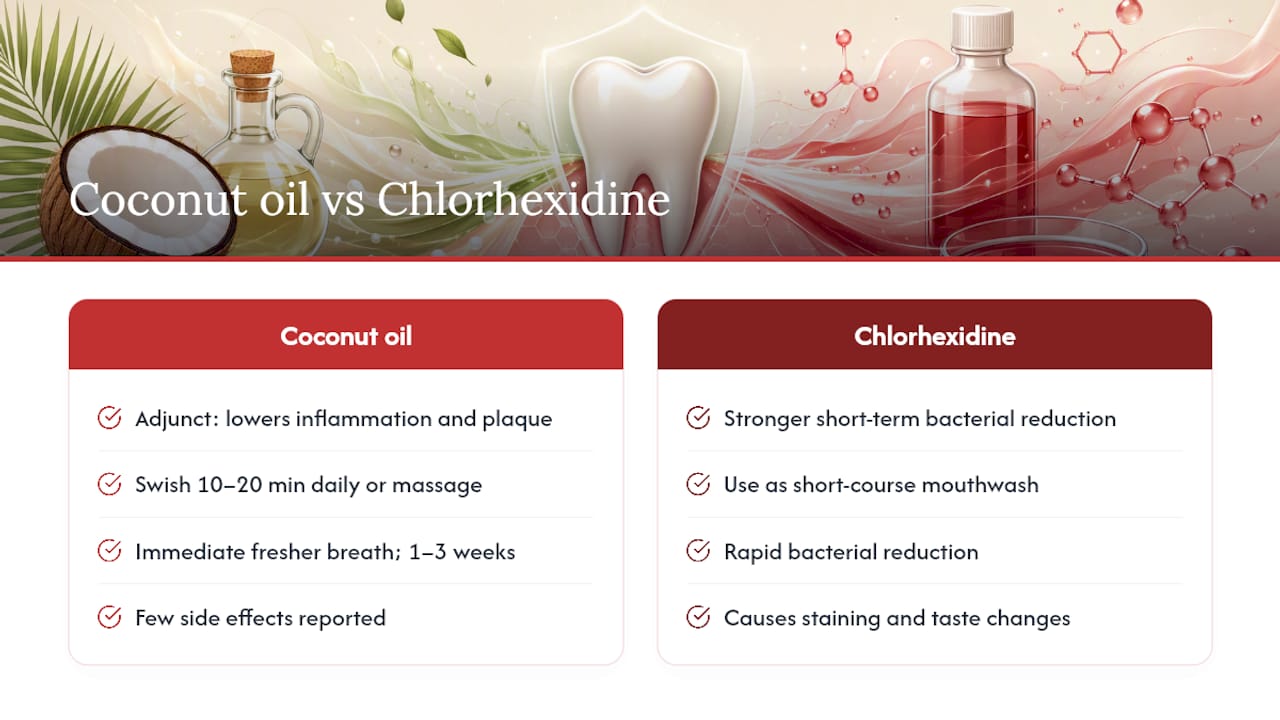
How long until I notice results from coconut oil pulling gums? Most people report fresher breath immediately and reduced gum puffiness or bleeding within one to three weeks of consistent daily use.
Sources
- Anti-inflammatory and antimicrobial efficacy of coconut oil for periodontal pathogens: a triple-blind randomized clinical trial | Clinical Oral Investigations
- Effect of coconut oil in plaque related gingivitis - PMC - NIH
- A Randomized Trial in Older Adults of a Flavor-Enhanced Coconut Oil-Based Mouthwash: Clinical Safety, Antimicrobial Efficacy, and User Satisfaction | MDPI
- Effectiveness of Oil Pulling Therapy with coconut and sesame oil on gingivitis patients (clinical trial) | PMC
- The Use of Coconut Oil Pulling in the Prevention and Treatment of Periodontal Diseases and Dental Caries - A Literature Review
Recommended
- Hemp Oil Benefits for Gums: Evidence and Practical Use – Stop Oral Care
- A Practical Guide to Using CBD for Gum Disease Treatment – Stop Oral Care
- Natural Oils in Oral Health: A Science-Based Guide – Stop Oral Care
- Marine Algae Mouthwash for Gum Inflammation: A Step-by-Step Guide to S – Stop Oral Care