

Oral probiotics produce modest, strain-specific improvements in gum bleeding and gingival inflammation when used alongside brushing, flossing, and professional cleaning, not in place of them. Randomized trials on strains like Bifidobacterium lactis HN019 and Levilactobacillus brevis CD2 show measurable reductions in bleeding indices, though systematic reviews caution that evidence quality varies by strain, dose, and trial length.
TL;DR:
- Probiotic strains like Bifidobacterium lactis HN019 and Levilactobacillus brevis CD2 can modestly reduce gum bleeding and inflammation when combined with standard oral hygiene.
- Most evidence relies on surrogate markers such as bleeding indices and plaque levels over short periods, with limited data on long-term clinical outcomes like attachment loss.
- Delivering probiotics via lozenges, chewables, or heat-killed toothpaste influences their effectiveness, with doses ranging from 5×10^5 to 5×10^10 CFU over four to eight weeks.
- Strains vary significantly in their oral benefits, with L. reuteri and B. lactis HN019 showing the strongest evidence for improving gum health.
- Probiotics should supplement, not replace, good mechanical oral care, and products must be carefully matched to strains, doses, and delivery methods validated in trials.
Table of Contents
- What Does the Clinical Evidence Show for Oral Probiotics for Gum Health?
- Which Probiotic Strains Have the Strongest Evidence for Gum Health?
- How Are Oral Probiotics Delivered, and How Long Do Trials Run?
- How Should You Use Probiotics for Gum Health?
- What Are the Safety Considerations and Research Gaps?
- An Evidence-Aware Take on Probiotics and the Oral Microbiome
- Where Stop-oralcare’s Products Fit Into a Probiotic-Friendly Routine
- Sources
What Does the Clinical Evidence Show for Oral Probiotics for Gum Health?
Systematic reviews consistently describe the same pattern: real signal, but not a uniform one. A meta-analysis of ten double-blind randomized controlled trials on gingivitis found weak but sometimes positive reductions in bleeding on probing (BOP) and gingival index (GI), with results that shifted depending on which strain was tested and how long researchers followed patients.
A broader umbrella review of meta-analyses reached a similar conclusion: probiotics show reductions in cariogenic bacteria and improvements in halitosis measures, but the pooled effect sizes stay modest and the underlying trials differ too much in design to combine into one confident number.
Individual randomized trials tell a more encouraging story in isolation. A placebo-controlled trial found that adding B. lactis HN019 lozenges to periodontal therapy reduced bleeding on marginal probing significantly more than placebo by 8 weeks, with microbiological sequencing confirming a shift in the bacterial profile. Separately, a double-blind RCT of L. brevis CD2 lozenges reported significant improvements in bleeding and plaque index after just four weeks.
Three limitations temper how far you should extend these findings:
- Most trials rely on surrogate endpoints like BOP, GI, and plaque index rather than long-term measures like clinical attachment loss.
- Sample sizes tend to be small, and follow-up rarely extends past a few months.
- Strain, dose, and delivery format vary so widely across studies that pooling results into one clean conclusion is difficult.
A useful number to hold onto: the PLOS ONE trial on HN019 found a statistically significant drop in bleeding on marginal probing at eight weeks (p<0.0001) when the strain was added to standard periodontal therapy, not used alone.
Which Probiotic Strains Have the Strongest Evidence for Gum Health?
Not every probiotic strain behaves the same way in your mouth, and this is where a lot of marketing gets sloppy. Trial evidence clusters around five organisms.
- Lactobacillus reuteri: studied for reduced gum bleeding and improved gingival indices in several RCTs, often delivered as chewable lozenges.
- Levilactobacillus brevis CD2: a double-blind, placebo-controlled trial found improved bleeding on probing, plaque index, salivary buffering capacity, and secretory IgA after four weeks, with no reported adverse effects.
- Streptococcus salivarius (K12, M18): better documented for reducing halitosis and supporting favorable oral colonization than for gingivitis specifically; the gum-health data stays mixed.
- Bifidobacterium animalis subsp. lactis HN019: shown to reduce bleeding and shift the periodontal microbiome when used alongside professional therapy, rather than as a standalone treatment.
- Lacticaseibacillus paracasei GMNL-143: a heat-killed strain formulated into toothpaste that lowered gingival index and showed a downward trend in Streptococcus mutans in crevicular fluid during a randomized crossover trial.
That last strain matters for a reason beyond its results. Because GMNL-143 is heat-killed, it doesn’t need to colonize your mouth to work. Its surface proteins still interact with other oral bacteria through coaggregation, which widens what “probiotic” can mean in a dental product beyond live cultures that need to survive your saliva.
How Are Oral Probiotics Delivered, and How Long Do Trials Run?
Trial designs fall into four delivery categories, and the format changes how the strain has a chance to work.
- Lozenges and chewables: the most common format for live strains like L. reuteri and L. brevis CD2, chosen because they keep the bacteria in contact with gum tissue longer than a rinse does.
- Probiotic toothpaste: typically formulated with heat-killed strains like GMNL-143, since toothpaste’s abrasives and surfactants aren’t hospitable to live cultures.
- Adjunctive lozenges after scaling and root planing (SRP): used in periodontitis trials to support standard mechanical therapy, not replace it.
- Mouth rinses: less common in the strain-specific literature reviewed here, generally used for shorter contact windows.
Dosing across trials spans a wide range, from roughly 5×10^5 to 5×10^10 CFU per dose, and most RCTs run four to eight weeks, with some extending follow-up further to check whether benefits hold.
Pro Tip: Look for exact CFU counts and strain identifiers on the label. A product listing “probiotic blend” with no strain ID or dose is not the same as one that matches what was actually tested in a trial.
How Should You Use Probiotics for Gum Health?
Probiotics work best as a supplement to what you’re already doing, not a substitute for it.
- Keep mechanical plaque control (brushing, flossing, professional cleaning) as your foundation. Probiotics support that routine; they don’t replace scaling and root planing for periodontitis.
- Check the label against four criteria: documented strain name, clinical trial backing for that exact strain, CFU per dose, and a delivery form and duration that match what was studied.
- Before starting, ask your dentist about your current periodontal status, any recent antibiotic use, and whether you have any condition that affects immune response.
What Are the Safety Considerations and Research Gaps?
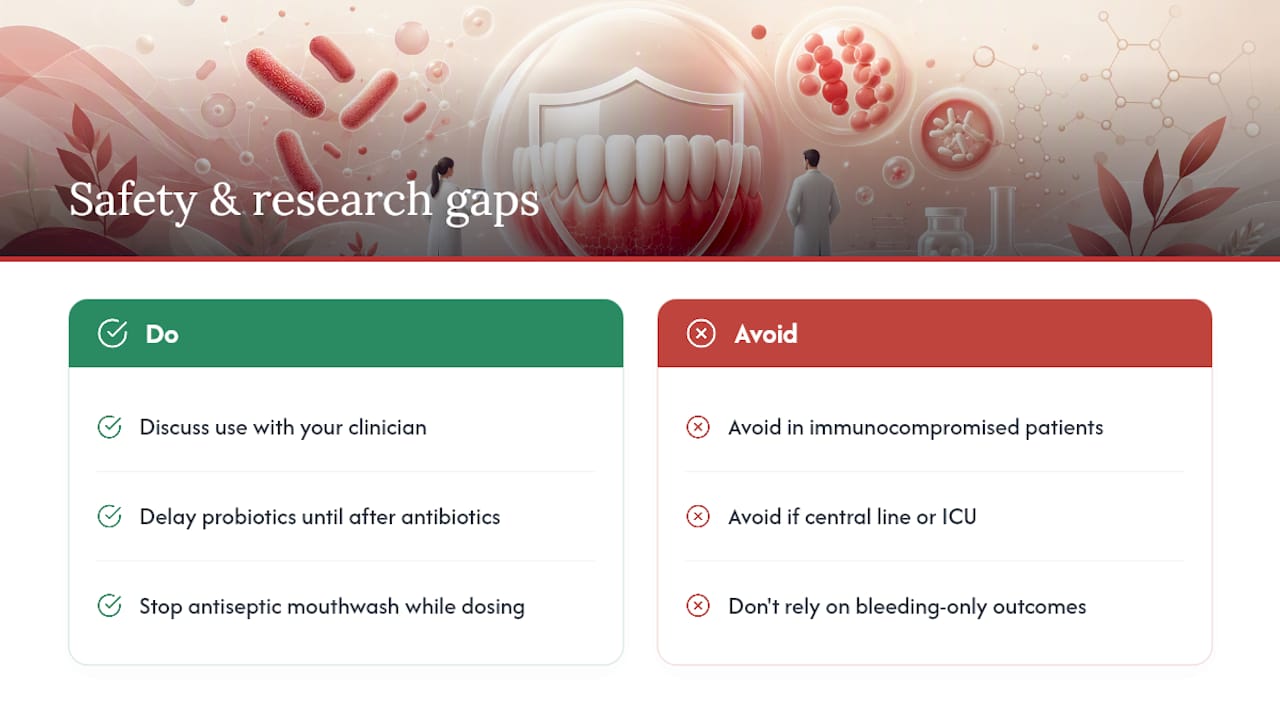
Trials generally report oral probiotics as well tolerated, with adverse events rare and mild when they occur. Caution applies for immunocompromised individuals and anyone with a central line or in intensive care, where any live bacterial product carries theoretical risk.
Timing matters too. Taking probiotics during a course of systemic antibiotics is unlikely to help, since the antibiotic can wipe out the introduced strain before it establishes itself. It’s also worth reconsidering daily use of broad-spectrum antiseptic mouthwash if you’re trying to support a probiotic regimen, since antiseptics don’t distinguish between harmful and beneficial bacteria. The clearest research gap: larger, longer trials measuring hard clinical endpoints like attachment loss, not just bleeding indices, across a standardized set of strains and doses.
An Evidence-Aware Take on Probiotics and the Oral Microbiome
Dr. Veronica Stahl’s read on this literature is straightforward: probiotics shift the oral ecosystem toward resilience, they don’t sanitize it. That distinction explains why the data reads as modest instead of dramatic. Probiotic strains compete for adhesion sites and produce antimicrobial compounds that nudge the microbial balance over weeks, not the immediate kill-everything effect people expect from a mouthwash.
Stop-oralcare’s fluoride-free, hemp and Dead Sea mineral formulations are built around that same premise: support the mouth’s natural balance daily rather than fight it with harsh antiseptics. Used alongside standard hygiene, that approach fits squarely within what the strain-specific trial data actually supports.
— Veronica
Where Stop-oralcare’s Products Fit Into a Probiotic-Friendly Routine
If you’re building a daily routine around the strain evidence above, the products you use every day matter as much as any supplement you add. Certain toothpaste, mouthwash, and oral spray products are formulated without fluoride, using ingredients like hemp and minerals to support gum tissue and reduce inflammation without broad-spectrum antiseptic action that can undercut a microbiome-friendly regimen.
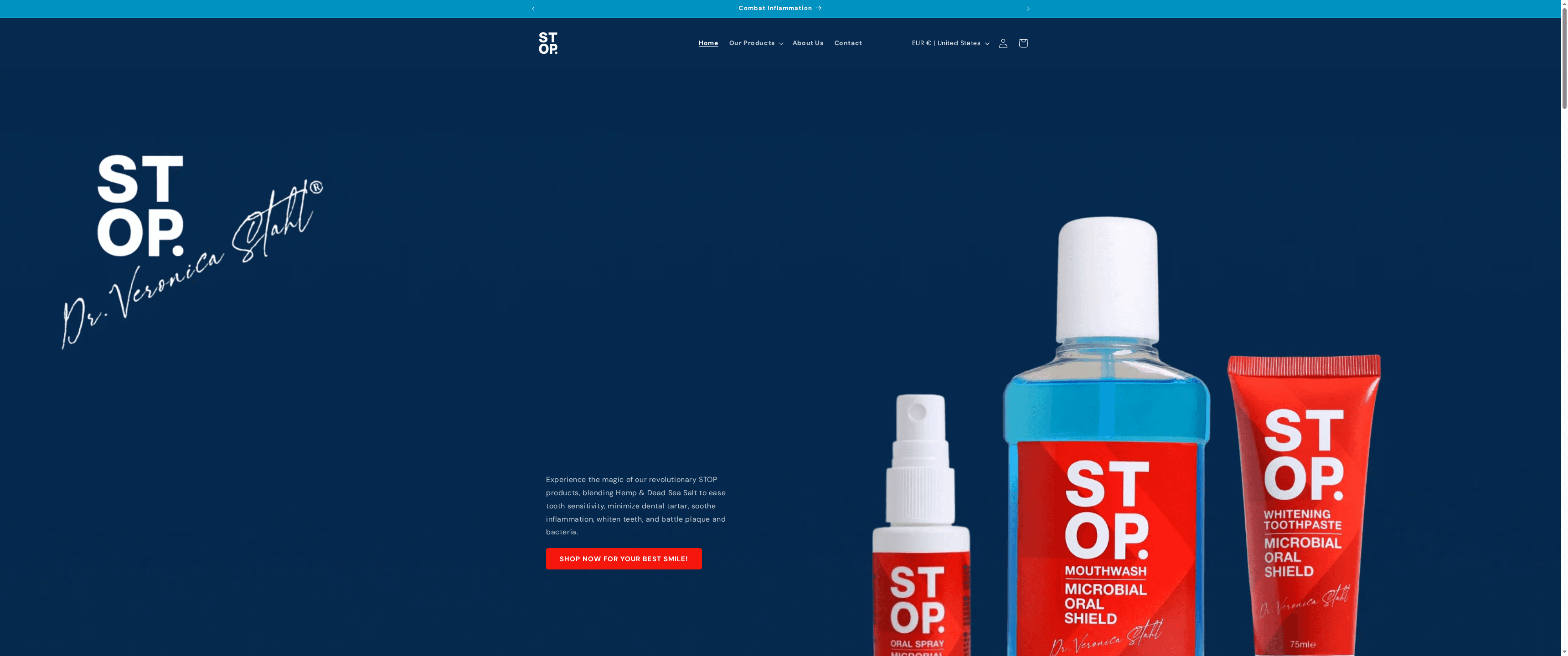
Think of these products as your daily foundation, gentle enough to pair with probiotic lozenges or toothpaste rather than compete with them. If you have active gum disease or periodontitis, use these products alongside professional dental care, not as a substitute for it. To see the full range, including toothpaste, mouthwash, and oral spray formulated for sensitive gums, visit Stop-oralcare’s product lineup and check which formulation matches your current routine.
Sources
For deeper reading: the umbrella review of probiotic meta-analyses, the systematic review on probiotics and oral health, and the HN019 and L. brevis CD2 randomized trials.
- The effects of probiotics intervention on oral health outcomes: a comprehensive umbrella review of meta-analyses
- Microbiological profile of patients with generalized gingivitis undergoing periodontal therapy and administration of Bifidobacterium animalis subsp. lactis HN019
- Levilactobacillus brevis CD2 as a multifaceted probiotic to preserve oral health: results of a double-blind, randomized, placebo-controlled trial in healthy adults
- The impact of Lacticaseibacillus paracasei GMNL-143 toothpaste on gingivitis and oral microbiota in adults