

TL;DR:
- Oral probiotics are live microorganisms that help maintain oral health by modulating the mouth’s microbial environment. They work through mechanisms like competing for adhesion sites, producing antimicrobial compounds, and reducing inflammation, with strain specificity being critical. Evidence supports their use in reducing cavities in children and improving periodontal health when used correctly and consistently.
Oral probiotics are defined as live microorganisms that, when administered in adequate amounts, confer measurable health benefits to the oral cavity by modulating the mouth’s microbial ecosystem. The role of probiotics in oral wellness extends beyond simple supplementation. These microorganisms work through competitive exclusion, biofilm modulation, and immune response regulation to prevent pathogenic bacteria from establishing dominance. Clinical research, including meta-analyses and controlled trials published through 2026, confirms that specific probiotic strains reduce caries incidence, support periodontal tissue health, and help control halitosis. Understanding which strains work, how they work, and how to use them correctly separates effective oral probiotic practice from guesswork.
How do probiotics work in the oral cavity?
Probiotics modulate the oral microbiome through three primary mechanisms: competitive exclusion, antimicrobial compound production, and immune response modulation. Each mechanism targets a different aspect of microbial ecology in the mouth.

Competitive exclusion is the most direct mechanism. Beneficial probiotic bacteria occupy adhesion sites on oral surfaces, physically blocking pathogens like Streptococcus mutans and Porphyromonas gingivalis from attaching. They also consume available nutrients, reducing the resources pathogens need to proliferate.
Antimicrobial compound production adds a chemical layer of defense. Certain strains produce hydrogen peroxide and bacteriocins, which are small proteins that inhibit or kill competing bacteria. This activity suppresses pathogen populations without disrupting the broader microbial community.
Immune modulation addresses the inflammatory component of oral disease. Probiotics reduce pro-inflammatory cytokines and enhance anti-inflammatory mediators in oral tissues. This response is particularly relevant in periodontal disease, where chronic inflammation drives tissue destruction.
Key probiotic actions in the oral cavity include:
- Occupying mucosal adhesion sites to block pathogen colonization
- Producing bacteriocins and hydrogen peroxide to suppress harmful bacteria
- Reducing inflammatory cytokine activity in gingival tissue
- Disrupting and stabilizing complex biofilm communities
- Competing for nutrients that pathogens require for growth
One critical limitation applies across all these mechanisms. Probiotic effects are strain-specific, meaning a strain effective against caries-causing bacteria may have no effect on periodontal pathogens. Generic probiotic products not formulated for the oral environment frequently lack the strains needed to produce these effects.
Pro Tip: When evaluating an oral probiotic product, check the label for genus, species, and strain designation (for example, Lactobacillus reuteri DSM 17938). A product listing only “Lactobacillus” without a strain code provides no assurance of oral-specific activity.
What clinical evidence supports probiotics for oral conditions?
The clinical evidence for oral probiotics is promising but condition-specific. Research through 2026 shows clear benefits in some areas and meaningful gaps in others.
Dental caries prevention
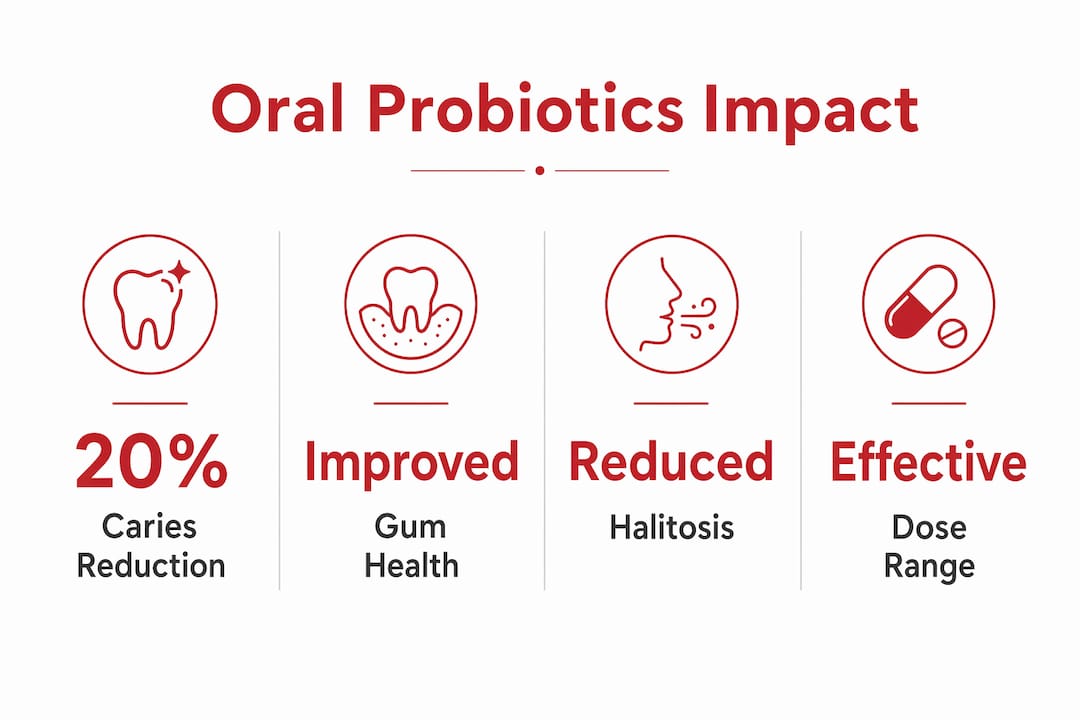
A January 2026 meta-analysis of approximately 2,300 pediatric subjects found that probiotic supplementation reduces new or progressive dental caries incidence by 20% in children, with a relative risk of 0.80. That reduction is clinically meaningful for a population where caries remains the most prevalent chronic childhood disease. The same analysis found that adults show no statistically significant benefit from probiotics for caries prevention, with a relative risk of 0.95 across six randomized controlled trials involving approximately 1,100 adults. This divergence suggests that the oral microbiome in adults may be more resistant to probiotic-driven compositional shifts, or that current adult-focused protocols are insufficient.
Periodontal disease
Limosilactobacillus reuteri strains show the strongest evidence for periodontal clinical improvements when used as adjuncts to conventional scaling and root planing. Measured outcomes include reductions in probing pocket depth and decreased bleeding on probing. These results position probiotics as adjunctive tools rather than standalone therapies for periodontal disease.
Halitosis and microbial composition
Streptococcus salivarius K12 reduces volatile sulfur compound production, the primary driver of halitosis, by competing with the anaerobic bacteria responsible for sulfur metabolism. Studies also show that probiotic use shifts oral microbial composition toward communities with lower pathogen density, which supports long-term oral tissue health.
Dosing and duration parameters
Effective probiotic interventions typically involve daily doses ranging from 5 × 10⁵ to 5 × 10¹⁰ CFU administered over 6–24 months. Shorter interventions show weaker or inconsistent results. This dosing window matters because oral microbiome shifts require sustained microbial pressure to become stable.
| Oral condition | Probiotic evidence level | Key strains studied |
|---|---|---|
| Pediatric dental caries | Strong (20% risk reduction) | Lactobacillus rhamnosus GG |
| Adult dental caries | Insufficient (no significant effect) | Multiple strains |
| Periodontal disease | Moderate (adjunctive benefit) | Limosilactobacillus reuteri |
| Halitosis | Moderate | Streptococcus salivarius K12 |
Which probiotic strains and delivery methods work best?
Strain selection determines whether an oral probiotic produces clinical results or none at all. Generic gut-health probiotics often lack the strains needed for oral cavity benefit. The concept of precision probiotics, meaning strains specifically selected for the oral environment, is now the standard framework in clinical oral microbiology research.
Three strains carry the strongest evidence base for oral applications:
- Limosilactobacillus reuteri (formerly Lactobacillus reuteri): Reduces periodontal pocket depth and bleeding when used alongside professional cleaning. Also suppresses S. mutans in some protocols.
- Streptococcus salivarius K12 and M18: K12 targets halitosis and upper respiratory pathogens. M18 produces dextranase and urease, enzymes that reduce biofilm and buffer oral pH against acid attack.
- Lactobacillus rhamnosus GG: Demonstrates the strongest evidence for pediatric caries reduction in the 2026 meta-analysis.
Pro Tip: Streptococcus salivarius K12 and M18 are naturally resident in healthy human saliva. Supplementing with these strains essentially restores a microbial population that modern diets and antiseptic mouthwashes tend to deplete.
Delivery form is equally important. Lozenges and chewing gums allow the probiotic bacteria to remain in contact with oral mucosa long enough to colonize effectively. Swallowed capsules designed for gut delivery pass through the oral cavity too quickly to establish meaningful colonization. This is a fundamental reason why gut-focused probiotic supplements produce no measurable oral benefit in most studies. For readers interested in how delivery format intersects with oral microbiome balance, the distinction between gut and oral delivery systems is one of the most underappreciated factors in product selection.
The oral-gut axis also deserves mention. Certain oral probiotic strains influence systemic health through immunological and metabolic pathways that extend beyond the oral cavity. This connection, explored in research on skin and gut health, suggests that oral microbiome management may carry broader systemic implications than previously recognized.
How to integrate probiotics into your oral wellness routine
Probiotics function as adjuncts to oral hygiene, not replacements for it. Probiotics modulate biofilm but do not remove it mechanically. Brushing and flossing remain non-negotiable foundations.
A practical integration protocol follows these steps:
- Maintain baseline hygiene first. Brush twice daily with a fluoride-free or microbiome-compatible toothpaste and floss once daily. Probiotics work more effectively in a mouth with reduced pathogen load from mechanical cleaning.
- Select an oral-specific probiotic product. Look for products listing Limosilactobacillus reuteri, Streptococcus salivarius K12 or M18, or Lactobacillus rhamnosus GG with a clearly stated CFU count. Avoid products that list only genus names without strain designations.
- Choose the correct delivery form. Use lozenges, chewing gums, or oral strips rather than standard capsules. Take the probiotic after brushing, not before, so the oral environment is clean when colonization begins.
- Commit to an adequate duration. Clinical evidence supports daily use over 6–24 months for measurable microbiome shifts. Short-term use produces inconsistent results.
- Add prebiotic oral care to support probiotic activity. Prebiotics feed beneficial bacteria already present in the mouth. Understanding prebiotic oral care and how it works alongside probiotics strengthens the overall approach.
- Consult a dental professional before starting. Probiotic supplementation is generally safe, but caution is warranted for immunocompromised individuals due to rare infection risks. A dentist or periodontist can assess whether a probiotic protocol fits your specific clinical picture.
Avoid antiseptic mouthwashes that indiscriminately kill oral bacteria during the probiotic colonization period. Alcohol-based rinses in particular disrupt the microbial environment that probiotics require to establish themselves.
Key Takeaways
Oral probiotics produce measurable clinical benefits only when the correct strain, dose, and delivery form are matched to the specific oral condition being addressed.
| Point | Details |
|---|---|
| Strain specificity is non-negotiable | Limosilactobacillus reuteri and Streptococcus salivarius K12/M18 carry the strongest oral evidence. |
| Pediatric caries benefit is confirmed | A 2026 meta-analysis shows a 20% reduction in caries incidence in children with probiotic use. |
| Delivery form determines colonization | Lozenges and chewing gums outperform swallowed capsules for oral cavity colonization. |
| Probiotics complement, not replace, hygiene | Mechanical cleaning must remain the foundation; probiotics modulate biofilm but cannot remove it. |
| Duration matters for results | Daily use over 6–24 months is required for stable oral microbiome shifts in clinical protocols. |
The nuance most oral probiotic articles miss
The science on oral probiotics is genuinely exciting, but the consumer market has outpaced the evidence by a wide margin. I see patients who have been taking generic probiotic capsules for years under the assumption that gut health benefits automatically extend to the mouth. They do not. The oral cavity is a distinct ecological niche with its own microbial community, adhesion dynamics, and immune environment. A strain that thrives in the intestinal tract may have no adhesion capacity in oral mucosa at all.
What I find most clinically significant is the emerging precision probiotic framework. Rather than broad-spectrum supplementation, the field is moving toward strain combinations selected for specific oral conditions, specific patient microbiome profiles, and specific delivery formats. Postbiotics, meaning the metabolic byproducts of probiotic activity rather than live bacteria, are also entering the research pipeline as potentially more stable and targeted alternatives.
The practical implication for health-conscious readers is straightforward. Demand strain-level transparency from any oral probiotic product you consider. If a product cannot tell you the exact strain designation and CFU count, it cannot tell you whether it will work. Long-term clinical protocols and personalized probiotic strategies are the future of this field, and that future is closer than most people realize. Integrating probiotics with a microbiome-compatible mouthwash and a well-designed hygiene routine is the most defensible approach available right now.
— Veronica
Natural oral care that supports your microbiome
Stop-oralcare develops fluoride-free oral care products formulated with hemp and Dead Sea minerals, designed to work with the oral microbiome rather than against it. The product line includes toothpaste, mouthwash, and oral sprays built on the principle that effective oral care preserves beneficial bacteria while addressing pathogens.
Readers who want to go deeper on microbiome-compatible oral care will find detailed guidance on the Stop-oralcare blog, including science-backed toothpaste for oral microbiome selection and how natural formulations support the bacterial balance that probiotics work to establish. For a full overview of the product range, visit Stop-oralcare.
FAQ
What is the role of probiotics in oral wellness?
Oral probiotics support mouth health by competing with harmful bacteria for adhesion sites, producing antimicrobial compounds, and modulating immune responses in oral tissue. They are most effective as preventive tools when used alongside standard oral hygiene practices.
Do probiotics help prevent cavities?
Clinical evidence shows a 20% reduction in caries incidence in children using probiotics, but current studies show no statistically significant caries prevention benefit in adults. Pediatric use with strains like Lactobacillus rhamnosus GG shows the strongest results.
Which probiotic strains are best for gum health?
Limosilactobacillus reuteri has the strongest clinical evidence for periodontal benefits, including reduced pocket depth and bleeding when used as an adjunct to professional scaling and root planing.
Do probiotics whiten teeth?
Probiotics do not whiten teeth. Their mechanism targets microbial composition and inflammatory response, not tooth surface pigmentation. Whitening requires separate physical or chemical interventions.
What delivery form works best for oral probiotics?
Lozenges and chewing gums are the most effective delivery forms because they maximize contact time between probiotic bacteria and oral mucosa. Standard swallowed capsules pass through the mouth too quickly to allow meaningful colonization.