

TL;DR:
- Dental cleansing oil involves swishing organic, cold-pressed oils like coconut or sesame to mechanically disrupt plaque and reduce oral bacteria as an adjunct to regular oral hygiene. Studies show it modestly lowers plaque and gingivitis through emulsification and antimicrobial compounds, but it does not replace brushing or professional care. Proper use entails 15 to 20 minutes of swishing on an empty stomach with high-quality oils, complementing, not substituting, conventional dental practices.
Dental cleansing oil is a natural oral hygiene practice in which edible oils such as coconut or sesame oil are swished through the mouth to mechanically disrupt plaque biofilm and reduce the concentration of oral bacteria. Commonly referred to in clinical literature as oil pulling, this technique originates from Ayurvedic medicine and has been studied in randomized controlled trials for its effects on plaque indices and gingival inflammation. The practice is classified as an adjunct therapy, meaning it supports but does not replace conventional mechanical cleaning methods including brushing, flossing, and professional prophylaxis. Products marketed as dental cleansing oil, such as those offered by Provida Organics, typically contain organic, cold-pressed oils formulated to maximize antimicrobial compound delivery during the swishing process.
What is dental cleansing oil and how does it clean your mouth?
Oil pulling works through two concurrent processes: mechanical disruption of the dental biofilm and biochemical interaction between the oil and oral microorganisms. During swishing, the oil is forced between teeth and along the gingival margin, physically dislodging loosely adherent plaque. Simultaneously, saponification occurs during swishing, producing soap-like compounds that emulsify bacterial cell membranes and break down the structural integrity of plaque biofilm. This dual action distinguishes oil pulling from simple rinsing with water.
Coconut oil is among the most studied oils for this application due to its high lauric acid content. Lauric acid inhibits oral pathogens including Streptococcus mutans, the primary bacterium associated with dental caries, and exerts anti-inflammatory effects on gingival tissue. Sesame oil, the traditional Ayurvedic choice, contains sesamin and sesamolin, both of which demonstrate antioxidant and antimicrobial properties relevant to periodontal health.
The standard protocol involves swishing approximately one tablespoon of oil for 15 to 20 minutes. This duration is not arbitrary. Shorter sessions reduce the mechanical contact time necessary for biofilm disruption, while sessions exceeding 20 minutes offer no documented additional benefit. The oil becomes progressively thinner and milky white during the process as it mixes with saliva and incorporates dislodged bacteria and cellular debris.

Pro Tip: Select organic, cold-pressed, unrefined coconut or sesame oil for oil pulling. Refined oils are stripped of the antimicrobial and antioxidant compounds that contribute to the practice’s documented oral health effects.
Key characteristics of the oil pulling mechanism include:
- Mechanical action: Swishing forces oil into interproximal spaces and subgingival areas, physically removing loosely adherent plaque.
- Saponification: Triglycerides in the oil undergo partial hydrolysis, generating fatty acid soaps that disrupt bacterial membranes.
- Emulsification: The oil-saliva mixture encapsulates bacteria and debris, preventing reattachment to tooth surfaces.
- Antimicrobial compounds: Lauric acid in coconut oil and lignans in sesame oil inhibit specific oral pathogens at the cellular level.
What are the benefits and limitations of dental cleansing oil?
Clinical evidence supports dental cleansing oil as a statistically significant adjunct for plaque and gingival inflammation reduction, though its efficacy does not match that of pharmaceutical-grade antiseptics. A randomized controlled trial found that sesame oil reduced plaque by 18.98% over eight weeks, measured by the Rustogi Modified Navy Plaque Index, compared to 10.49% with distilled water. This difference is clinically meaningful for patients seeking non-pharmacological adjuncts to their oral hygiene routine.
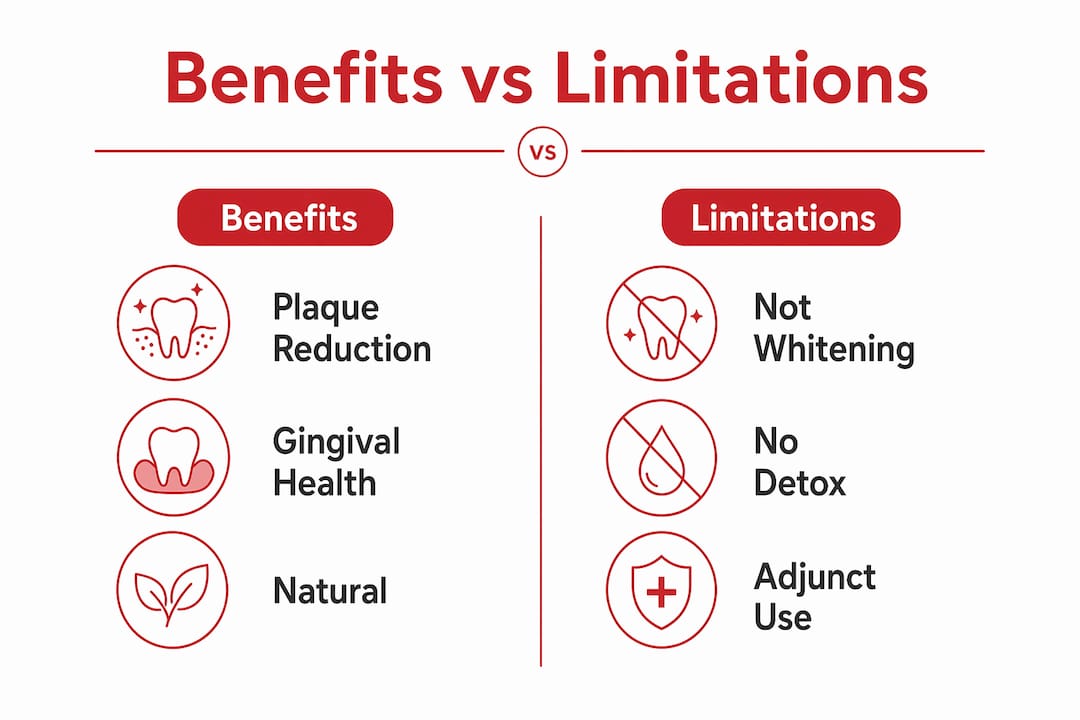
Systematic reviews confirm that oil pulling reduces plaque and gingival inflammation across multiple study populations, though the effect size remains consistently lower than that of chlorhexidine gluconate, the gold standard antiseptic mouthwash. Chlorhexidine achieves superior bacterial reduction but carries documented side effects including tooth staining, altered taste perception, and disruption of the oral microbiome with prolonged use. Oil pulling produces none of these adverse effects at standard protocols, which positions it as a viable long-term adjunct for patients who cannot tolerate chlorhexidine.
The following table compares dental cleansing oil to conventional oral care approaches across key clinical parameters:
| Parameter | Dental cleansing oil | Chlorhexidine mouthwash | Brushing and flossing |
|---|---|---|---|
| Plaque reduction | Moderate (documented) | High | High |
| Gingival inflammation | Moderate reduction | High reduction | High reduction |
| Antimicrobial spectrum | Broad (bacteria) | Broad (bacteria, fungi) | Mechanical only |
| Enamel remineralization | None documented | None | Fluoride-dependent |
| Side effects | Minimal | Staining, dysgeusia | None |
| Replaces brushing/flossing | No | No | Standard of care |
The American Dental Association maintains a neutral stance on oil pulling, acknowledging its low-risk profile when used alongside brushing and flossing while declining to endorse it as a clinically proven standalone treatment. This position reflects the current state of evidence: promising but not yet sufficient for broad clinical recommendation. Patients seeking to understand the science behind essential oils in oral hygiene will find that the existing literature supports adjunct use with appropriate expectations.
Popular claims that oil pulling whitens teeth, detoxifies the bloodstream, or cures systemic diseases are not supported by peer-reviewed evidence. These assertions exceed the documented mechanism of action and should be evaluated critically.
How to use dental cleansing oil safely and effectively at home
Correct technique determines whether dental cleansing oil delivers measurable oral health benefits. The standard protocol specifies one tablespoon of edible oil swished for 15 to 20 minutes on an empty stomach, followed by spitting and brushing. Deviating from this protocol, particularly by reducing swishing time or using refined oils, reduces the practice’s documented efficacy.
Follow these steps for correct application:
- Select the oil. Use organic, cold-pressed, unrefined coconut or sesame oil. Refined oils lack the antimicrobial compounds necessary for therapeutic effect.
- Measure the dose. Place approximately one tablespoon (15 mL) of oil in the mouth. A smaller volume reduces mechanical coverage; a larger volume causes fatigue more rapidly.
- Swish on an empty stomach. Perform oil pulling before breakfast and before brushing. Food particles and saliva dilute the oil and reduce its mechanical efficacy.
- Maintain continuous motion. Push and pull the oil through the interdental spaces for the full duration. Passive holding does not produce the mechanical disruption documented in clinical trials.
- Spit into a trash receptacle. Coconut oil solidifies in plumbing and accumulates in household drains, causing blockages. Spitting into the sink is a documented plumbing hazard.
- Rinse with warm water. A water rinse removes residual oil and expelled bacteria from the oral cavity before brushing.
- Brush and floss as normal. Oil pulling does not replace mechanical cleaning. Brushing after oil pulling removes residual debris and delivers fluoride or other active agents to tooth surfaces.
Pro Tip: Beginners frequently experience jaw fatigue during the 15 to 20 minute protocol. Start with 5 minutes and increase session duration by two to three minutes each week until reaching the full protocol. Compliance improves significantly with gradual adaptation.
Common misconceptions and safety considerations
Several claims associated with dental cleansing oil circulate in consumer wellness communities without scientific support. Accurate understanding of both the evidence base and the limitations of this practice is necessary for safe and effective use.
The antimicrobial properties reduce bacterial load but do not treat established periodontal disease, active carious lesions, or structural dental pathology. Patients presenting with any of these conditions require professional intervention. Oil pulling does not substitute for scaling, root planing, restorative dentistry, or endodontic treatment.
Key safety and misconception points include:
- Oil pulling is not a systemic detox. The oral mucosa does not absorb toxins from the oil during swishing. Claims that oil pulling removes heavy metals or purifies the bloodstream have no mechanistic or clinical basis.
- Whitening claims are unsubstantiated. No peer-reviewed study documents enamel whitening attributable to oil pulling. Surface stain reduction from mechanical action may produce a modest cosmetic effect, but this is not equivalent to bleaching.
- Mucosa irritation is possible. Rare cases of oral mucosal irritation have been reported, particularly with essential oil-infused products. Individuals with known sensitivities should perform a patch assessment before regular use.
- Oil pulling does not replace professional cleanings. Subgingival calculus, deep periodontal pockets, and established infections require professional dental care that no home practice can replicate.
- Swallowing the oil is contraindicated. The expelled oil contains bacteria, cellular debris, and salivary enzymes. Ingestion introduces this microbial load to the gastrointestinal tract.
- Consult a clinician if symptoms persist. Bleeding gums, persistent halitosis, or tooth sensitivity that does not resolve with improved oral hygiene warrants professional evaluation, not continued self-treatment.
Readers seeking clarity on broader natural dental care myths will find that many popular claims about oil-based oral care exceed the available evidence, and that distinguishing documented benefits from unsupported assertions is central to responsible use.
Key takeaways
Dental cleansing oil reduces plaque and supports oral hygiene through saponification and mechanical biofilm disruption, but it functions exclusively as an adjunct to brushing, flossing, and professional dental care.
| Point | Details |
|---|---|
| Mechanism of action | Saponification and emulsification during swishing disrupt plaque biofilm and reduce oral bacteria. |
| Documented efficacy | Sesame oil reduced plaque by 18.98% over eight weeks in a randomized controlled trial. |
| Oil quality matters | Only organic, cold-pressed, unrefined oils contain the antimicrobial compounds relevant to oral health. |
| Not a replacement | Oil pulling does not treat cavities, periodontal disease, or replace professional prophylaxis. |
| Safe adjunct use | The American Dental Association acknowledges oil pulling as low-risk when used alongside standard oral hygiene. |
A clinician’s perspective on dental cleansing oil in practice
The growing interest in oil-based oral hygiene reflects a broader shift toward natural, low-intervention health practices, and I find this trend worth examining carefully rather than dismissing. In clinical practice, patients frequently arrive having adopted oil pulling based on social media claims that far exceed what the evidence supports. My concern is not with the practice itself but with the expectations attached to it.
What the data actually shows is instructive. Sesame and coconut oil produce measurable plaque reductions in controlled settings, and the saponification mechanism is scientifically coherent. These are not trivial findings. However, the patients most likely to benefit from oil pulling are those who already maintain adequate brushing and flossing habits and are seeking an additional antimicrobial adjunct, not those hoping to replace professional care with a home remedy.
The compliance challenge is real. A 15 to 20 minute daily commitment is substantial, and jaw fatigue causes many patients to abandon the practice before achieving the muscle adaptation necessary for consistent technique. Gradual protocol adoption, starting at five minutes and building incrementally, produces better long-term adherence than attempting the full duration immediately.
My recommendation is straightforward: oil pulling is a reasonable, low-risk addition to an established oral hygiene routine for patients who are motivated and correctly informed. It is not a substitute for fluoride, scaling, or professional examination. Patients who approach it as one tool among many, rather than a cure-all, are the ones who report the most sustainable benefit.
— Veronica
Explore natural oral care at Stop-oralcare

Stop-oralcare offers a curated selection of evidence-informed natural oral health products, including fluoride-free formulations developed with hemp and Dead Sea minerals. For individuals building a natural dental cleansing routine, the platform provides both product options and detailed educational resources grounded in current dental research. Understanding how oil-based oral care interacts with other natural ingredients, such as those found in hemp-based oral care, is central to building a routine that delivers consistent, documented results. Stop-oralcare’s approach, led by Dr. Veronica Stahl, combines scientific rigor with practical guidance for patients seeking alternatives to conventional dental products.
FAQ
What is dental cleansing oil?
Dental cleansing oil is an edible oil, typically coconut or sesame, swished through the mouth to mechanically disrupt plaque biofilm and reduce oral bacteria. It is classified as an adjunct oral hygiene practice, not a replacement for brushing or flossing.
How long should you swish dental cleansing oil?
The standard protocol specifies 15 to 20 minutes of continuous swishing on an empty stomach. Beginners should start at five minutes and increase duration gradually to build jaw muscle endurance and improve compliance.
Is dental cleansing oil effective for reducing plaque?
Clinical evidence confirms a statistically significant plaque reduction with oil pulling. Sesame oil produced an 18.98% plaque reduction over eight weeks in a randomized controlled trial, compared to 10.49% with distilled water.
Can dental cleansing oil replace brushing and flossing?
No. Systematic reviews confirm that oil pulling reduces plaque and gingival inflammation but does not provide enamel remineralization and cannot replace the mechanical cleaning delivered by brushing and flossing or the professional removal of subgingival calculus.
What oil is best for dental cleansing oil use?
Organic, cold-pressed, unrefined coconut or sesame oil is recommended. Refined oils lack the antimicrobial compounds, including lauric acid in coconut oil, that contribute to the documented oral health effects of oil pulling.