

Yes, cleaning your tongue is a useful adjunct to brushing and flossing for most people who want fresher breath. A dedicated scraper tends to lift tongue coating more effectively than a toothbrush, but neither replaces brushing, flossing, and regular dental checkups, which remain the foundation of oral hygiene.
TL;DR:
- Tongue cleaning significantly reduces volatile sulfur compounds and tongue coating, with effect sizes of about 0.745 for VSCs and 0.922 for coating based on multiple studies.
- Scraping tends to outperform brushing by effectively lifting debris and bacteria in a single motion, but brushing may be more comfortable for those with gag reflex sensitivities.
- Gentle, last-step tongue cleaning after brushing and flossing limits irritation; overdoing it can cause soreness or minor ulcers, especially when scraping too hard or reaching too far back.
- Most issues with tongue coating resolve within a couple of weeks of consistent, gentle cleaning, but persistent or unusual symptoms warrant professional evaluation.
- Tongue cleaning is an optional addition to routine oral hygiene, with most guidance emphasizing mild techniques and caution to avoid harm.
Table of Contents
- Should You Brush Your Tongue? What Reviews and Trials Show
- Brush vs. Scraper: Which Method Actually Works Better?
- How to Clean Your Tongue the Right Way
- Is Tongue Brushing Safe? Risks to Know Before You Start
- When Should You See a Dentist About Your Tongue?
- How Dr. Veronica Stahl Applies This Evidence in Practice
- A Simple, Gentle Take on Tongue Cleaning
- A Gentle Adjunct: Where Stop-oralcare Fits Into Your Routine
- Sources
- FAQ
Should You Brush Your Tongue? What Reviews and Trials Show
The short answer is that tongue cleaning works, but the size of the benefit depends on how you measure it. A systematic review of mechanical tongue cleaning found that adding tongue cleaning to toothbrushing produced significantly larger reductions in volatile sulfur compounds (VSCs) and tongue coating than toothbrushing alone, with reported effect sizes of 0.745 for VSCs and 0.922 for tongue coating. Those are substantial numbers in oral health research, where many interventions produce only marginal improvement.
A 2026 randomized controlled trial involving 80 participants adds more recent weight. After four weeks, tongue brushing significantly lowered VSC levels, and combining tongue cleaning with oral probiotics produced additional statistically significant improvement.
Statistic Callout: Tongue cleaning added to brushing shows an effect size of 0.922 for reducing tongue coating and 0.745 for VSC reduction, according to the pooled data from five trials in the systematic review cited above.
The evidence base still has gaps worth acknowledging:
- Sample sizes in most trials remain small, often under 100 participants.
- Researchers haven’t settled on standardized frequency or duration guidance.
- Long-term effects on the oral microbiome remain an open question rather than a settled one.
That combination, real benefit paired with real uncertainty, is why most clinical guidance treats tongue cleaning as optional rather than mandatory.
Brush vs. Scraper: Which Method Actually Works Better?
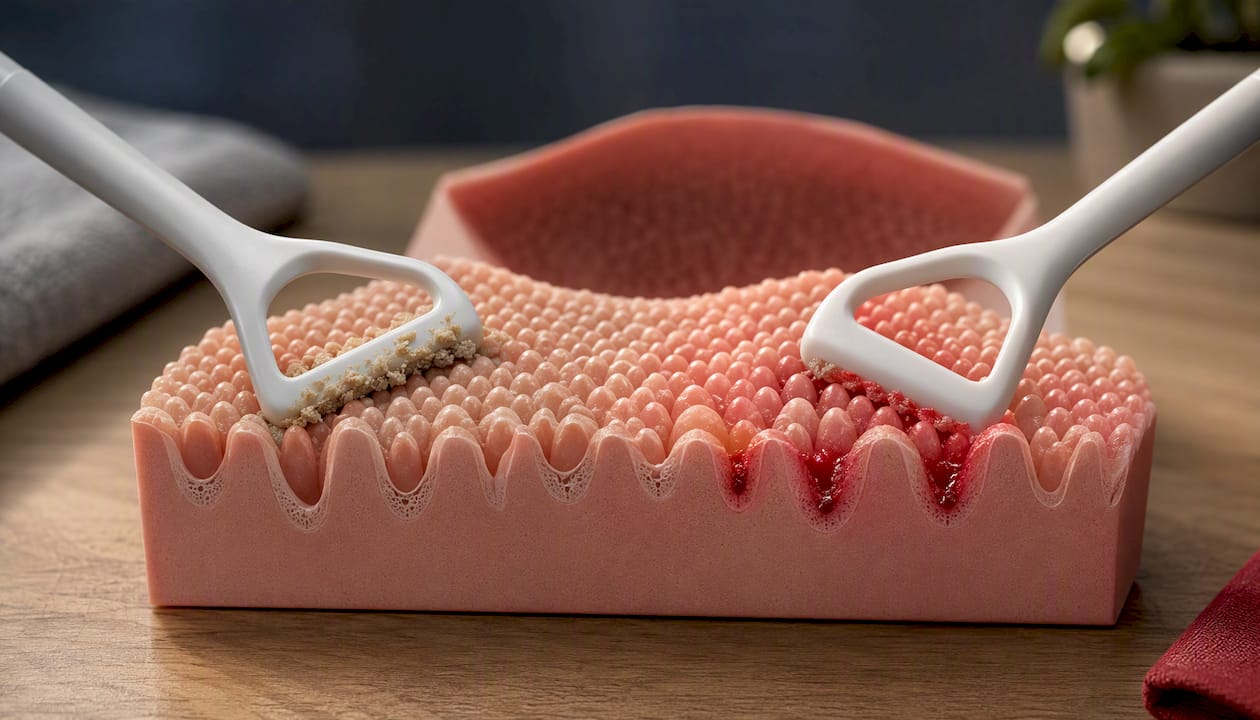
A toothbrush and a dedicated scraper solve the same problem in different ways, and the mechanics explain why one often outperforms the other. Scraping lifts debris and bacterial film off the tongue’s surface in a single motion. Brushing, by contrast, can press some of that same debris down into the papillae, the small bumps that make the tongue’s surface uneven, rather than lifting it away.
That mechanical difference lines up with what practitioners report in practice. Clinicians frequently favor scrapers because the pulling motion clears coating more completely in one pass, an insight echoed in Cleveland Clinic’s guidance on tongue scraping. Consumer health resources from UCLA Health reach a similar conclusion: scraping tends to produce more immediate reduction in the coating responsible for bad breath.
That doesn’t make the toothbrush useless. Several practical factors tip the decision one way or another:
- Gag reflex: a wide scraper reaching too far back can trigger gagging faster than a toothbrush’s smaller head.
- Convenience: if you’re already holding a toothbrush, using its back ridge (on models designed with one) skips an extra step.
- Tool upkeep: scrapers need rinsing between passes and periodic replacement; metal versions last longer than plastic.
- Ergonomics: scraper shape and width genuinely affect performance, a point Wikipedia’s overview of tongue cleaner designs lays out clearly across metal, plastic, and brush-style tools.
Pro Tip: If you gag easily, try a narrower scraper first. Width matters more than material for comfort, and a slimmer profile clears the middle of the tongue without triggering the back-of-throat reflex.
How to Clean Your Tongue the Right Way
Sequence matters as much as technique. Clean your tongue last, after brushing, flossing, and rinsing, so you’re not redepositing debris you just removed. One or two gentle passes is enough; more isn’t better here.
- Brush your teeth first, then floss to clear food particles from between teeth.
- Rinse with water or mouthwash to wash away loosened debris.
- For a scraper: start at the middle to back of the tongue (not the very back), pull forward in one smooth stroke, and rinse the tool before repeating once or twice.
- For a toothbrush: use light strokes moving from back to front, or the textured ridge on the back of the brush head if it has one.
- Stop after one or two passes. Scraping repeatedly in the same spot raises the risk of irritation without adding benefit.
If the gag reflex is your main obstacle, start on the front third of the tongue and work backward gradually over several days as tolerance builds. Breathing through your nose during the pass also helps suppress the reflex.
Pro Tip: Do your tongue cleaning first thing in the morning, before food or coffee. Overnight is when coating and bacteria build up most, so that’s when the payoff is largest.
Is Tongue Brushing Safe? Risks to Know Before You Start
Cleaning your tongue is low-risk when done gently, but aggressive technique causes real problems. Reported issues include soreness, minor ulcers, and a heightened gag reflex from scraping or brushing too hard or too far back, concerns detailed in UCLA Health’s reporting on tongue brushing.
Statistic Callout: No large study has quantified microbiome disruption from tongue cleaning with precision. Commentaries raise the possibility, but the evidence remains limited and inconclusive rather than a confirmed risk.
Follow a few simple rules to avoid harm:
- Use light pressure. Bleeding or persistent soreness means you’re pressing too hard.
- Stop immediately if you notice bleeding, and give the area time to heal.
- Avoid scraping the very back of the tongue near the tonsils, where the tissue is more sensitive and the gag reflex is strongest.
When Should You See a Dentist About Your Tongue?
Most tongue coating clears up with a couple of weeks of gentle, consistent cleaning. See a dentist or doctor if you notice any of the following:
- Discoloration or coating that doesn’t improve after two weeks of gentle cleaning.
- Sores, pain, or bleeding lasting longer than two weeks.
- A sudden change in taste, persistent bad breath despite good hygiene, or other symptoms affecting your overall health.
Thick white, yellow, black, or red patches that resist gentle cleaning can point to a fungal infection or other issues that need professional evaluation rather than more scraping.
How Dr. Veronica Stahl Applies This Evidence in Practice
Dr. Veronica Stahl’s practical guidance for most patients is straightforward: gentle tongue cleaning up to twice daily, if you want it for breath control, fits comfortably alongside a standard hygiene routine. It’s a preference-based addition, not an obligation.
For patients who want extra support between cleanings, a fluoride-free toothpaste, mouthwash, and oral spray can serve as gentle adjuncts that round out the routine covered in our dental care checklist without replacing the mechanical step of tongue cleaning itself.
A Simple, Gentle Take on Tongue Cleaning
Tongue cleaning genuinely helps many people manage bad breath, but it works best as a light, consistent habit rather than an aggressive fix. Brushing, flossing, and regular dental visits still come first.
— Veronica
A Gentle Adjunct: Where Stop-oralcare Fits Into Your Routine
Stop-oralcare gives you a fluoride-free way to round out the gentle tongue-cleaning habit covered above, built around hemp and Dead Sea minerals instead of the harsher ingredients found in many conventional products.

The lineup covers three specific needs. The STOP Protective & Whitening Toothpaste (12,99 €) supports daily brushing for sensitive teeth and gums. The STOP Mouthwash (20,00 €) rinses away loosened debris after you’ve scraped or brushed your tongue, the exact step the how-to section above calls for. The STOP Protective Oral Spray (11,99 €) offers a quick, on-the-go option for breath freshness between full cleanings.
None of these products replace tongue cleaning, brushing, flossing, or dental visits. They complement a routine you’re already building. If you want a natural, fluoride-free option to pair with your tongue-cleaning habit, visit Stop-oralcare’s product lineup to see current pricing and pick what fits your routine.
This article is general information, not a substitute for advice from a qualified doctor. Consult a qualified healthcare professional about your own circumstances before acting on anything here.
Sources
- Randomized trial of tongue cleaning and oral probiotics on volatile sulfur compounds (2026)
- Effectiveness of mechanical tongue cleaning on breath odour and tongue coating: a systematic review
- Should you try tongue scraping? | UCLA Health
- Does tongue scraping actually work, and should I be doing it? | Cleveland Clinic
FAQ
Does Your Tongue Need to Be Brushed?
It’s not strictly required, but it’s a reasonable and evidence-supported step for reducing bad breath. Reviews show that adding tongue cleaning to toothbrushing lowers volatile sulfur compounds and tongue coating more than toothbrushing alone.
What Percentage of People Brush Their Tongues?
Exact adoption figures vary by survey and aren’t consistently tracked in the clinical literature reviewed here. What’s clear is that dental professionals increasingly recommend it as a helpful, optional addition to a standard hygiene routine.
Do Dentists Actually Recommend Tongue Scrapers?
Many do, particularly for patients dealing with persistent bad breath. Clinical resources note that scrapers often remove tongue coating more effectively than brushing because the scraping motion lifts debris rather than pressing it into the tongue’s surface, a point covered in Cleveland Clinic’s guidance.
What Happens When I Don’t Brush My Tongue?
Nothing dangerous happens on its own, but bacterial coating and food debris can build up, contributing to bad breath and a visibly coated tongue. For most people, skipping tongue cleaning simply means missing out on an extra layer of freshness that brushing and flossing alone don’t fully provide.