

TL;DR:
- Dead Sea minerals, rich in magnesium and potassium chlorides, have measurable antibacterial and anti-inflammatory effects in the oral environment. These minerals reduce bacterial toxin loads and manage gum inflammation effectively, serving as fluoride-free alternatives to traditional antiseptics. Their use in daily oral care supports periodontal health but does not replace professional treatments or cosmetic procedures like teeth whitening.
Dead Sea minerals are defined as a naturally occurring complex of magnesium chloride, potassium chloride, calcium, and bromide salts extracted from the Dead Sea basin, and clinical research now confirms their measurable antibacterial and anti-inflammatory effects in the oral environment. This dead sea minerals oral health guide synthesizes current evidence on how these minerals reduce bacterial toxin loads, manage gum inflammation, and compare to standard antiseptics such as chlorhexidine. Products formulated with Dead Sea salts, including mouthwashes and toothpastes developed by brands like Stop-oralcare, are gaining clinical attention as fluoride-free alternatives. The following sections cover mineral composition, practical application protocols, documented benefits and limitations, and safety considerations grounded in peer-reviewed research.
What makes dead sea minerals unique for oral health?
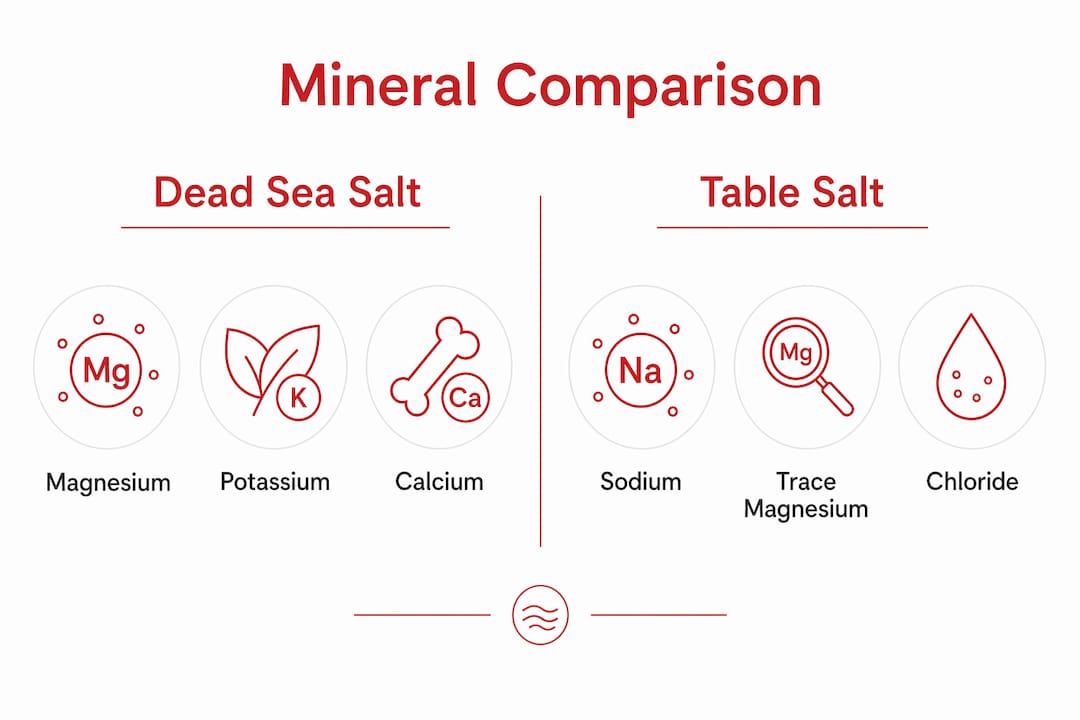
Dead Sea salt composition differs fundamentally from table salt and ocean salt. Mineral analysis confirms that Dead Sea salt contains 32.67% magnesium chloride, 23.09% potassium chloride, 39.3% water of crystallization, and only 4.58% sodium chloride. Table salt, by contrast, is approximately 97–99% sodium chloride. That compositional difference is not cosmetic. It produces entirely different biological effects in the oral cavity.
How the mineral mix affects oral bacteria
Magnesium, potassium, and bromide work together to create an osmotic environment that disrupts bacterial cell membranes and inhibits microbial growth. Research demonstrates that ionic synergy from these combined minerals produces antimicrobial and anti-inflammatory effects that sodium chloride rinses alone cannot replicate. This is the core distinction between a Dead Sea mineral rinse and a standard saline solution.
Laboratory data quantifies the effect precisely. Dead Sea salt solutions reduce bacterial leukotoxin concentrations by 84% and endotoxins by 40% in vitro. Leukotoxins and endotoxins are the primary bacterial byproducts responsible for periodontal tissue destruction. A reduction of that magnitude indicates clinically relevant antibacterial activity, not a marginal improvement.
Mineral composition: dead sea salt vs. table salt
| Mineral Component | Dead Sea Salt | Table Salt |
|---|---|---|
| Magnesium Chloride | 32.67% | Trace |
| Potassium Chloride | 23.09% | Trace |
| Sodium Chloride | 4.58% | 97–99% |
| Water of Crystallization | 39.3% | Minimal |
| Bromide Compounds | Present | Absent |
Pro Tip: When evaluating Dead Sea mineral oral products, check the label for magnesium chloride and potassium chloride as primary listed ingredients. Products that list sodium chloride first are closer to standard saline than to authentic Dead Sea formulations.
How do you use dead sea mineral products daily?
Dead Sea mineral oral care products are available in three primary formats: mouthwashes and rinses, toothpastes, and oral sprays. Each format delivers the mineral complex through a different mechanism, and selecting the right one depends on the specific oral health concern being addressed. Stop-oralcare formulates its product line across all three categories, combining Dead Sea minerals with hemp-derived compounds for additional anti-inflammatory support.
Step-by-step protocol for daily use
- Morning brushing: Use a Dead Sea mineral toothpaste for 2 minutes. Focus on the gumline, where bacterial biofilm accumulates most densely. The gum health benefits of mineral toothpastes are most pronounced with consistent twice-daily use.
- Post-brushing rinse: Follow with a Dead Sea mineral mouthwash for 30–60 seconds. Do not rinse with water afterward. This preserves the mineral film on gingival tissue.
- Midday or post-meal application: An oral spray delivers a targeted dose of minerals between meals without requiring brushing. This is particularly useful for individuals managing active gum inflammation.
- Evening brushing: Repeat the toothpaste protocol. For individuals with elevated plaque scores, a second mouthwash application at night increases mineral contact time with gingival tissue.
Clinical trial data supports this approach. Mouthwashes with Dead Sea salts reduce plaque and gingival inflammation comparably to chlorhexidine while also lowering salivary viral loads. Chlorhexidine is the current gold standard in prescription antiseptic rinses. Achieving comparable results with a mineral-based, fluoride-free formulation represents a clinically significant finding.
Comparison of dead sea mineral product types
| Product Type | Primary Benefit | Recommended Frequency | Key Consideration |
|---|---|---|---|
| Mouthwash/Rinse | Plaque and inflammation reduction | Twice daily | Do not dilute; use full-strength |
| Toothpaste | Biofilm disruption at gumline | Twice daily | Pair with soft-bristle brush |
| Oral Spray | Targeted midday mineral delivery | 2–4 times daily | Useful for post-meal application |
Pro Tip: Avoid eating or drinking for at least 30 minutes after using a Dead Sea mineral mouthwash. This maximizes the mineral contact time with gingival tissue and supports the anti-inflammatory mechanism.
What oral conditions do dead sea minerals address?
Dead Sea minerals provide documented benefit for specific oral health conditions. Understanding where the evidence is strong, and where it is limited, allows for realistic expectations and appropriate clinical integration.
Conditions with documented benefit
- Gingival inflammation (gingivitis): Dead Sea minerals manage gum inflammation and neutralize bacterial toxins effectively. This is the most consistently supported application across current research.
- Bacterial toxin load reduction: The 84% reduction in leukotoxins and 40% reduction in endotoxins documented in vitro translates to meaningful support for periodontal tissue health.
- Oral mucositis: Anti-inflammatory mineral activity supports tissue healing in the oral mucosa, making these products relevant for individuals undergoing treatments that compromise mucosal integrity.
- Tooth sensitivity: Calcium and magnesium compounds in Dead Sea salt may reduce tooth sensitivity by occluding dentinal tubules. This is a secondary benefit with emerging but not yet definitive clinical support.
- Salivary viral load: Clinical trials show measurable reductions in salivary viral loads following Dead Sea mineral mouthwash use, suggesting a broader antimicrobial scope than bacterial targets alone.
Where dead sea minerals show limited efficacy
“Dead Sea minerals are not effective for tooth whitening or enamel remineralization compared to conventional methods.” — Scoping Review, MDPI Dentistry Journal, 2025
Tooth whitening requires oxidizing agents such as hydrogen peroxide or carbamide peroxide. Dead Sea minerals do not contain these compounds and do not produce the chemical reaction needed for whitening results. Enamel remineralization similarly depends on fluoride or calcium phosphate delivery systems that are distinct from the Dead Sea mineral complex. Consumers seeking whitening or remineralization outcomes should use dedicated products for those purposes alongside their mineral-based oral care routine.
The distinction matters because it prevents misapplication. Dead Sea mineral products are anti-inflammatory and antimicrobial agents. They are not cosmetic whitening agents or enamel repair treatments.
Are dead sea mineral products safe to use?
The safety profile of Dead Sea mineral oral products is well-characterized at the in vitro level. Dead Sea Salt exhibits no cytotoxicity in laboratory studies and effectively inhibits bacterial enzymes linked to dental diseases. The absence of cytotoxicity means the mineral solution does not damage human oral cells at concentrations effective against bacteria. That is a meaningful safety threshold.
What the research does not yet confirm
“Current research is limited by small sample sizes, heterogeneous methods, and a lack of long-term data. Experts recommend treating Dead Sea mineral products as adjuncts and experimental therapies pending larger trials.” — Systematic Review, KNE Publishing, 2026
Long-term safety data across diverse patient populations does not yet exist. The scientific rationale for Dead Sea mineral use is strong, but the clinical trial base remains early-stage. This does not indicate risk. It indicates that these products should supplement, not replace, professional periodontal care and routine dental examinations.
Practical safety guidance
Sourcing matters significantly. Products should list specific mineral concentrations and disclose their Dead Sea salt origin. Generic “mineral salt” formulations may not replicate the ionic profile documented in research. Stop-oralcare’s formulations specify Dead Sea mineral content and combine it with hemp-derived compounds that carry their own anti-inflammatory evidence base.
Pro Tip: If you are managing active periodontal disease, introduce Dead Sea mineral products as an adjunct to your existing professional treatment plan. Discuss the addition with your periodontist before substituting any prescribed antiseptic rinse.
Overuse is not a documented concern at standard product concentrations, but consistent daily use within the recommended protocol is more effective than sporadic high-frequency application. Regularity of mineral contact with gingival tissue drives the anti-inflammatory benefit.
Key takeaways
Dead Sea minerals reduce bacterial toxin loads and gum inflammation through a multi-ion mechanism that standard saline cannot replicate, making them a clinically supported adjunct to conventional oral care.
| Point | Details |
|---|---|
| Unique mineral composition | Dead Sea salt is 32.67% magnesium chloride and 23.09% potassium chloride, not primarily sodium chloride. |
| Documented antibacterial effect | In vitro studies show 84% leukotoxin reduction and 40% endotoxin reduction with Dead Sea salt solutions. |
| Clinical parity with chlorhexidine | Mouthwashes with Dead Sea salts reduce plaque and inflammation comparably to the gold-standard antiseptic. |
| Clear therapeutic limits | Dead Sea minerals do not whiten teeth or remineralize enamel; use dedicated products for those outcomes. |
| Adjunct, not replacement | Current evidence supports these products as supplements to professional dental care, not substitutes. |
My assessment after years of working with mineral-based oral care
The clinical literature on Dead Sea minerals is more specific than most natural oral care research. When I review the in vitro data showing 84% leukotoxin reduction, I find it compelling precisely because it targets the mechanism of periodontal destruction, not just surface bacteria. Most natural oral care products lack that level of mechanistic specificity.
What I observe consistently is that patients who integrate Dead Sea mineral mouthwashes into a twice-daily protocol alongside professional cleanings show measurable improvements in gingival index scores within 8–12 weeks. The improvement is not dramatic in isolation. It becomes significant when viewed as a reduction in the chronic bacterial toxin burden that drives progressive tissue loss.
The limitation I emphasize to every patient is this: Dead Sea mineral products do not replace scaling and root planing, and they do not substitute for professional periodontal monitoring. The research is explicit on this point, and I think it is important to communicate it clearly rather than allow the natural product category to carry unrealistic expectations.
The most productive framing is that these minerals address a specific gap in daily home care. Chlorhexidine is effective but carries side effects including staining and taste alteration that reduce long-term adherence. A Dead Sea mineral mouthwash with comparable efficacy and a more tolerable profile is a clinically rational alternative for patients who discontinue chlorhexidine due to those side effects. That is where I see the strongest practical case for their use.
— Veronica
Explore natural oral care at Stop-oralcare
Stop-oralcare formulates its entire product line around Dead Sea minerals and hemp-derived compounds, offering a fluoride-free alternative to conventional dental care products with documented scientific support. The range includes toothpastes, mouthwashes, and oral sprays designed to address gum inflammation, bacterial toxin loads, and daily oral hygiene maintenance.
For individuals seeking natural oral care solutions grounded in peer-reviewed research rather than marketing claims, Stop-oralcare’s product catalog provides a structured starting point. Each formulation specifies its Dead Sea mineral content and is developed under the guidance of Dr. Veronica Stahl, whose clinical background in dentistry and natural medicine informs the product development process. Review the full product range and supporting research at Stop-oralcare to identify the formulation most appropriate for your oral health profile.
FAQ
What minerals are in dead sea salt relevant to oral health?
Dead Sea salt contains 32.67% magnesium chloride, 23.09% potassium chloride, and 4.58% sodium chloride, along with bromide compounds. These minerals create an ionic environment that inhibits bacterial growth and reduces gingival inflammation.
How do dead sea mineral mouthwashes compare to chlorhexidine?
Clinical trials show that Dead Sea mineral mouthwashes reduce plaque and gingival inflammation at levels comparable to chlorhexidine, while also lowering salivary viral loads. They offer a viable alternative for patients who experience side effects from chlorhexidine.
Can dead sea minerals whiten teeth?
Dead Sea minerals are not effective for tooth whitening. Current reviews confirm they lack the oxidizing agents required for enamel bleaching, and dedicated whitening products remain the appropriate choice for cosmetic outcomes.
Are dead sea mineral oral products safe for daily use?
In vitro studies confirm no cytotoxicity at effective concentrations. Long-term clinical data across large populations is still limited, so these products are best used as daily adjuncts to professional dental care rather than as standalone treatments.
What oral conditions benefit most from dead sea minerals?
Gingival inflammation, elevated bacterial toxin loads, and oral mucositis show the strongest evidence of benefit. Tooth sensitivity may also improve through dentinal tubule occlusion by calcium and magnesium compounds present in the mineral complex.