

TL;DR:
- Evaluating dental product safety in 2025 involves confirming independent certifications and reviewing ingredient risk profiles. Consumers should conduct patch tests, review biocompatibility data, and request ingredient disclosures before full use. Ongoing safety assessment is essential due to product reformulations and individual health changes.
Assessing dental product safety in 2025 requires applying a structured, multi-criteria evaluation framework rather than relying on any single indicator. Consumers should verify certifications such as the ADA Seal of Acceptance, which has evaluated over-the-counter oral care products for over 93 years through independent laboratory and clinical testing. The 2025 revision of ISO 7405 introduced a margin of safety approach aligned with ISO 10993-5, establishing the current biological evaluation benchmark for dental medical devices. Ingredient scrutiny for allergens such as tree nut-based resins, milk casein, and triclosan, combined with patch-testing protocols and review of clinical data, constitutes the practical foundation of sound dental product safety evaluation.
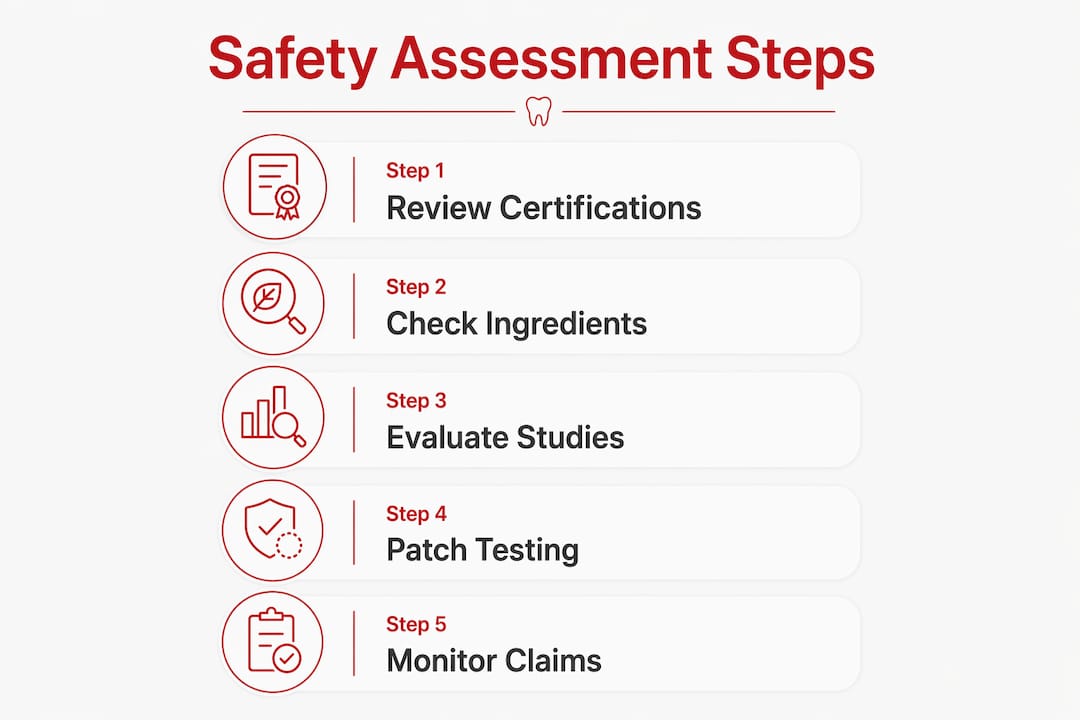
Core consumer safety steps include:
- Confirm the presence of the ADA Seal of Acceptance or equivalent independent certification
- Cross-reference ingredients against personal allergen profiles and current health conditions
- Review updated ISO 7405 and ISO 10993 biocompatibility data where available
- Request Material Safety Data Sheets (MSDS/SDS) from dental providers for full ingredient disclosure
- Conduct patch testing before full product adoption
- Monitor manufacturer communications for post-market formulation changes
How to assess dental product safety: regulatory standards and evaluation frameworks
The ADA Seal of Acceptance program, established in 1931, remains the primary consumer-facing certification for oral care product safety in the United States. Products awarded the Seal must undergo independent laboratory or clinical testing, and the Seal is valid for five years, with mandatory updated data submission required if the product’s composition changes during that period. The ADA Council on Scientific Affairs consults independent experts in toxicology, pharmacology, and microbiology before awarding the designation, making it a scientifically validated trust signal rather than a marketing label.
The 2025 update to ISO 7405 introduced new normative references, harmonized test assessment criteria with ISO 10993-5, and added a margin of safety approach specific to dental medical devices. This standard governs the biological evaluation of all devices that come into direct or indirect contact with a patient’s body, from restorative materials to oral sprays. The dental industry has also shifted toward a continuous lifecycle approach to biological safety evaluation, reassessing risks as product usage patterns and environmental contexts evolve. Consumers benefit from understanding that safety certification is not a one-time event but an ongoing process subject to revision.
How to scrutinize dental product ingredients for allergens and irritants
Patients with allergies, asthma, or autoimmune conditions face elevated risk from ingredients commonly present in dental formulations. Tree nut-based resins, milk casein, triclosan, and artificial colorings or flavorings can trigger adverse reactions ranging from mild mucosal irritation to severe anaphylaxis. Cross-reactivity between structurally similar compounds further complicates individual risk assessment, particularly for consumers managing multiple chronic conditions.

Dental professionals emphasize that safety assessment is dynamic; a product safe for the general population may pose specific risks for individuals whose health status has changed since their last dental visit. Reading ingredient lists requires attention to both primary components and excipients, including stabilizers, preservatives, and flavoring agents that manufacturers are not always required to highlight prominently. Consumers with complex health histories should request annual updates to their product safety review in consultation with their dental provider.
Pro Tip: Request a Material Safety Data Sheet (MSDS/SDS) directly from your dental provider or the product manufacturer. These documents disclose full ingredient profiles beyond what appears on retail labels and allow for individualized allergen screening before product use.
What safety seals and certifications actually tell you
The ADA Seal of Acceptance functions as a scientific benchmark, not merely a commercial endorsement. Products displaying the Seal have undergone rigorous scientific review by the ADA Council on Scientific Affairs, with consultation from specialists in dental materials, microbiology, pharmacology, toxicology, and chemistry. Only products that demonstrate both safety and efficacy through this process receive the designation.
The Seal is voluntary. Products without it are not necessarily unsafe, but they lack this layer of independent scientific verification. Consumers should treat the absence of the Seal as a prompt to apply additional scrutiny, not as a disqualifying factor. Certifications must also be interpreted in light of product reformulations: if a manufacturer alters the composition of a Sealed product, updated chemical and safety data must be submitted before the product may continue to carry the designation. For guidance on current dental safety standards, Stop-oralcare provides detailed overviews of the regulatory criteria shaping product evaluation in 2025.
Practical steps to choose safe dental products in 2026
Applying best practices for dental safety in 2025 begins with verifying the ingredient list against a current personal allergen profile before purchasing any new product. Consumers should then conduct a patch test by applying a small amount of the product to the inner forearm or a discrete mucosal area and observing for 24–48 hours before full oral use. Clinical trial data and peer-reviewed studies, when available from the manufacturer, provide an additional layer of evidence beyond label claims.
- Verify ingredient lists against personal allergen and health profiles before purchase
- Conduct a 24–48 hour patch test on skin or mucosa before full oral use
- Review available clinical study summaries published by the manufacturer
- Request MSDS documentation from dental providers for complete ingredient disclosure
- Monitor manufacturer websites and product packaging for formulation updates post-purchase
- Favor manufacturers with transparent, publicly accessible ingredient disclosures and documented scientific backing
Pro Tip: Maintain an updated personal health and allergy profile, reviewed at least annually with your dental provider. Products that were safe under a previous health status may require reassessment following new diagnoses, medication changes, or the development of new sensitivities.
Stop-oralcare’s formulations, developed under the scientific direction of Dr. Veronica Stahl, a recognized expert in dentistry and natural medicine, incorporate hemp and Dead Sea minerals with documented biocompatibility profiles. Consumers seeking natural oral care guidance will find that transparent ingredient disclosure and scientific backing are central to Stop-oralcare’s product development framework.
Key organizations that shape dental product safety evaluation
Several institutions define the standards against which dental product safety is measured in the United States. The American Dental Association, through its Council on Scientific Affairs, administers the Seal of Acceptance program and publishes category-specific safety and efficacy requirements. The U.S. Food and Drug Administration (FDA) governs the premarket evaluation of dental devices through the 510(k) pathway, referencing ISO 7405 and ISO 10993-1 as recognized biocompatibility standards. The International Organization for Standardization (ISO) develops the technical frameworks, most notably ISO 7405 and the ISO 10993 series, that manufacturers and testing laboratories use globally. The Centers for Disease Control and Prevention (CDC) contributes infection prevention guidelines specific to dental settings, which indirectly inform product safety expectations for materials used in clinical environments. Understanding the distinct but complementary roles of these bodies allows consumers to interpret product claims with greater precision.
How to evaluate scientific studies on dental product safety
Peer-reviewed clinical trials and published biocompatibility studies represent the highest-quality evidence for assessing dental product safety. Consumers should prioritize studies published in indexed dental or biomedical journals, with clearly described sample sizes, control groups, and outcome measures. Manufacturer-sponsored studies are not inherently invalid, but independent replication by third-party researchers strengthens the evidentiary basis for any safety claim. For product compliance standards, regulatory frameworks require that biocompatibility endpoints be addressed through recognized test methods, including cytotoxicity assays and systemic toxicity evaluations specified in ISO 10993-5 and ISO 10993-11. Consumers reviewing study summaries should confirm that the tested formulation matches the currently marketed product, given that reformulations can alter the safety profile documented in earlier research.
Recognizing misleading claims in dental product labeling
Dental product labels frequently employ terms such as “natural,” “clinically proven,” and “dentist recommended” without specifying the evidentiary basis for these claims. “Natural” carries no standardized regulatory definition in the United States for oral care products, meaning it does not guarantee the absence of synthetic preservatives, artificial flavors, or allergenic compounds. “Clinically proven” requires scrutiny of the underlying study design; a single small-scale, manufacturer-funded trial does not carry the same weight as a replicated, peer-reviewed investigation. Consumers should distinguish between products that display the ADA Seal, which reflects independent scientific review, and those that use marketing language designed to simulate comparable authority without equivalent substantiation. Reviewing the dental ingredient safety resources published by Stop-oralcare provides a practical framework for distinguishing evidence-based claims from promotional language.
Natural vs. synthetic ingredients: how formulation affects safety
The safety profile of a dental product depends on the specific compounds present and their concentrations, not on whether those compounds are classified as natural or synthetic. Hemp-derived cannabinoids, for example, have been studied for their antimicrobial and anti-inflammatory properties in oral biofilm contexts, while Dead Sea minerals including magnesium, potassium, and calcium contribute to remineralization without the cytotoxicity concerns associated with certain synthetic agents. Conversely, some naturally derived ingredients, including tree nut-based resins and casein, carry significant allergen risk for susceptible individuals. Formulation decisions, including the selection of preservatives, emulsifiers, and pH-modifying agents, determine whether a product’s overall biocompatibility profile meets the thresholds established by ISO 7405. Consumers seeking natural ingredient benefits should evaluate the full formulation rather than relying on the presence of a single highlighted compound as a proxy for overall safety.
Patch-testing new dental products: a structured approach
Patch testing provides a practical, low-risk method for detecting individual adverse reactions before committing to full product use. Apply a small quantity of the product to the inner forearm or the buccal mucosa and observe the site for 24–48 hours, noting any erythema, edema, pruritus, or mucosal changes. Consumers with known contact allergies should conduct testing under the guidance of a dental or medical professional, particularly when introducing products containing novel botanical extracts or mineral compounds. If no reaction occurs after the initial observation period, a brief supervised intraoral trial of one to two days is appropriate before regular use. Any adverse response, however mild, warrants discontinuation and consultation with a dental provider to identify the causative ingredient and update the personal allergen profile accordingly.
Key Takeaways
Dental product safety evaluation in 2025 requires integrating regulatory certification review, ingredient-level allergen analysis, and individualized patch-testing into a continuous, lifecycle-aware assessment process.
| Point | Details |
|---|---|
| ADA Seal validity period | The Seal is valid for five years and requires updated safety data if the product’s composition changes. |
| ISO 7405 2025 update | The revised standard introduced a margin of safety approach aligned with ISO 10993-5 for dental medical device biocompatibility. |
| High-risk ingredients | Tree nut-based resins, milk casein, and triclosan can cause reactions ranging from mild irritation to anaphylaxis in sensitive individuals. |
| Lifecycle safety assessment | Safety evaluation must be revisited after product reformulations or changes in a consumer’s health status. |
| MSDS transparency | Requesting Material Safety Data Sheets from dental providers reveals full ingredient profiles beyond retail label disclosures. |