

Tea tree oil has short-term randomized trial evidence supporting its use as an adjunct for gingivitis and, when clinician-applied as a gel, for periodontitis alongside scaling and root planing. It is not a substitute for mechanical cleaning or professional periodontal care. Always dilute it to trial-tested concentrations, never apply the concentrated essential oil directly to gum tissue, and never swallow a tea tree oil rinse.
TL;DR:
- Clinical trials show low-concentration tea tree oil mouthwashes can significantly reduce plaque and bleeding, matching chlorhexidine’s benefits with fewer side effects.
- Intrapocket gel applications delivered by dentists improve periodontitis markers but are not suitable for home use or DIY application.
- Most effective home use involves formulated mouthwashes containing 0.2% to 1% tea tree oil, never applying pure essential oil directly to gums.
- Higher concentrations of tea tree oil, especially above 25%, increase risks of irritation and cell damage, making formulation control essential for safety.
- Tea tree oil should be an adjunct to regular oral hygiene and professional care, not a standalone cure or substitute for scaling and root planing.
Table of Contents
- Tea Tree Oil for Gums: What the Clinical Trial Evidence Shows
- How to Use Tea Tree Oil for Gums Safely
- Who Should Avoid Tea Tree Oil on Their Gums
- Tea Tree Oil Versus Chlorhexidine: Where It Actually Fits
- A Practical Routine for Using Tea Tree Oil on Your Gums
- Why Formulation Matters More Than the Ingredient Itself
- Why I’d Rather See Readers Use a Formulated Product Than a Bottle of Essential Oil
- A Formulated Alternative to DIY Tea Tree Oil Rinses
- Sources
- FAQ
Tea Tree Oil for Gums: What the Clinical Trial Evidence Shows
Three trial types dominate the tea tree oil for gum health literature: mouthwash trials, intrapocket gel studies, and the systematic reviews that try to make sense of both. Each tells a slightly different story, and none of them supports tea tree oil as a standalone cure.
The clearest signal comes from a pilot randomized, double-blinded trial that compared tea tree oil mouthwash against chlorhexidine in gingivitis patients over 14 days. The tea tree oil group’s plaque index dropped from 53.25% to 5.50%, and the bleeding index fell from 38.41% to 4.22%, reductions the pilot RCT reported as statistically significant. Chlorhexidine performed comparably on clinical indices, but roughly 20% of chlorhexidine users developed dental staining, a side effect the tea tree oil group did not experience.
The 14-day snapshot: In the pilot trial, tea tree oil mouthwash cut plaque index by almost 90% and bleeding index by nearly 89%, with no reported tooth staining or taste changes.
A more recent exploratory trial pushes the comparison further. A 2026 triple-blind clinical trial tested a 1% tea tree oil mouthwash against 0.12% chlorhexidine over 15 days. Both rinses significantly reduced plaque and gingival inflammation, with tea tree oil producing clinical outcomes that were largely comparable to chlorhexidine. Chlorhexidine still won on raw microbiological reduction, killing more bacteria in vitro, but tea tree oil users reported fewer adverse effects and higher tolerability. That combination, similar clinical results with a gentler side effect profile, is the strongest argument for tea tree oil mouthwash as a viable adjunct rather than a chlorhexidine replacement.
Gingivitis is surface-level inflammation. Periodontitis involves deeper pocket infection, and that is where intrapocket gel studies come in. A randomized trial published in BMC Oral Health tested a 5% tea tree oil gel applied directly into periodontal pockets as an adjunct to scaling and root planing (SRP), the standard mechanical deep-cleaning procedure for periodontitis. Patients who received the gel alongside SRP showed superior improvements in pocket depth, clinical attachment level, gingival index, and bleeding on probing compared to SRP alone. The gel group also showed reduced levels of MMP-8, an inflammatory enzyme in gum fluid tied to tissue breakdown, and those gains persisted for up to six months.
That is a meaningful finding, but it comes with a major caveat: the gel was applied by a clinician directly into the pocket, not brushed on at home. This is not a protocol you can replicate with a bottle of essential oil and a cotton swab.
Systematic reviews temper the enthusiasm from individual trials. A 2023 systematic review of randomized controlled trials on Melaleuca alternifolia oil found consistent clinical effects across topical uses, but also flagged minor side effects as common, particularly as concentrations climbed toward 25% or higher. Separately, reviewers examining the dental-specific literature have pointed to a lack of standardized formulations across studies, small sample sizes, and short follow-up windows as reasons to hold off on broad clinical adoption.
The National Center for Complementary and Integrative Health adds an important reality check to all of this. NCCIH notes that low-concentration tea tree oil mouthrinses are marketed for gingivitis and plaque control, but calls the actual effectiveness uncertain given the inconsistency across products and formulations. Its guidance is blunt on one point: mouthrinses containing tea tree oil should never be swallowed.
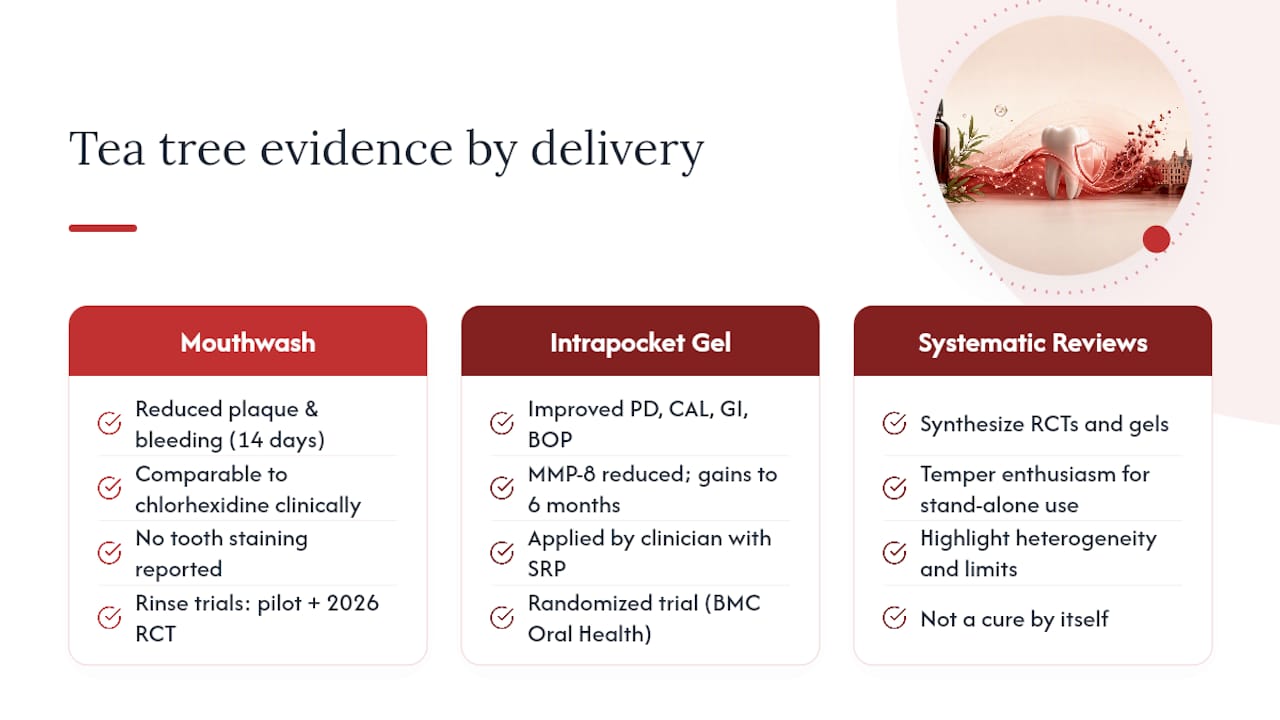
What does that add up to? A handful of well-designed small trials show real, measurable benefits, mostly matching or approaching chlorhexidine on clinical indices with better tolerability. But the evidence base is still thin compared to decades of chlorhexidine research, and formulation matters enormously.
How to Use Tea Tree Oil for Gums Safely
The gap between “tea tree oil works in a clinical trial” and “tea tree oil is safe to use at home” comes down entirely to concentration and formulation. Raw tea tree essential oil, the kind sold for diffusers and topical skin use, is far too concentrated for oral tissue and should never touch your gums undiluted.
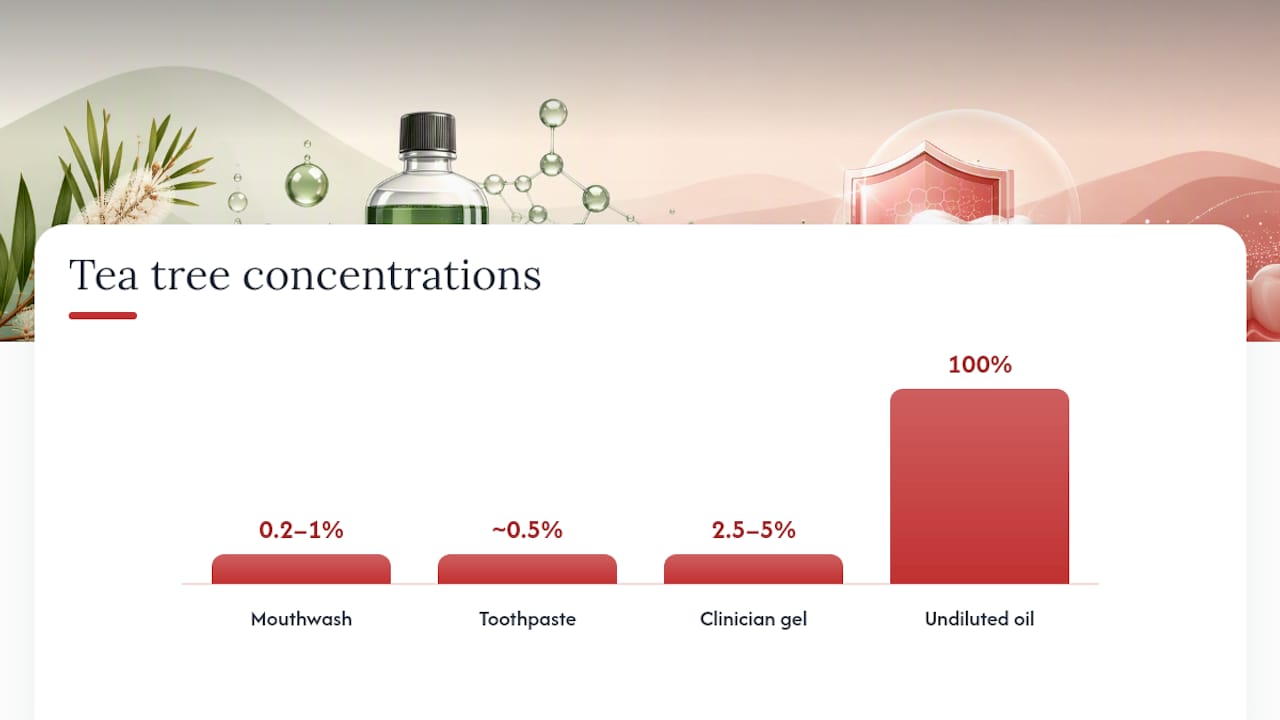
Trials that produced measurable benefits used specific, low concentrations:
- Mouthwash: 0.2% to 1% v/v tea tree oil, diluted in a proper aqueous or emulsified base
- Toothpaste: around 0.5% tea tree oil as a formulated ingredient
- Gel (clinician-applied only): 2.5% to 5%, delivered directly into periodontal pockets by a dental professional
These ranges reflect the concentrations reported across dental formulation research, and the gap between a 1% mouthwash and a 100% essential oil bottle is enormous. Undiluted oil applied to gum tissue can cause chemical burns, mucosal irritation, and cell damage that no gingivitis benefit could possibly offset.
If you want to use tea tree oil for gum health, follow a simple routine:
- Choose a commercially formulated tea tree oil mouthwash or toothpaste, not a DIY dilution of pure essential oil.
- Check the label for a stated concentration in the 0.2% to 1% range for rinses.
- Rinse with about 10 to 15 milliliters for 30 to 60 seconds, twice daily, matching trial protocols.
- Spit thoroughly and do not swallow any of the rinse.
- Avoid combining tea tree oil products with alcohol-based rinses, which can compound mucosal irritation.
- Store the product away from heat and light, since essential oil compounds degrade and can become more irritating over time.
Pro Tip: Before committing to daily use, patch test a small amount of diluted product on the inside of your cheek for a few minutes. If you notice burning, swelling, or numbness beyond a mild tingle, stop and choose a different formulation.
Skip anything marketed as “pure tea tree oil for oral use” without a stated percentage. If a product doesn’t disclose its concentration, you have no way to know whether you’re rinsing with something closer to the 1% trials or a dangerously stronger mix.
Who Should Avoid Tea Tree Oil on Their Gums
Even at trial-tested concentrations, tea tree oil isn’t risk-free for everyone. The most commonly reported adverse effects in trials and reviews are mild: transient irritation, changes in taste, and short-term shifts in salivary sensation. Those tend to resolve quickly and rarely require stopping treatment.
The bigger concerns show up at higher concentrations or in specific populations. The 2023 systematic review associated concentrations at or above 25% with a higher rate of adverse events, and separate in vitro research has shown cytotoxic effects on oral cells at high strengths, reinforcing why clinical gels stay in the 2.5% to 5% range under professional supervision rather than consumer hands.
Roughly 1 in 5 chlorhexidine users developed dental staining in the pilot RCT comparing it to tea tree oil, a side effect the tea tree oil group avoided entirely, though that trade-off doesn’t erase tea tree oil’s own risks at the wrong concentration.
Certain groups should avoid tea tree oil products altogether, or only use them after checking with a healthcare provider:
- Pregnant or breastfeeding individuals, where safety data is insufficient
- Children under 12, due to swallowing risk and thinner oral mucosa
- Anyone with a known allergy to tea tree oil or colophony (pine rosin), a common cross-sensitivity
- People with a history of oral mucosal sensitivity or contact stomatitis
If you experience burning, swelling, or persistent numbness after using a tea tree oil product, stop immediately. Persistent gum bleeding, swelling, or pain that doesn’t improve within a week or two is a sign you need a dentist, not a stronger rinse.
Tea Tree Oil Versus Chlorhexidine: Where It Actually Fits
Chlorhexidine has been the gold standard antimicrobial mouthwash for decades, and the trial data shows why: it consistently produces larger reductions in oral bacteria than tea tree oil does. But “larger microbiological reduction” and “better clinical outcome” aren’t the same thing.
Across both major trials comparing the two, plaque index and gingival index improvements were similar between tea tree oil and chlorhexidine over comparable time periods. The difference shows up in side effects and long-term usability:
- Chlorhexidine delivers stronger antibacterial killing but carries a well-documented risk of tooth staining, taste alteration, and, with prolonged use, mucosal desquamation.
- Tea tree oil trails slightly on microbiological potency but shows better short-term tolerability and no reported staining across the trials reviewed here.
- Neither has been tested extensively enough for indefinite daily use. Chlorhexidine is typically prescribed for limited courses; tea tree oil lacks the decades of long-term safety data chlorhexidine has accumulated.
That trade-off shapes where tea tree oil actually belongs in a gum care routine. It works best as a rotational or adjunctive rinse alongside brushing and flossing, not as a chlorhexidine replacement for active infection control, and never as a substitute for professional scaling and root planing when periodontitis is already present. The lack of standardized commercial formulations remains the biggest obstacle to recommending it more broadly. Until manufacturers converge on consistent, disclosed concentrations, patients are left comparing products that may not match the tea tree oil used in any given trial.
A Practical Routine for Using Tea Tree Oil on Your Gums
Translating trial protocols into a home routine is straightforward if you separate what you can do yourself from what requires a dentist.
For daily gum maintenance:
- Use a formulated tea tree oil mouthwash (0.2% to 1%) twice a day, morning and night, after brushing.
- Rinse for 30 to 60 seconds, spit fully, and avoid eating or drinking for 15 to 30 minutes afterward.
- Track your gums over 1 to 2 weeks. Reduced bleeding on brushing and less puffiness are the expected early signs, mirroring the 14-day improvement window seen in trial data.
- If bleeding, swelling, or pain persist past two weeks, schedule a dental exam rather than increasing frequency or concentration on your own.
Intrapocket gel application, the approach shown to help with periodontitis in the BMC Oral Health trial, is not a home procedure. It requires a clinician to place a 5% gel directly into periodontal pockets after scaling and root planing, under controlled, sterile conditions.
Pro Tip: When comparing products, prioritize a labeled concentration and a recognized oral-care certification over marketing claims like “100% natural” alone. Ingredient transparency tells you far more than the word “natural” does.
Why Formulation Matters More Than the Ingredient Itself
The clinical trials that produced measurable results didn’t use tea tree oil straight from a bottle. They used carefully diluted, emulsified formulations designed to distribute the active compound safely across oral tissue without the cytotoxicity risk that comes with higher concentrations. That distinction is the entire reason Stop-oralcare builds its natural mouthwash for periodontal disease around formulated botanical actives, hemp compounds and Dead Sea minerals among them, rather than raw essential oils diluted at home with guesswork.
Formulation controls what a bottle of essential oil cannot: consistent concentration, pH balance, and a delivery vehicle that keeps active ingredients in contact with gum tissue long enough to matter without irritating it. Intrapocket procedures, meanwhile, stay squarely in clinical hands. No formulated consumer product replaces scaling and root planing performed by a dentist or periodontist when periodontitis has already set in.
Why I’d Rather See Readers Use a Formulated Product Than a Bottle of Essential Oil
The trial data on tea tree oil is more encouraging than most consumer coverage gives it credit for, but I think the bigger story gets missed: the benefit in every study came from a controlled concentration, not from the ingredient’s reputation as “natural.” A bottle of pure tea tree essential oil sitting in a bathroom cabinet is a completely different product from the 1% mouthwash tested in these trials, and treating them as interchangeable is where most self-care attempts go wrong. My honest read is that tea tree oil earns its place as an adjunct, not a headline treatment, and the moment gum symptoms persist past two weeks, no amount of rinsing substitutes for a professional exam. Readers exploring more conservative options for early gum inflammation should look at early periodontitis remedies before assuming any single ingredient will solve a deeper problem.
— Veronica
A Formulated Alternative to DIY Tea Tree Oil Rinses
If the concentration guesswork around raw tea tree oil gives you pause, that hesitation is well-founded.

Each product is built around gum health, plaque reduction, and sensitivity relief without the staining or irritation trade-offs that come with stronger antimicrobial rinses. If you want a natural, fluoride-free option that already accounts for the dosing questions raised in this article, browse the Stop-oralcare product lineup and see which formulation fits your gum care routine.
Sources
- Tea Tree Oil versus Chlorhexidine Mouthwash in Treatment of Gingivitis: A Pilot Randomized, Double Blinded Clinical Trial
- Effect of a tea tree oil mouthwash on plaque-induced gingivitis when comparing to chlorhexidine: an exploratory randomised clinical trial
- Tea Tree Oil: Usefulness and Safety | NCCIH
FAQ
What is the best oil to heal gingivitis?
No single oil “heals” gingivitis outright, but low-concentration tea tree oil mouthwash has shown plaque and bleeding index reductions comparable to chlorhexidine in clinical trials, used alongside regular brushing and flossing.
Can you put tea tree oil directly in your mouth?
No. Concentrated tea tree essential oil should never go directly into the mouth or onto gum tissue; it should only be used through a properly diluted, formulated oral product, and rinses should never be swallowed, per NCCIH guidance.
What is the fastest way to heal a gum infection?
Professional treatment, scaling and root planing for periodontitis or a dental cleaning for gingivitis, works faster than any at-home remedy; formulated adjuncts like a natural mouthwash designed for periodontal disease can support recovery but should not delay a dental visit if bleeding, swelling, or pain persist.