

A rash after brushing is often allergic contact cheilitis, an irritant reaction, or both. Stop using the suspected toothpaste, rinse thoroughly, and switch to a bland, fragrance-free product while the skin recovers. Common culprits include mint and cinnamon flavorings, sodium lauryl sulfate (SLS), and occasionally stannous compounds. Seek urgent medical care if you notice facial or tongue swelling, or any trouble breathing.
TL;DR:
- Flavorings, especially mint and cinnamon derivatives, are the leading triggers for toothpaste-related allergic and irritant cheilitis.
- Sodium lauryl sulfate is the most common irritant, often causing immediate stinging and worsening of existing dermatitis.
- Patch testing is necessary for definitive allergy diagnosis, as symptoms can overlap and irritants can mimic allergies.
- Most cases improve within two weeks of stopping the suspected toothpaste, but severe reactions may require corticosteroids.
- Choosing unflavored or non-mint, non-cinnamon toothpaste and avoiding multiple product switches at once can help prevent recurrence.
Table of Contents
- What Toothpaste-Allergy Rashes and Cheilitis Look Like
- Common Toothpaste Ingredients That Cause Allergic or Irritant Rashes
- Allergic Contact Dermatitis vs. Irritant Reaction: How Clinicians Tell the Difference
- What to Do Now: Immediate Self-Care and Safe Short-Term Swaps
- Diagnosis: Patch Testing and the Clinical Pathway
- Treatment and Expected Recovery Timeline
- How to Choose a Safer Toothpaste and Prevent Recurrence
- Expert Perspective and Resources for Sensitive Reactions
- A Note on Living With Toothpaste Sensitivity
- Sources
What Toothpaste-Allergy Rashes and Cheilitis Look Like
The classic presentation is cheilitis: dry, cracked, or fissured lips, often with peeling skin at the vermilion border, the line where the lip meets facial skin. That border matters diagnostically, since toothpaste sits against the lips longer than almost any other product you use daily.
Beyond the lips themselves, look for these patterns:
- Redness or scaling spreading onto the skin just outside the mouth, especially around the corners
- Persistent itching or a burning sensation that intensifies right after brushing
- Small blisters, weeping, or flaking skin in more advanced cases
- Soreness or tingling inside the mouth if the toothpaste reaches the buccal mucosa or tongue
Timing tells you a lot. Immediate allergic reactions, technically a form of contact urticaria, cause rapid swelling or hives within minutes of exposure. Delayed eczematous cheilitis is slower and messier: it builds over days or weeks of repeated exposure, which is why many people don’t connect the dots to their toothpaste until the rash has been recurring for a while. If your lips look fine right after brushing but flare up by evening, or if the problem has been low grade for months, you’re likely dealing with the delayed type.
Common Toothpaste Ingredients That Cause Allergic or Irritant Rashes
Flavorings cause more toothpaste reactions than any other ingredient category. Mint derivatives, spearmint, peppermint, menthol, and carvone, along with cinnamon compounds like cinnamal and cinnamic aldehyde, top the list in peer-reviewed case reviews.
Flavorings are the number one reported trigger in documented cases of toothpaste-related allergic contact cheilitis, ahead of detergents, preservatives, and metals combined, according to dermatology case literature.
The rest of the suspect list breaks down into a few working categories:
- Surfactants: Sodium lauryl sulfate (SLS) is the most common irritant, not always a true allergen, but it strips protective lip oils and worsens existing dermatitis. Cocamidopropyl betaine, a milder foaming agent, has its own scattered case reports.
- Humectants and preservatives: Propylene glycol and parabens show up occasionally as sensitizers, particularly in people with a history of reacting to cosmetics.
- Metals: Stannous (tin) compounds, used for their anti-plaque properties, have caused documented cheilitis in specific patients, confirmed through patch testing with tin salts.
- Thickeners: Pyrophosphates, used in tartar-control formulas, appear less frequently but are worth ruling out in stubborn cases.
Here’s the frustrating part for label readers: manufacturers can list “flavor” as a single line item that hides a dozen distinct chemicals. The American Dental Association notes that this generic labeling makes it genuinely difficult to identify the exact allergen without professional testing, even when you’re being careful.
Allergic Contact Dermatitis vs. Irritant Reaction: How Clinicians Tell the Difference
The distinction isn’t academic. It changes what your dentist or dermatologist does next. Allergic contact dermatitis is an immune response, delayed, eczematous, and confirmed only through patch testing. Irritant contact dermatitis is a direct chemical injury to the skin barrier, usually from SLS or another harsh detergent, and it’s diagnosed clinically based on history and appearance rather than a lab test.
Irritant reactions tend to sting or burn almost immediately and improve fast once you stop the product. Allergic reactions build more slowly and can persist for days after exposure ends. In practice, the two overlap constantly. A clinician may treat you empirically, meaning they start conservative care right away, while arranging patch testing in parallel rather than waiting for a formal diagnosis before offering any relief.
What to Do Now: Immediate Self-Care and Safe Short-Term Swaps
Act on the assumption that your current toothpaste is the problem until proven otherwise.
- Stop the suspected toothpaste immediately and rinse your mouth thoroughly with plain water.
- Switch to a fragrance-free or SLS-free toothpaste, or brush with water alone for a few days.
- Change only one product variable at a time. If you swap toothpaste, mouthwash, and lip balm simultaneously, you’ll never isolate the trigger.
- Apply cool compresses and a bland, non-irritant lip ointment (plain petrolatum works well) to ease dryness and cracking.
- Avoid layering on other topical remedies, essential oils, or medicated lip balms, since these can introduce new allergens on top of an already irritated barrier.
A short course of topical steroid on the surrounding facial skin can help persistent cases, but only use one if a clinician has prescribed it. Watch for red-flag symptoms that override all of the above: swelling of the face, lips, or tongue, difficulty breathing, or a rash spreading rapidly. Those signs mean you need urgent care, not a home trial.
Pro Tip: Keep the suspected toothpaste tube. If you end up seeing an allergist, they may want the exact ingredient list, and matching the batch to a patch test panel is far easier with the product in hand.
Diagnosis: Patch Testing and the Clinical Pathway
See a GP or dentist if cheilitis persists or keeps returning despite switching products for at least two weeks. That visit typically leads to a referral to a dermatologist or allergist for patch testing, the only test that actually confirms allergic contact dermatitis rather than just describing symptoms.
Patch testing works by applying small amounts of suspect substances, including the toothpaste “as is,” to your back under adhesive patches. Readings happen at 48 to 72 hours, then again later, since some allergic reactions take days to surface. Clinicians often run a fragrance series and a metal series alongside the toothpaste itself, since tin and fragrance mixes are common cross-reactors.
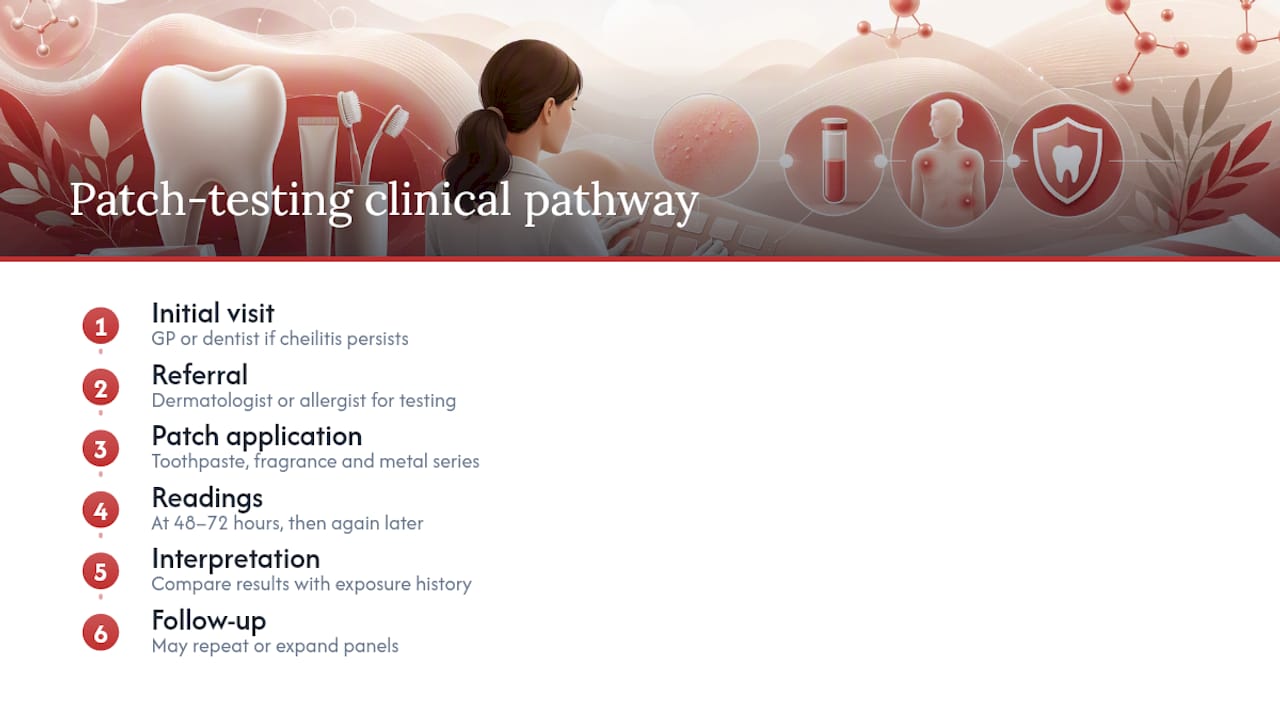
Testing has limits. A positive reaction to full-strength toothpaste can sometimes reflect irritation rather than true allergy, so results get interpreted alongside your exposure history. Some patients need repeated or expanded panels before a clear culprit emerges.
Treatment and Expected Recovery Timeline
Most cases improve within about two weeks of stopping the trigger, based on clinical guidance from DermNet NZ. That timeline assumes genuine avoidance, not just switching to a different mint flavor from the same fragrance family.
Persistent eczematous cheilitis sometimes needs a topical corticosteroid to calm inflammation faster than avoidance alone. Cases involving intra-oral mucosal symptoms occasionally call for specialist mouthwashes or, rarely, systemic therapy if the reaction is severe or widespread. Once patch testing identifies your specific allergen, the long-term plan is straightforward: strict avoidance, and getting that allergen documented in your medical records so future dentists and pharmacists know to flag it.
How to Choose a Safer Toothpaste and Prevent Recurrence
Start by reading the full ingredient list, not just the marketing copy on the front of the box. Where possible, choose products that specify their flavoring rather than burying it under a generic “flavor” line, and lean toward unflavored formulas or those built around a non-mint, non-cinnamon profile.
- Trial one new product at a time and keep a brief symptom diary for at least two weeks before judging whether it worked.
- If you’re sensitive to cinnamon or mint in food, expect possible cross-reactivity with the same compounds in toothpaste; DermNet NZ documents this overlap between food and oral-care allergens.
- Denture wearers should consider cleaning solutions as a possible source, too. Materials in dentures and their cleaning agents can harbor allergens that mimic a toothpaste reaction.
- Talk to a clinician before adding essential oils or other natural remedies to your routine. They carry their own allergy risk and can complicate an already sensitive picture.
Our guide on how to assess dental product safety walks through label red flags in more detail if you want a fuller checklist before your next purchase.
Expert Perspective and Resources for Sensitive Reactions
Stop-oralcare’s educational content is guided by Dr. Veronica Stahl, whose background in dentistry and natural medicine informs how the site frames ingredient safety and sensitivity. Her core message is consistent: allergic and irritant reactions to toothpaste are common enough that they deserve real diagnostic attention, not guesswork.
If you’re dealing with burning rather than a visible rash, our piece on why toothpaste burns your mouth covers a related but distinct set of triggers. Readers with intra-oral symptoms may also find our article on toothpaste and mouth ulcers useful for sorting out overlapping conditions.
One caution worth repeating: “natural” doesn’t mean automatically safe. Essential oils and plant-derived flavorings can sensitize skin just as readily as synthetic ones, so choosing a hemp or mineral-based formula, like some fluoride-free options on the market, still calls for the same patch-test caution and single-variable trial approach as any other switch.
A Note on Living With Toothpaste Sensitivity
Most toothpaste-related rashes are manageable once you know what to look for. The pattern usually isn’t mysterious: a sore, cracked mouth that tracks suspiciously well with one product. What surprises people is how long they’ll tolerate low-grade irritation before connecting it to their morning routine, sometimes for years, since sensitization can build gradually with repeated exposure rather than announcing itself on day one.
If your reaction keeps coming back after you’ve tried the obvious swaps, don’t keep guessing. Patch testing exists precisely because self-diagnosis with toothpaste ingredients is unreliable. Start with one fragrance-free change, track it for two weeks in a simple diary, and loop in a clinician if nothing improves. That’s a more reliable path than cycling through five different mint variants hoping one sticks.
— Veronica
This article is general information, not a substitute for advice from a qualified doctor. Consult a qualified healthcare professional about your own circumstances before acting on anything here.
Sources
- DermNet NZ: Contact reactions to toothpaste and other oral hygiene products
- Toothpaste Allergy Diagnosis and Management — PMC (NIH)
- PubMed: case reports and reviews noting toothpaste allergens
- American Dental Association — Toothpastes: Allergens and irritants