

TL;DR:
- Bioavailability in toothpaste refers to the fraction of an active ingredient that remains soluble and therapeutically effective in the oral cavity during and after brushing. It is influenced by formulation chemistry, ingredient interactions, and user behavior, rather than just total ingredient concentration. Technologies like bioadhesive polymers and sustained-release systems enhance bioavailability, making formulation choice more critical than ingredient percentages alone.
Bioavailability in toothpaste is defined as the fraction of an active ingredient that remains in soluble, therapeutically active form in the oral cavity during and after brushing. Total ingredient concentration printed on a label does not equal therapeutic effect. A toothpaste listing 1,450 ppm fluoride may deliver far less protective benefit than its label implies if formulation chemistry, ingredient interactions, or brushing habits reduce the amount of free, reactive fluoride available to act on enamel. Understanding this distinction is the foundation of informed oral care product selection.
What is bioavailability in toothpaste, and how is it measured?
Bioavailability is defined as the soluble portion of an active ingredient that remains therapeutically available in the oral environment, verified through analytical techniques including Ion-Selective Electrode (ISE) analysis and chromatography. These methods distinguish between total ingredient content and the fraction that is chemically free to interact with tooth surfaces, gingival tissue, and oral biofilm. The difference between these two values is clinically significant.
The concept applies to every class of active ingredient in oral care formulations. Fluoride compounds, hydroxyapatite particles, antimicrobial agents, and natural actives such as curcumin or botanical extracts all carry bioavailability profiles that differ substantially from their nominal concentrations. A product with a high listed concentration of any active may still underperform if that active is bound, complexed, or cleared before it can exert a therapeutic effect.
Bioavailability in oral care is not a single fixed property. It changes across the product’s shelf life, within the oral environment during brushing, and in response to individual physiological variables such as salivary pH and flow rate. Manufacturers who measure only total ingredient content at the point of formulation may be reporting a number that bears little relationship to what the consumer actually receives at the tooth surface.
Pro Tip: When evaluating a toothpaste’s efficacy claims, look for published data on free ion concentration or soluble active fraction rather than total ingredient percentage. These figures reflect actual bioavailability, not just formulation input.
How does toothpaste bioavailability work at the chemical level?
The mechanisms governing how does toothpaste bioavailability work are rooted in the chemistry of ingredient solubility, enzymatic activation, and the physical dynamics of the oral environment. Not all fluoride compounds, for example, behave identically once inside the mouth.
Sodium fluoride (NaF) dissociates rapidly in aqueous solution, releasing free fluoride ions almost immediately upon contact with saliva. Sodium Monofluorophosphate (SMFP), by contrast, is a covalently bonded compound that requires enzymatic cleavage by salivary alkaline phosphatase before it releases bioavailable fluoride ions. This enzymatic step introduces a biological variable: if salivary enzyme activity is low, SMFP-based toothpastes may deliver less free fluoride than NaF-based equivalents at the same nominal concentration. This distinction is rarely communicated to consumers.
Several factors govern the chemical bioavailability of actives during brushing:
- Solubility of the active compound: Ionic species like NaF dissolve readily; particulate actives like hydroxyapatite require surface contact and partial dissolution to release protective ions.
- Salivary pH and enzyme activity: Alkaline phosphatase activity, which is required to activate SMFP, varies between individuals and is influenced by systemic health and medication use.
- Formulation pH: The pH of the toothpaste slurry during brushing affects the ionization state of active ingredients and their affinity for enamel surfaces.
- Ingredient interactions: Calcium-containing excipients can complex with fluoride ions, reducing the free fluoride fraction before it reaches the tooth surface.
- Particle size and surface area: Smaller particles of hydroxyapatite or bioactive glass present greater surface area for dissolution and ion release, directly increasing bioavailability.
Formulation technology also determines how long an active remains in contact with oral tissues. Bioadhesive polymers, for instance, extend the residence time of active particles on enamel and gingival surfaces, increasing the window during which therapeutic ions can be absorbed. Without such technology, the majority of active ingredients are cleared by saliva within minutes of brushing.
What factors influence fluoride and active ingredient bioavailability?
The effects of bioavailability in toothpaste are shaped by both formulation variables and user behavior, and the interaction between these two categories determines real-world therapeutic outcomes.
-
Brushing duration and the absorption window. The absorption window for fluoride during brushing is approximately 2 minutes, after which the majority of free fluoride is diluted and cleared by saliva. This means that brushing for less than 2 minutes substantially reduces the amount of fluoride available for enamel remineralization. Consistent use over approximately 3 months is required to observe measurable clinical benefit, underscoring that bioavailability is not a single-event phenomenon.
-
Post-brushing rinsing behavior. Rinsing and salivary flow after brushing significantly reduce fluoride availability and thus therapeutic outcomes. Rinsing with water immediately after brushing removes residual fluoride from the oral cavity, cutting short the post-brush exposure period. Spitting without rinsing preserves a higher concentration of active ingredients on tooth surfaces.
-
Calcium-fluoride complexation. Calcium-containing dentifrices can complex with fluoride ions, reducing free fluoride concentration in the oral environment. This is a formulation-level factor that consumers cannot control through behavior. Products that combine calcium-based abrasives with fluoride salts may deliver less bioavailable fluoride than fluoride-only formulations, regardless of the labeled concentration.
-
Bioadhesive and particle technology. Surface modification and bioadhesive polymers are critical for maintaining particle adhesion to enamel during the short brushing cycle. Without these technologies, particulate actives such as hydroxyapatite are mechanically removed before they can release protective ions.
-
Salivary flow rate. High salivary flow dilutes active ingredients more rapidly, shortening the effective exposure period. Individuals with xerostomia (dry mouth) face a different challenge: reduced salivary enzyme activity may impair SMFP activation, while reduced flow may paradoxically extend contact time for ionic actives.
Pro Tip: To maximize bioavailability and fluoride absorption, spit after brushing but do not rinse with water. Allow residual toothpaste to remain on tooth surfaces for several minutes post-brush to extend the active ingredient exposure window.
How do different toothpaste formulations compare in bioavailability?
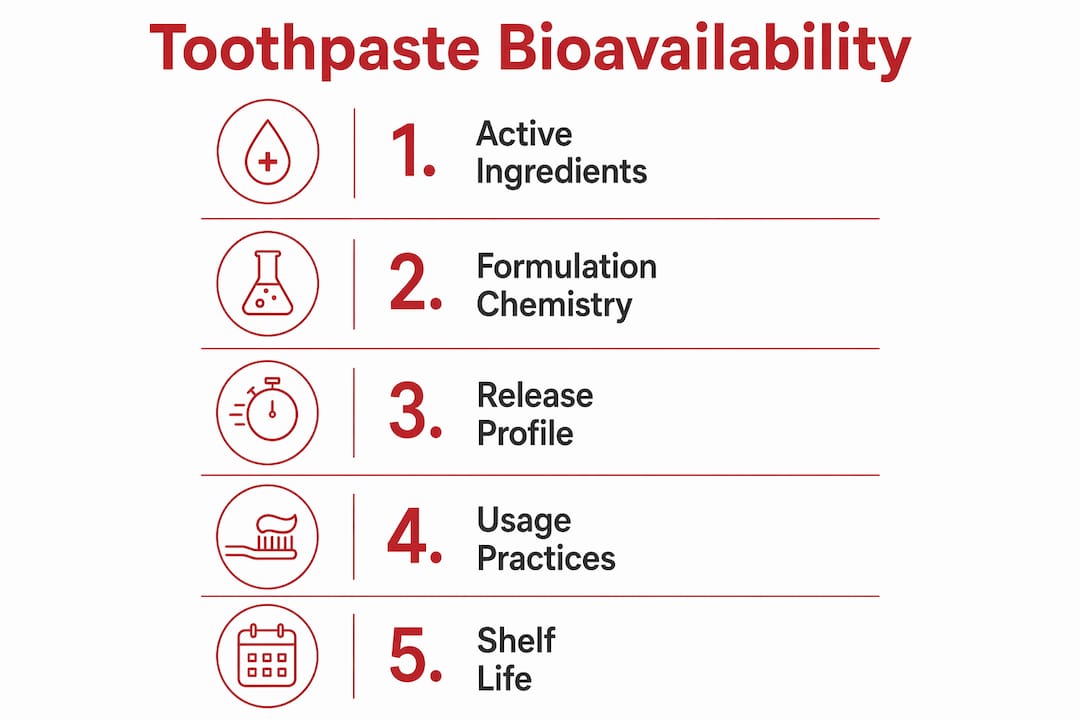
The importance of bioavailability in toothpaste becomes most apparent when comparing formulation categories side by side. Delivery technology, not ingredient concentration, determines which products provide superior enamel protection and therapeutic outcomes.
| Formulation type | Active release profile | Bioavailability characteristics | Key limitation |
|---|---|---|---|
| Sodium fluoride (NaF) | Immediate ionic release | High free fluoride, rapid availability | Cleared within minutes; no sustained release |
| Sodium Monofluorophosphate (SMFP) | Enzymatic activation required | Dependent on salivary alkaline phosphatase activity | Enzyme variability reduces predictability |
| Hydroxyapatite (HAp) | Particulate dissolution | Concentration-dependent; adhesion-limited | High concentration may reduce bioavailability due to insoluble complex formation |
| Bioactive glass | Sustained ionic release | Releases fluoride, calcium, and phosphate over 10 to 12 hours | Requires specific pH conditions for optimal dissolution |
| Fluoride-free botanical actives | Variable; hydrophobicity-limited | Low without nanoformulation technology | Rapid saliva clearance without delivery system |
Bioactive glass releases fluoride, calcium, and phosphate ions gradually over 10 to 12 hours, providing sustained bioavailability that extends well beyond the brushing period. This sustained release forms acid-resistant mineral layers on enamel, offering longer protection and measurable sensitivity reduction. The clinical advantage over conventional NaF formulations is not higher peak fluoride concentration but prolonged exposure at therapeutic levels.
Hydroxyapatite presents a different challenge. Increasing its concentration beyond a formulation threshold does not proportionally increase bioavailability. High concentration hydroxyapatite toothpaste may lose cleaning efficacy or cause abrasivity problems, and insoluble complex formation reduces the fraction of hydroxyapatite that can interact with enamel. Consumers who select products based on hydroxyapatite percentage alone may be misled by a metric that does not reflect therapeutic delivery.
For fluoride-free formulations, the bioavailability challenge is compounded by the hydrophobic nature of many natural actives. Products relying on botanical ingredients must address solubility and retention through formulation technology rather than concentration increases.
What technologies are improving bioavailability in toothpaste today?
Current research in oral care formulation focuses on extending the active ingredient exposure window and improving the solubility of compounds that are inherently difficult to deliver in an aqueous oral environment. Several technology platforms are advancing this field.
- Nanoformulations. Many natural actives like curcumin have low oral bioavailability due to hydrophobicity and rapid saliva clearance. Nanotechnology platforms including nanogels and micellar systems improve solubility, stability, and oral residence time for these compounds, substantially increasing their clinical potential. Curcumin encapsulated in nanomicelles, for example, demonstrates antimicrobial activity against oral pathogens that free curcumin cannot achieve at equivalent concentrations.
- Bioadhesive polymer systems. These polymers bind active particles to enamel and mucosal surfaces during brushing, extending contact time beyond the mechanical brushing period. They are particularly relevant for particulate actives like hydroxyapatite, where surface adhesion determines how much ion release occurs.
- Sustained-release bioactive glass. The absorption window is a critical bottleneck in conventional fluoride delivery. Sustained-release bioactive glasses bypass this limitation by gradually releasing protective ions over hours post-brushing, decoupling therapeutic benefit from the 2-minute brushing window.
- pH-optimized formulations. Buffering the toothpaste slurry to a pH range that maximizes active ion solubility and enamel affinity improves the fraction of active ingredient that reaches and binds to the tooth surface. This is particularly relevant for hydroxyapatite, whose dissolution rate is pH-dependent.
- Surface-modified particles. Coating active particles with agents that improve their dispersibility and adhesion in the oral environment addresses the physical clearance problem without requiring increased total ingredient concentration.
Understanding bioactive toothpaste formulations and the technologies behind them allows consumers to evaluate products on the basis of delivery science rather than ingredient lists alone.
Key takeaways
Bioavailability, not total ingredient concentration, determines whether a toothpaste delivers its stated therapeutic benefits to enamel and oral tissues.
| Point | Details |
|---|---|
| Bioavailability defined | The soluble, therapeutically active fraction of an ingredient, not its total concentration in the formula. |
| Absorption window | Free fluoride is available for approximately 2 minutes during brushing; post-brush rinsing eliminates residual benefit. |
| Ingredient interactions | Calcium-fluoride complexation and SMFP enzymatic requirements reduce bioavailable active fractions in specific formulations. |
| Sustained release advantage | Bioactive glass delivers protective ions over 10 to 12 hours, providing clinical benefit beyond the brushing period. |
| Technology over concentration | Bioadhesive polymers, nanoformulations, and pH optimization improve bioavailability more effectively than increasing ingredient percentages. |
Why bioavailability should drive your toothpaste decisions
From my perspective as a clinician and researcher in natural dentistry, the most persistent misconception I encounter is the belief that a higher percentage of any active ingredient guarantees a better product. It does not. Delivery technology determines whether an ingredient reaches the tooth surface in a form that can exert a therapeutic effect. A toothpaste with 15% hydroxyapatite that forms insoluble complexes in the oral environment is clinically inferior to one with 10% hydroxyapatite formulated with bioadhesive technology that maintains particle contact with enamel throughout the brushing cycle.
Brushing habits matter as much as formulation. The decision to rinse immediately after brushing is, from a bioavailability standpoint, a decision to discard a significant portion of the product’s therapeutic potential. Patients who spit without rinsing and brush for a full 2 minutes consistently demonstrate better fluoride retention in clinical observation, regardless of which toothpaste they use.
My recommendation is to approach marketing claims with the same skepticism applied to any scientific assertion. Ask whether the manufacturer has published data on free ion concentration or soluble active fraction. Ask whether the formulation includes a delivery technology that extends active ingredient residence time. The answers to those questions are more informative than any percentage listed on the packaging. For consumers exploring fluoride-free alternatives, the same principle applies: the bioavailability of botanical and mineral actives depends entirely on how the product is formulated, not on the presence of a natural ingredient list.
— Veronica
How Stop-oralcare addresses bioavailability in oral care formulation
Stop-oralcare develops fluoride-free oral care products formulated with hemp-derived actives and Dead Sea minerals, with bioavailability as a central design criterion. The formulations are developed to address the solubility and retention challenges that limit the efficacy of natural actives in conventional toothpaste formats. Rather than relying on high ingredient concentrations, Stop-oralcare’s approach prioritizes delivery technology that extends active ingredient contact with oral tissues beyond the brushing window. Consumers seeking scientifically grounded alternatives to conventional fluoride toothpaste can explore the full product range and supporting research at Stop-oralcare. For a deeper understanding of how bioactive ingredients improve outcomes for sensitive teeth and enamel protection, the Stop-oralcare blog provides peer-referenced clinical context alongside product information.
FAQ
What is bioavailability in toothpaste?
Bioavailability in toothpaste is the fraction of an active ingredient, such as fluoride or hydroxyapatite, that remains in soluble, therapeutically active form in the oral cavity during and after brushing. It is measured using techniques like Ion-Selective Electrode analysis and is distinct from total ingredient concentration.
Does a higher fluoride concentration mean better bioavailability?
Not necessarily. Calcium-fluoride complexation and post-brush rinsing can substantially reduce free fluoride availability regardless of the labeled concentration. Formulation design and user behavior determine actual bioavailability and fluoride absorption more than the nominal ppm value.
How does SMFP differ from sodium fluoride in bioavailability?
Sodium fluoride releases free fluoride ions immediately upon contact with saliva, while SMFP requires enzymatic cleavage by salivary alkaline phosphatase to become bioavailable. This enzymatic dependency makes SMFP’s bioavailability variable across individuals with differing salivary enzyme activity.
Can fluoride-free toothpastes achieve meaningful bioavailability?
Yes, provided the formulation includes delivery technologies that address the solubility and retention limitations of natural actives. Nanoformulations, bioadhesive polymers, and pH-optimized systems can substantially improve the bioavailability of botanical and mineral actives in fluoride-free products.
What is the most effective way to maximize toothpaste bioavailability?
Brush for a full 2 minutes to utilize the complete absorption window, and spit without rinsing afterward to preserve residual active ingredients on tooth surfaces. Selecting a formulation with bioadhesive or sustained-release technology further extends the therapeutic exposure period beyond brushing.