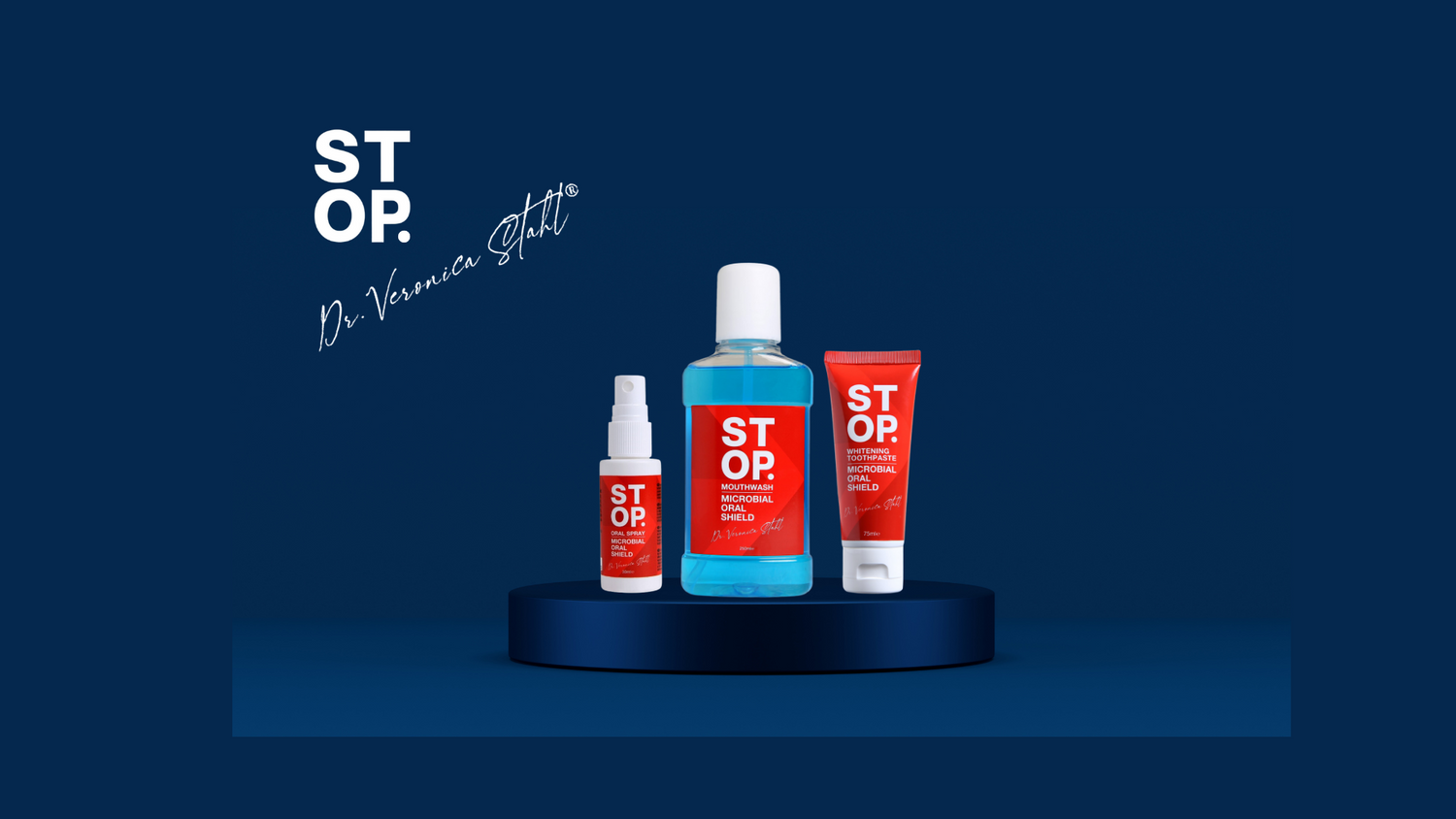


The evidence linking alcohol-based mouthwash to head and neck cancer remains inconclusive, but pooled data show a modest, measurable risk increase among long-term and frequent users, particularly those who also smoke or drink heavily. Switching to an alcohol-free formula costs nothing in oral health benefit and removes one plausible variable from the equation, making it a reasonable, low-cost precaution rather than a proven necessity.
TL;DR:
- Long-term, frequent use of alcohol-based mouthwash over decades, especially more than once daily for over 35 years, shows a small but measurable increase in head and neck cancer risk.
- Casual or occasional mouthwash use does not appear to significantly elevate cancer risk according to large pooled analyses and recent studies.
- Switching to alcohol-free mouthwash eliminates the ethanol-to-acetaldehyde pathway, removing the plausible, though unproven, carcinogenic link without compromising oral health benefits.
- Effective alcohol-free mouthwashes use active ingredients like cetylpyridinium chloride or reformulated essential oils, with transparent labeling and clinical backing.
- Mouthwash remains a supporting oral hygiene tool; quitting smoking, moderating alcohol intake, and maintaining daily brushing and flossing are far more impactful for oral cancer risk reduction.
Table of Contents
- Alcohol Free Mouthwash Cancer Risk: What the Research Actually Shows
- How Alcohol in Mouthwash Could Plausibly Raise Cancer Risk
- Why the Alcohol Mouthwash Cancer Link Isn’t Fully Settled
- Are Alcohol-Free Mouthwash Formulas a Safer Bet?
- How to Choose and Use Alcohol-Free Mouthwash Safely
- Why Stop-oralcare Takes an Evidence-First Approach to Formulation
- A Cautious Recommendation, Not a Verdict
- A Simple, Alcohol-Free Switch Worth Making Today
- Where to Read the Research Yourself
- Sources
- FAQ
Alcohol Free Mouthwash Cancer Risk: What the Research Actually Shows
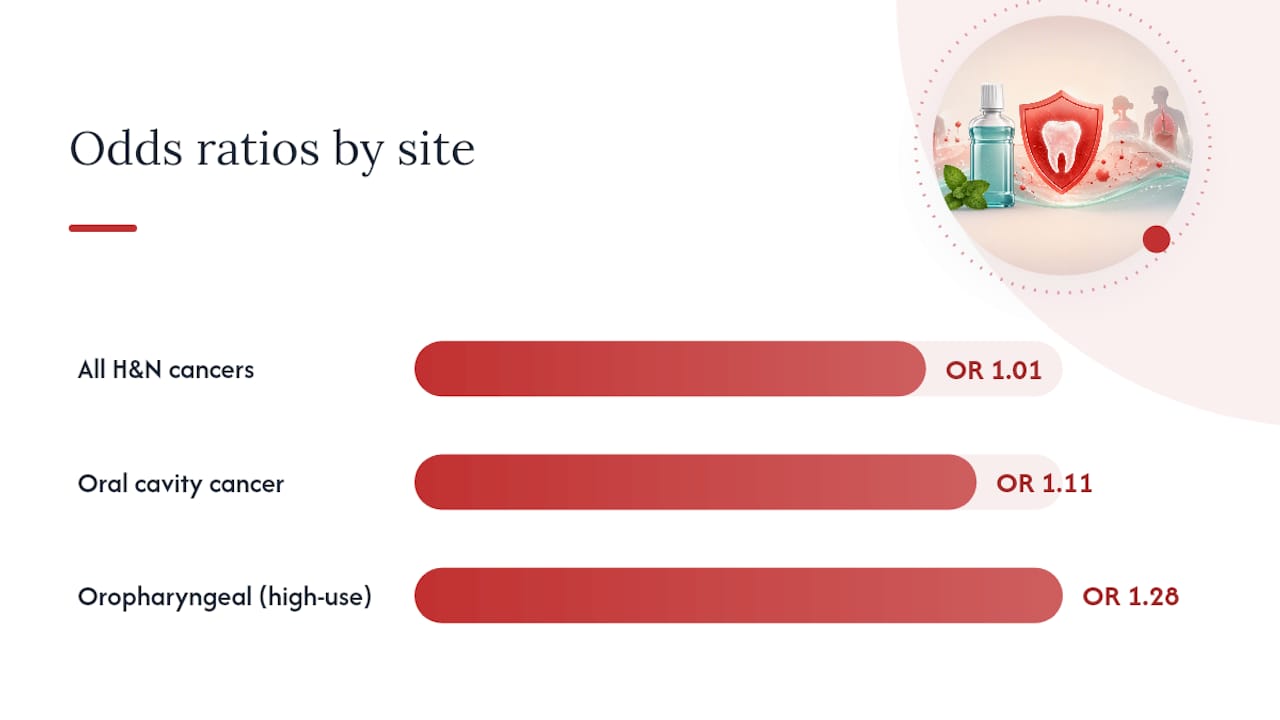
The largest and most frequently cited dataset on this question comes from the International Head and Neck Cancer Epidemiology Consortium, known as INHANCE. Its pooled analysis of 8,981 cases and 10,090 controls across 12 studies (https://pmc.ncbi.nlm.nih.gov/articles/PMC4752930/) found no elevated risk for head and neck cancer overall among people who had ever used mouthwash, with an odds ratio of 1.01, essentially indistinguishable from no effect. That headline number is where a lot of casual reporting stops, and it’s also where the real story gets buried.
Break the data down by cancer site and the picture shifts. The same INHANCE analysis found an odds ratio of 1.11 for cancer of the oral cavity and 1.28 for oropharyngeal cancer, with the highest risk concentrated in people who had used mouthwash for more than 35 years or more than once a day. An odds ratio of 1.28 means those long-term, high-frequency users showed a modestly higher odds of oropharyngeal cancer compared to non-users, a small signal, not the kind of risk multiplier you’d see with heavy smoking or tobacco combined with alcohol.
More recent work complicates rather than clarifies the picture. A 2023 review of 15 to 17 studies covering tens of thousands of participants found mixed results: no robust association for casual or occasional mouthwash use, but small, statistically significant increases in risk for people using mouthwash three or more times daily or for multiple decades. The effect sizes were marginal, and the studies included varied enough in design and population that pooling them produced meaningful heterogeneity, the statistical term for “these studies don’t quite agree with each other.”
That heterogeneity matters more than it sounds. When 15 studies from different countries, using different questionnaires, different control groups, and different definitions of “regular use,” get combined into one meta-analysis, a small average effect can hide a lot of underlying disagreement between individual studies. Some show no association at all. A few show a stronger one. None of them, individually, would be enough to call the case closed.
The numbers at a glance:
- Overall mouthwash use (any frequency): OR 1.01 for all head and neck cancers, no meaningful association
- Oral cavity cancer specifically: OR 1.11, a small increase
- Oropharyngeal cancer specifically: OR 1.28, the largest signal in the INHANCE data
- Highest-risk subgroup: more than 35 years of use, more than once daily
- Recent meta-analyses: mixed, with small significant increases only in the most frequent, longest-duration users
The pattern that keeps showing up: across multiple independent analyses, the risk signal isn’t in casual, occasional mouthwash use. It concentrates almost entirely in people using it multiple times a day for decades, which is a very different exposure profile than the average person rinsing once after brushing.
The American Cancer Society’s guidance frames this cautiously, noting that some studies suggest high-alcohol mouthwash might be linked to oral and oropharyngeal cancer risk, but that the research is complicated by confounding factors that are hard to fully separate out. That caution, from a major public health authority rather than a single study author, is worth taking seriously in both directions: it doesn’t dismiss the signal, but it doesn’t validate it as settled science either.
Diet plays a role too, and it’s rarely mentioned alongside mouthwash research. A meta-analysis on protective lifestyle factors found that regular fruit and vegetable intake is associated with meaningfully reduced head and neck cancer risk, a reminder that oral cancer risk is a composite of many exposures, not a single-variable problem that mouthwash choice alone determines.
How Alcohol in Mouthwash Could Plausibly Raise Cancer Risk
The mechanism researchers point to most often is acetaldehyde, a byproduct created when ethanol gets metabolized. Bacteria naturally present in the mouth, along with enzymes in saliva, convert alcohol into acetaldehyde almost immediately on contact. The International Agency for Research on Cancer classifies acetaldehyde as a Group 1 carcinogen when associated with alcohol consumption, meaning there’s sufficient evidence linking it to cancer in humans through this exact metabolic pathway.
Small clinical and laboratory studies back up the biological plausibility. A systematic review of alcohol-based mouthwash as an oral cancer risk factor documented transient spikes in salivary acetaldehyde after exposure to alcohol-containing rinses, along with genotoxic signals, meaning visible cellular damage, in exfoliated oral cells in a handful of small sample studies. These aren’t large-scale human trials proving cancer causation. They’re mechanistic snapshots showing that the chemistry researchers worry about actually happens at the cellular level after rinsing.
What separates someone at negligible risk from someone in a genuinely higher-risk category comes down to a short list of modifiers:
- Frequency: rinsing more than once or twice daily multiplies cumulative exposure to acetaldehyde over the course of a year.
- Duration: the INHANCE data specifically flagged more than 35 years of regular use as the threshold where risk became more apparent.
- Smoking: tobacco introduces its own carcinogens, and alcohol has a documented role in helping DNA-damaging chemicals from tobacco penetrate oral tissue more easily, according to the American Cancer Society.
- Heavy drinking: combining alcohol-based mouthwash with regular alcohol consumption compounds total ethanol exposure to oral tissue rather than adding two separate, unrelated risks.
- Rinsing technique: how you use the product matters more than most people assume.
That last point deserves its own explanation. Research on rinsing technique and contact time found that failing to dilute mouthwash, or leaving residue in the mouth rather than following with water, extends the amount of time oral tissue stays in contact with ethanol and its byproducts. Longer contact time means more opportunity for that acetaldehyde conversion to happen against the cells lining your mouth and throat.
Pro Tip: If you use an alcohol-based rinse and aren’t ready to switch, cut contact time by rinsing with plain water for a few seconds immediately after. It won’t eliminate the exposure, but it reduces how long ethanol and its byproducts sit against oral tissue.
None of this proves that mouthwash alone causes cancer. It explains why researchers keep investigating the question instead of dismissing it outright, and why the risk, where it appears, clusters so tightly around heavy, prolonged use combined with other exposures.
Why the Alcohol Mouthwash Cancer Link Isn’t Fully Settled
Every study cited above comes with caveats that responsible researchers flag explicitly, and they’re worth understanding before you draw a firm conclusion in either direction.
- Most studies rely on retrospective recall. Case-control designs ask people, often years after a cancer diagnosis, to remember how often they used mouthwash decades earlier. Memory is unreliable, and people with a cancer diagnosis may recall past habits differently than healthy controls, a well-documented phenomenon called recall bias.
- Confounding variables are hard to fully separate. Reviews of the mouthwash-cancer literature note that heavy mouthwash users often overlap with smokers, heavy drinkers, or people managing existing oral health problems like gum disease or dry mouth. Any of those factors could independently drive cancer risk, making it difficult to isolate mouthwash as the actual cause rather than a marker of other behaviors.
- Ingredient reporting is inconsistent. Because mouthwash is regulated as a cosmetic product in many jurisdictions rather than a drug, labeling requirements don’t always mandate detailed disclosure of alcohol concentration. Studies conducted decades apart may be comparing products with meaningfully different ethanol content without realizing it.
- Selection bias affects who gets studied. People willing to participate in detailed retrospective interviews about oral hygiene habits may differ systematically from the general population in ways researchers can’t fully control for.
- No large prospective cohort study has settled the question. Nearly all the strongest data comes from case-control designs, which look backward from diagnosis. A prospective cohort, following healthy people forward over decades while tracking mouthwash habits, alcohol use, and smoking status independently, would offer far stronger causal evidence. That study largely doesn’t exist yet at the scale needed.
That combination of limitations is exactly why the American Cancer Society and researchers publishing on this topic describe the link as suggestive rather than proven. It’s a real signal worth taking seriously, filtered through study designs that can’t fully separate mouthwash from the other habits that tend to travel alongside it.
Are Alcohol-Free Mouthwash Formulas a Safer Bet?
Alcohol-free mouthwash sidesteps the entire ethanol-to-acetaldehyde pathway simply by not introducing ethanol into the mouth in the first place. That doesn’t automatically make every alcohol-free product equally effective, since the antimicrobial and breath-freshening job that alcohol used to do in older formulas now falls to a different active ingredient. Get the choice right, and you avoid the ethanol question entirely without giving up antiplaque or antibacterial performance.
Several actives have real evidence behind them as alcohol alternatives:
- Cetylpyridinium chloride (CPC), an antimicrobial compound shown to reduce plaque and gingivitis in clinical trials without relying on ethanol as a delivery solvent.
- Reformulated essential oil systems, which use micellar or solubilized delivery methods to achieve antibacterial action similar to older alcohol-based essential oil rinses.
- Short-term chlorhexidine rinses, used under dental supervision for specific conditions like post-surgical care, though not intended for daily long-term use due to staining and taste alteration.
- Fluoride rinses, aimed specifically at cavity prevention rather than antimicrobial action, useful as a targeted addition rather than a general daily rinse.
Formulation chemistry explains why this swap works without sacrificing efficacy. Antimicrobial actives need a solvent to stay stable and distribute evenly through a liquid rinse. Alcohol has historically been the cheapest, most available solvent for that job, but propylene glycol, glycols, and solubilized delivery systems can carry the same active ingredients effectively while eliminating ethanol content entirely.
Reality check on “alcohol-free” claims: removing alcohol doesn’t automatically make a formula gentle. Some alcohol-free rinses substitute in other irritants, high concentrations of certain essential oils, or aggressive preservatives, that can still cause burning, dry mouth, or mucosal irritation in sensitive users. “Alcohol-free” describes one ingredient removed, not a guarantee of a mild formula overall.
A short checklist for evaluating any alcohol-free mouthwash before you buy:
- The active ingredient and its intended purpose (plaque control, gum health, whitening) are clearly stated on the label.
- The concentration of active ingredients is disclosed rather than hidden behind a generic “proprietary blend.”
- The formula avoids common irritants known to bother sensitive mouths, like high-percentage essential oils or harsh preservatives.
- It’s positioned as suitable for dry mouth or sensitive tissue if that’s a concern for you specifically.
- Some form of clinical or published research backs the active ingredient’s effectiveness, rather than resting on marketing language alone.
Choosing based on that list, rather than the word “natural” or “alcohol-free” on the front label, is what actually separates an effective swap from a lateral move to a different set of problems. For readers dealing specifically with chronic dry mouth, a guide to alcohol-free options built for that issue walks through additional formulation considerations worth knowing before you switch.
How to Choose and Use Alcohol-Free Mouthwash Safely
Making the switch is straightforward, but a few practical habits determine whether you actually get the benefit you’re switching for.
- Confirm the label says alcohol-free, not just “gentle” or “sensitive.” Those marketing terms aren’t regulated the same way, and a product can call itself sensitive while still containing ethanol.
- Look for a named active ingredient with a stated purpose. CPC for plaque and gum health, fluoride for cavity prevention, or a specific essential oil blend with disclosed concentrations are all better signals than a vague “freshens breath” claim.
- Follow the labeled frequency, typically once or twice daily. More isn’t better here. Overusing any mouthwash, alcohol-free or not, can disrupt the natural bacterial balance in your mouth or irritate tissue unnecessarily.
- Never substitute mouthwash for brushing and flossing. Rinsing removes surface bacteria and freshens breath temporarily; it doesn’t remove plaque mechanically the way a toothbrush and floss do. Mouthwash is a supplement to your routine, not a replacement for it.
- Don’t use mouthwash to mask tobacco-related odor as a substitute for quitting. This sounds obvious written out, but it’s a common pattern, and it does nothing to address the actual carcinogenic exposure from smoking that mouthwash can’t touch.
- Consider a water rinse afterward if residue concerns you. This is a low-effort habit that reduces prolonged contact time with any active ingredient, alcohol-based or not.
Pro Tip: Keep a small notebook (or a note on your phone) of any mucosal changes, persistent ulcers, or unusual soreness that lasts more than two weeks. Most mouth irritation resolves on its own, but anything sitting past that window is worth mentioning at your next dental visit, not waiting on.
That last point matters more than most people give it credit for. Persistent mouth ulcers, unexplained white or red patches, or soreness that doesn’t resolve within two weeks are exactly the kind of changes a dentist or physician should evaluate directly, since early-stage oral cancer can sometimes present in ways that look deceptively like a routine canker sore. If you have a complex medical history involving prior cancer, immunosuppression, or heavy tobacco and alcohol use together, that’s also a reasonable trigger to loop in a professional rather than self-managing with over-the-counter products alone. For readers wanting a deeper look at safe frequency ranges specifically, a guide on mouthwash frequency covers that in more detail.
Why Stop-oralcare Takes an Evidence-First Approach to Formulation
A product development philosophy shaped around avoiding unnecessary ethanol exposure aims to deliver measurable oral health benefits. Given the mechanistic plausibility around acetaldehyde formation and the modest but real risk signals in long-term, frequent users, formulating without alcohol from the outset is a defensible, precautionary design choice rather than a marketing gimmick.
A line of products uses hemp-derived compounds and Dead Sea minerals as the primary active ingredients instead of ethanol as a solvent or antimicrobial base, targeting plaque reduction, gum inflammation, and sensitivity without introducing the alcohol variable discussed above.
What that looks like in practice:
- Formulated around naturally derived actives instead of conventional solvent systems.
- Ingredient transparency is considered an important feature.
- Formulations aim to support sensitive tissue and gum health.
Readers who want to dig into the ingredient science behind that approach can review a breakdown of which oral care ingredients actually hold up under evidence, and those specifically motivated by irritation or sensitivity concerns can read more on the reasons people make the alcohol-free switch.
A Cautious Recommendation, Not a Verdict
If you’re weighing whether to switch, my honest read of this evidence is that alcohol-free mouthwash is the more sensible default for most people, not because the cancer link is proven, but because the potential downside of switching is essentially zero. You lose nothing in oral health effectiveness by choosing a well-formulated alcohol-free rinse with a disclosed active ingredient, and you remove one plausible variable from a risk equation that researchers themselves admit isn’t fully resolved.
Where I’d push back on overreaction: don’t let mouthwash choice distract from the habits that move the needle far more, quitting smoking, moderating alcohol intake generally, and keeping up with brushing, flossing, and regular dental checkups. Mouthwash is a supporting player in oral cancer risk, not the lead.
— Veronica
A Simple, Alcohol-Free Switch Worth Making Today
If the checklist above left you looking for a formula that actually checks every box, ingredient transparency, no alcohol, no fluoride, and actives designed for sensitive tissue, The lineup was built around that standard rather than retrofitted to claim it.
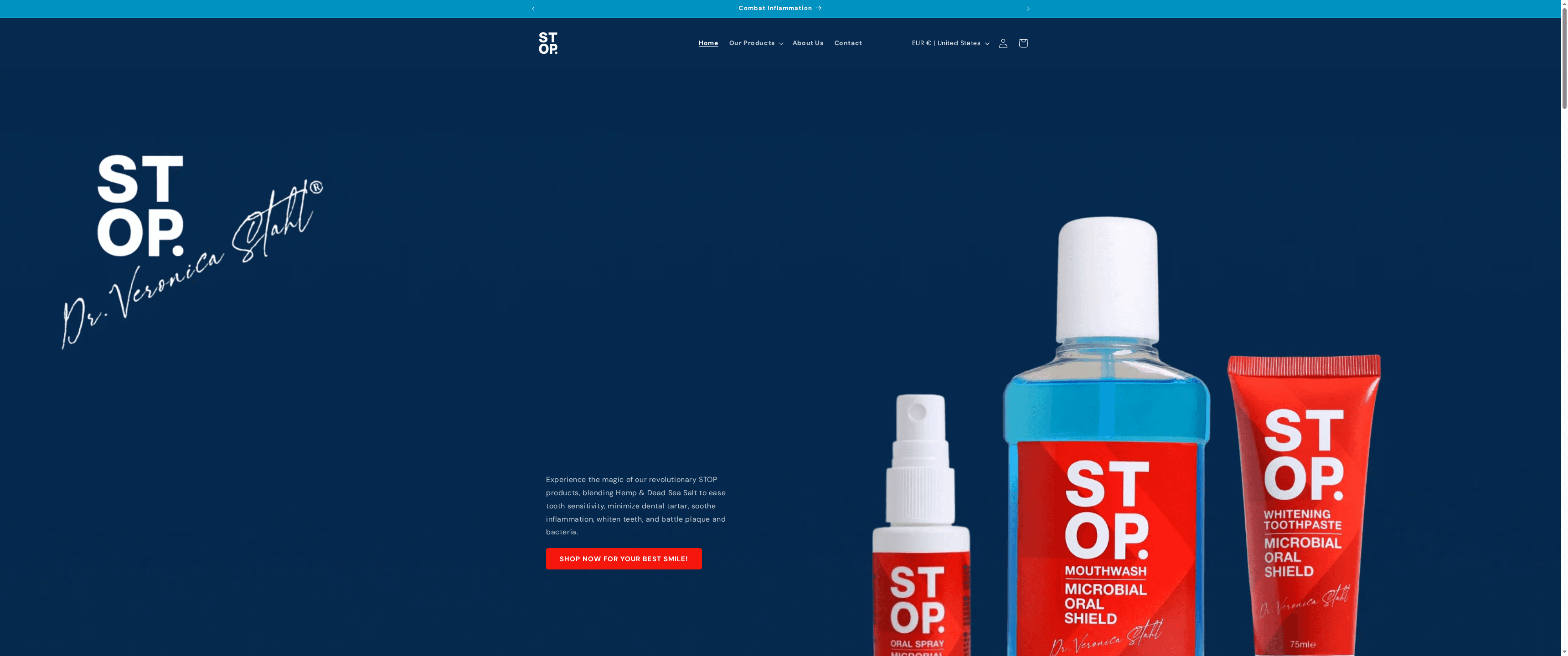
The STOP Mouthwash uses hemp-derived compounds and Dead Sea minerals instead of ethanol, with the active ingredients and purpose stated plainly rather than buried in a proprietary blend. Current prices are available on the website. It pairs naturally with the STOP Protective & Whitening Toothpaste, for readers who want their full routine built on the same fluoride-free, alcohol-free foundation. Current prices are available on the website. A protective oral spray is also available for those who want a quick, alcohol-free touch-up between rinses. Current prices are available on the website.
None of these products claim to prevent cancer, and no honest formulation would. What they offer is a straightforward way to remove ethanol from your daily oral care routine without giving up plaque control or gum support. If that’s the precaution you’ve been looking to take after reading through the research above, the full lineup is available now at Stop-oralcare.
Where to Read the Research Yourself
- The INHANCE pooled analysis remains the largest single dataset on mouthwash and head and neck cancer, combining nearly 9,000 cases and 10,000 controls across a dozen studies.
- The 2023 systematic review and meta-analysis shows why more recent literature still produces mixed, heterogeneous results depending on which studies get included.
- The American Cancer Society’s guidance page offers the clearest public-facing summary of how alcohol, tobacco, and mouthwash interact as combined risk factors.
This article is general information, not a substitute for advice from a qualified doctor. Consult a qualified healthcare professional about your own circumstances before acting on anything here.
Sources
- Meta-analyses reporting mixed results on mouthwash use and oral cancer risk (2023 review)
- Oral Cavity and Oropharyngeal Cancer Causes, Risk Factors, and Prevention | American Cancer Society
FAQ
Are alcohol-free mouthwashes safe to use daily?
Yes, when used as labeled, typically once or twice daily. Alcohol-free formulas avoid the ethanol-to-acetaldehyde pathway entirely, though any mouthwash should supplement, not replace, brushing and flossing.
Is alcohol-based mouthwash a real risk factor for oral cancer?
The strongest pooled data show a small increased risk, an odds ratio of 1.28 for oropharyngeal cancer, concentrated in people using it more than once daily for over 35 years, according to the INHANCE analysis. Occasional or moderate use hasn’t shown a comparable signal.
Can mouth cancer look like a common mouth ulcer?
Yes, early oral cancer can present as a sore, lesion, or white or red patch that resembles a routine ulcer but fails to heal within two weeks. Any mouth sore lasting longer than that window warrants a dental or medical evaluation rather than continued self-treatment.
What mouthwash is considered a safer choice regarding cancer risk?
An alcohol-free formula with a disclosed, evidence-backed active ingredient, such as CPC or a reformulated essential oil system, avoids the ethanol exposure researchers have flagged as a plausible contributing factor. An alcohol-free mouthwash formulated using hemp-derived compounds and Dead Sea minerals in place of ethanol is available.