

Most tea stains sit on the enamel surface, not inside it, so they respond well to consistent home care. Rinse with water right after your last sip, wait 30 to 60 minutes before brushing, and use a gentle whitening toothpaste daily. If discoloration persists after several weeks, a hygienist cleaning removes buildup that toothpaste alone cannot touch.
TL;DR:
- Rinsing with water immediately after tea and waiting 30 to 60 minutes before brushing helps prevent softening enamel from allowing stains to set.
- Using a gentle whitening toothpaste consistently over weeks is more effective than temporary or aggressive remedies for removing tea stains.
- Black tea causes the most staining due to higher tannin content, while herbal and green teas generally leave lighter pigmentation.
- Drinking hot tea accelerates staining because heat opens enamel pores and increases tannin bonding, making cool or iced tea slightly less staining.
- Regular professional cleanings and avoiding frequent sipping throughout the day help keep surface stains from reaccumulating.
Table of Contents
- Why Does Tea Stain Teeth?
- Everyday Prevention Habits That Stop Tea Stains From Building
- At-Home Stain Removal Methods That Actually Work
- When Should You See a Dental Professional for Tea Stains?
- An Enamel-Safe Approach to Tea Stains
- Does Tea Temperature Change How Much It Stains?
- Do Black, Green, and Herbal Teas Stain Differently?
- How Does Saliva Affect Tea Stains?
- What Other Foods and Drinks Stain Teeth Like Tea Does?
- How Do You Keep Teeth From Re-Staining Long Term?
- Practical Takeaways for Regular Tea Drinkers
- A Gentle Whitening Routine That Fits Your Tea Habit
- Sources
- FAQ
Why Does Tea Stain Teeth?
Tea contains tannins, which are polyphenol compounds that latch onto microscopic grooves in tooth enamel. Black tea carries the highest tannin load, but green and herbal varieties contribute their own chromogens, the pigmented molecules that give stains their color. Enamel isn’t perfectly smooth under magnification; it has ridges and pores that act like a net for these pigments, which is why the same cup of tea stains one person’s teeth faster than another’s.
The distinction that matters most is extrinsic versus intrinsic staining:
- Extrinsic stains sit on the enamel surface and come from what you eat and drink. These respond to whitening toothpaste, cleanings, and bleaching.
- Intrinsic stains develop inside the tooth structure, often from aging, certain medications, or old trauma. Whitening products barely touch these.
Enamel that’s been softened by acidic drinks grabs pigment more readily, and enamel naturally thins with age, which makes tea stains look more pronounced in older adults even when their tea habits haven’t changed.
Everyday Prevention Habits That Stop Tea Stains From Building
Small adjustments to how you drink tea matter more than any whitening product you’ll buy later. Cleveland Clinic and Mayo Clinic both point to prevention habits like rinsing and limiting exposure time as the foundation of any stain-control routine, well before whitening products enter the picture.
- Rinse with plain water immediately after finishing your cup, or chew sugar-free gum if water isn’t handy. This clears tannins before they settle into enamel grooves.
- Add milk or another dairy product when it fits your taste. The proteins bind to tannins and reduce how much pigment reaches your teeth. Non-dairy creamers don’t offer the same binding effect, so they won’t help much here.
- Use a straw for iced tea. It routes the liquid past your front teeth, which are the ones people notice first.
- Finish your tea in one sitting rather than sipping across a whole afternoon. Constant low-level exposure does more damage than one concentrated serving, because your teeth never get a break from the tannins.
- Wait 30 to 60 minutes before brushing. Tea’s mild acidity softens enamel temporarily, and brushing too soon can wear down that softened layer instead of just cleaning it. This guidance echoes broader dental advice on enamel erosion timing.
- Book a hygienist cleaning on a regular schedule, every six months for most people, more often if you drink several cups a day.
Pro Tip: Keep a travel toothbrush and a small tube of fluoride toothpaste in your bag if you drink tea away from home. Brushing on your normal schedule, rather than skipping until evening, keeps stains from compounding day after day.
At-Home Stain Removal Methods That Actually Work
Whitening toothpaste is the most realistic starting point for daily tea drinkers. These formulas use mild abrasives and sometimes low concentrations of peroxide to lift surface pigment, and most people see visible improvement within two to six weeks of consistent twice-daily brushing. Don’t expect overnight results. A 2024 comparative study found that peroxide-and-abrasive commercial whitening pastes reduced tea-induced stains more effectively than certain papain-based organic alternatives, which is worth knowing if you have been drawn to enzyme-based “natural” pastes expecting equal results.
Baking soda can help in moderation, but it needs a light hand:
- Mix a small amount with water into a loose paste, never use it dry or undiluted.
- Limit use to one or two times a week. Daily use wears down enamel over time.
- Skip it entirely if you already have sensitivity or thin enamel.
Oil pulling, activated charcoal, and rubbing fruit on your teeth are popular online, but the evidence behind them is thin at best. Charcoal in particular carries a real abrasion risk with frequent use, since its gritty texture can scratch enamel rather than polish it.
Over-the-counter strips and dentist-prescribed trays occupy different tiers of strength. Cleveland Clinic notes that OTC products carry lower bleaching concentrations than professional treatments, which means slower, milder results but a lower risk profile for unsupervised use.
The one rule that overrides all of these: never brush immediately after an acidic drink, tea included. Rinse with water instead and let your saliva neutralize the acid before you introduce a toothbrush.
When Should You See a Dental Professional for Tea Stains?
A hygienist cleaning, technically called scaling and polishing, removes surface stains and hardened tartar that no toothpaste can reach on its own. This is the first stop for most tea drinkers whose stains have crept past what daily brushing controls.
In-office bleaching and dentist-prescribed trays use much higher peroxide concentrations than anything sold over the counter, which is why NHS guidance frames dentist-supervised whitening as safer and generally more effective than unsupervised methods. Laboratory research backs this up from a different angle: combining chemical pretreatments like oxalic acid or sodium hypochlorite with bleaching gel improved correction of tea-induced discoloration compared with bleaching alone, though this kind of layered protocol belongs in a clinical setting, not a bathroom counter.
Watch for these red flags that call for a professional exam rather than another whitening product:
- Gray or brown discoloration that doesn’t match typical surface staining
- Tooth sensitivity that appears or worsens during whitening attempts
- Fillings, crowns, or veneers that won’t lighten along with natural teeth
Most professional whitening results last several months to a couple of years depending on your tea habits, with touch-up cleanings recommended regularly to maintain them.
An Enamel-Safe Approach to Tea Stains
Regular tea drinkers don’t need to choose between their habit and a bright smile; they need a routine that respects enamel while still targeting surface pigment. That means favoring gentle, low-abrasion formulas over harsh scrubs, and treating aggressive DIY hacks, charcoal especially, as something to use rarely if at all.
A sustainable stain-management plan starts with what you do in the first hour after drinking tea, not with what whitening product you eventually buy. Rinse first, wait before brushing, then let a gentle formula do its work over weeks, not days.
Readers looking for a structured version of this can follow the natural teeth whitening workflow that Stop-oralcare outlines for daily use, escalating to a hygienist or dentist when stains resist several weeks of consistent care.
— Veronica
Does Tea Temperature Change How Much It Stains?
Hot tea stains faster than iced tea, largely because heat opens the pores in enamel slightly and speeds up how quickly tannins bind to the tooth surface. Cold tea moves through the mouth faster too, especially when sipped through a straw, which cuts down contact time with your front teeth.
Temperature also affects how tannins release from tea leaves in the first place. Steeping black tea at near-boiling temperatures pulls more tannins into the water than a cooler brew does, which means a strong hot cup carries a heavier pigment load than the same tea served over ice. Iced tea made from a concentrate, on the other hand, can still stain heavily if it’s brewed hot before chilling.
None of this means switching to iced tea eliminates the problem. It just shifts the odds slightly in your favor. If you’re a committed hot-tea drinker, the temperature factor is one more reason to rinse immediately rather than letting a warm, tannin-rich film sit on your teeth between cups. Letting tea cool for a few minutes before drinking won’t meaningfully change staining, since the tannins are already dissolved in the water by the time it reaches your cup.
Do Black, Green, and Herbal Teas Stain Differently?
Black tea is the heaviest stainer of the three because it undergoes full oxidation during processing, which concentrates tannins and darkens the leaf. Green tea is only lightly oxidized, so it carries fewer tannins and tends to leave a lighter, yellowish tint rather than the deeper brown associated with black tea. Herbal teas vary widely since they’re not true tea leaves at all. Hibiscus and berry-based blends can stain surprisingly hard because of their intense natural pigments, while chamomile and mint blends leave minimal residue.
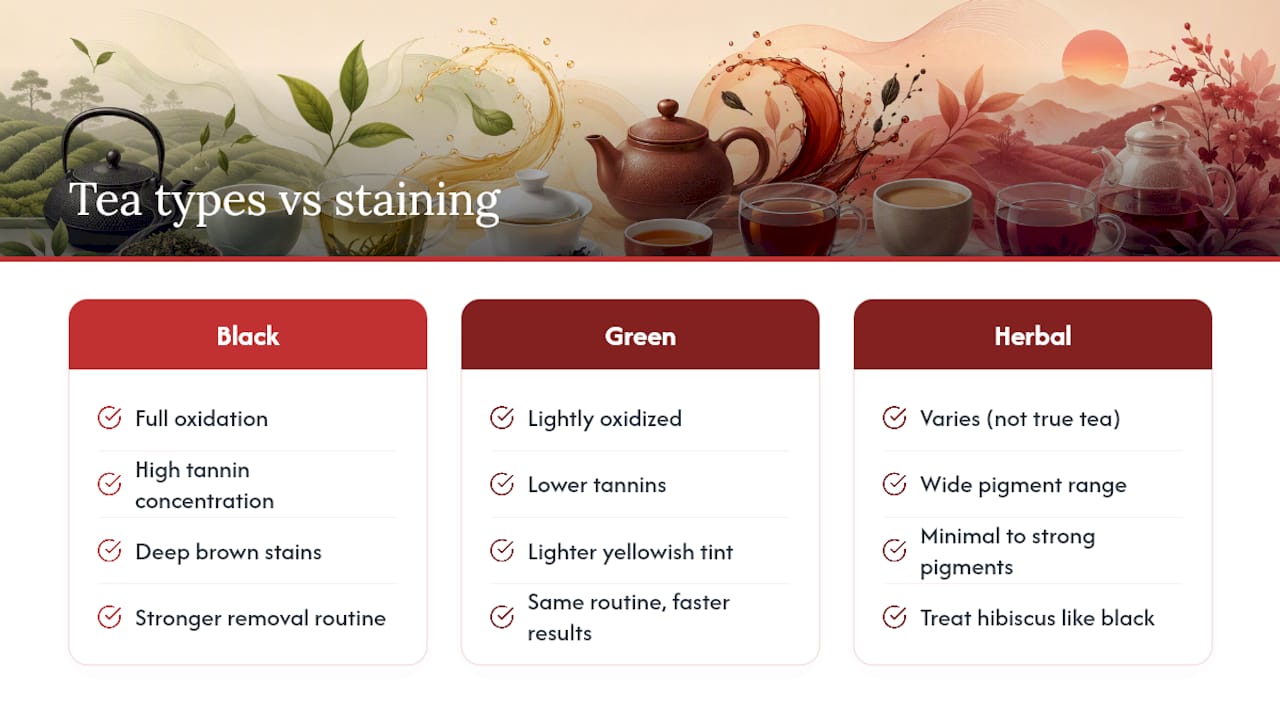
The removal approach doesn’t need to change dramatically by tea type, but the intensity of your routine should scale with how much you drink and which kind. Heavy black tea drinkers benefit most from a whitening toothpaste used consistently and a shorter interval between hygienist cleanings. Green tea drinkers often see results faster with the same routine since the pigment load is lighter to begin with. If hibiscus or fruit-forward herbal blends are your daily habit, treat them with the same caution as black tea. Rinse promptly and don’t assume “herbal” means stain-free.
One practical note: this is another reason to skip mixing habits. Someone who drinks black tea in the morning and hibiscus tea in the afternoon is stacking two different pigment sources onto the same enamel each day, which adds up faster than either one alone.
How Does Saliva Affect Tea Stains?
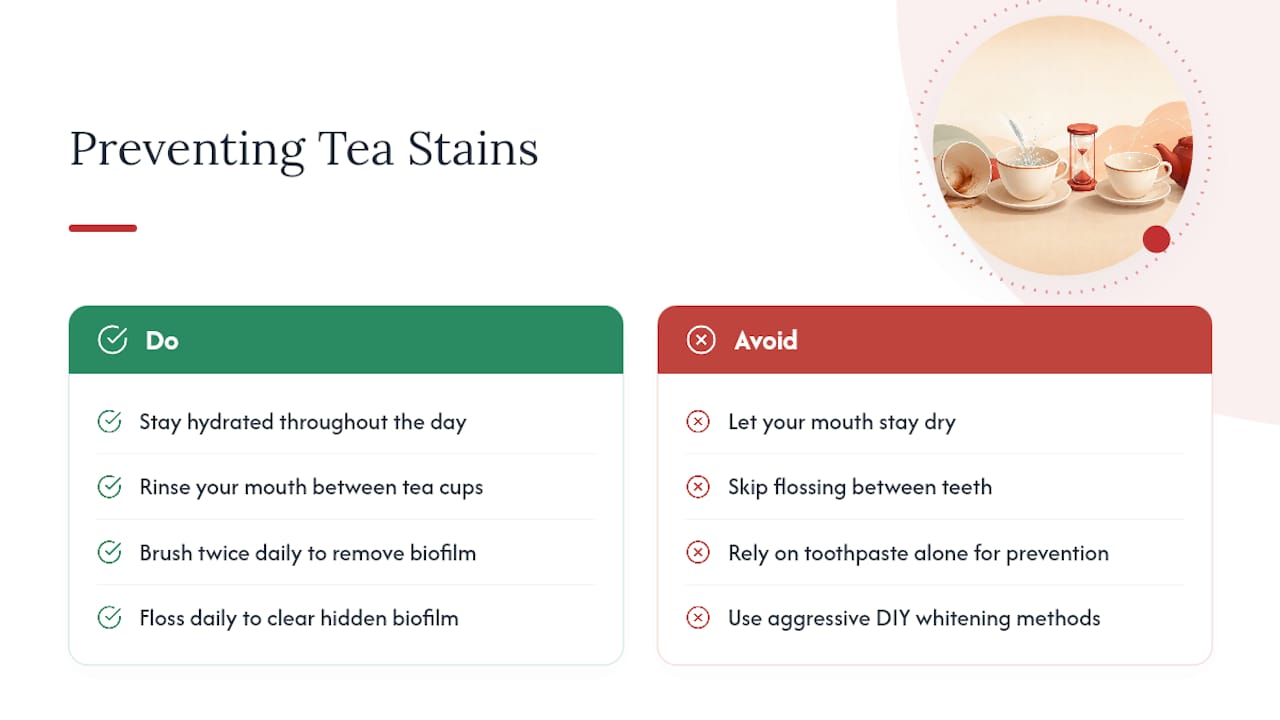
Saliva does more work against stains than most people give it credit for. It contains enzymes and minerals that help buffer acidity and wash away loose food particles and pigment residue between cups of tea. People with naturally lower saliva flow, whether from dehydration, medication side effects, or age, tend to hold onto stains longer because there’s less natural rinsing happening in the mouth throughout the day.
Staying hydrated keeps saliva flow steady, which is a simple, often-overlooked lever in stain prevention that has nothing to do with what toothpaste you buy. Dry mouth, on the other hand, gives tannins more uninterrupted contact time with enamel.
Good oral hygiene amplifies what saliva already does. Brushing twice daily removes the biofilm layer where pigments accumulate, and flossing clears the spaces between teeth where a toothbrush can’t reach and staining biofilm tends to hide longest. Dentists and hygienists generally favor this steady maintenance approach, rinsing, regular cleanings, and gentle whitening products, over aggressive DIY methods for anyone focused on long-term results rather than a quick fix. Skipping flossing doesn’t just risk gum problems; it leaves a stain reservoir sitting untouched between brushing sessions.
What Other Foods and Drinks Stain Teeth Like Tea Does?
Tea rarely works alone. Coffee shares nearly identical staining chemistry, with tannins and dark pigments that behave almost the same way on enamel. Red wine adds tannins plus deeply pigmented anthocyanins, which is why a glass of red at dinner on top of an afternoon tea habit compounds the problem faster than either drink alone.
Dark berries, balsamic vinegar, tomato-based sauces, and soy sauce all carry pigments that settle into the same enamel grooves tannins target. Curry spices, particularly turmeric, stain aggressively because of their concentrated pigment content. Even sports drinks and dark sodas contribute, partly from artificial coloring and partly from the acidity that softens enamel and makes it more receptive to staining in the first place.
The practical takeaway isn’t to eliminate these foods. It’s to apply the same rinse-and-wait principle across your whole diet, not just to tea. If your day includes coffee in the morning, tea in the afternoon, and red wine at dinner, you’re layering three staining sources onto the same enamel with almost no recovery window in between. Spacing them out, and rinsing after each one, does more for your smile than cutting any single item entirely.
How Do You Keep Teeth From Re-Staining Long Term?
Consistency beats intensity when it comes to keeping tea stains from creeping back. A whitening toothpaste used two or three times a week, paired with your normal daily brushing, maintains results far better than an occasional aggressive treatment followed by weeks of neglect.
Hygienist cleanings every six months function as a reset point, catching buildup that daily habits miss even when you’re doing everything right. Heavy tea drinkers sometimes shift to a four-month interval, which is worth discussing at your next appointment if stains keep returning faster than expected.
The habits that prevent stains in the first place, rinsing after tea, waiting before brushing, using a straw for iced varieties, don’t stop mattering once your teeth look brighter. They’re what keeps the improvement from reversing within a few months. Treating whitening as a one-time event rather than an ongoing routine is the most common reason people feel like their results don’t last.
Practical Takeaways for Regular Tea Drinkers
Daily: rinse with water or chew sugar-free gum after tea, avoid sipping across hours, and keep up gentle brushing. Weekly: limit baking soda treatments to once or twice if you use them, and lean on a whitening toothpaste for steady upkeep. See a hygienist if stains resist several weeks of this routine, or a dentist if you notice sensitivity or gray discoloration.
A Gentle Whitening Routine That Fits Your Tea Habit
Once rinsing and timing become second nature, the toothpaste you reach for each morning is what carries the routine forward. Stop-oralcare’s STOP Protective and Whitening Toothpaste is formulated without fluoride, built instead on hemp and Dead Sea minerals designed to target surface stains while supporting enamel rather than wearing it down.

That matters for tea drinkers specifically, since the abrasives in many whitening pastes can be too aggressive for daily use on enamel that’s already dealing with regular tannin exposure. A gentler, low-abrasion formula slots naturally into the rinse, wait, brush sequence outlined earlier: rinse right after your cup, wait 30 to 60 minutes, then brush with a formula built for frequent use rather than occasional touch-ups. For a fuller walkthrough of building this into a daily habit, Stop-oralcare’s guide to safe at-home whitening breaks down the sequencing step by step. Visit Stop-oralcare to see the full toothpaste details and place an order.
This article is general information, not a substitute for advice from a qualified doctor. Consult a qualified healthcare professional about your own circumstances before acting on anything here.
Sources
- Teeth whitening — NHS
- Comparative study on whitening paste efficacy — PMC
- Mayo Clinic Q&A on whitening options — Mayo Clinic News Network
FAQ
How do tea drinkers keep their teeth white?
Rinse with water right after finishing a cup, wait 30 to 60 minutes before brushing, and use a gentle whitening toothpaste consistently rather than relying on occasional harsh treatments.
How do I get brown stains off my teeth?
Brown surface stains usually respond to a whitening toothpaste used daily over two to six weeks; if they persist, a hygienist cleaning removes buildup that brushing alone can’t reach.
Why is tea staining my teeth?
Tea contains tannins and chromogens that bind to microscopic grooves in enamel, and hot brews stain faster than cooler ones because heat speeds up that binding process.
Will my teeth get whiter if I stop drinking tea?
Stopping tea removes an ongoing source of pigment, which can slow new staining, but it won’t reverse stains already set into the enamel; those still need a whitening routine or professional cleaning to fade.