

Hard water can leave a chalky, removable mineral film on teeth that looks like a stain but usually is not one. In most cases, this residue is extrinsic, meaning it sits on the enamel surface rather than inside the tooth, and it responds well to a professional cleaning. Permanent, intrinsic discoloration is a different problem entirely, and hard water alone rarely causes it.
Here is what to do before you worry any further:
- Check your faucets, kettle, and showerhead for chalky white or gray buildup. That is your household clue that your water supply carries a high mineral load.
- Book a professional cleaning and polish. If the dulling on your teeth disappears afterward, you are dealing with surface mineral residue.
- Schedule a dental exam regardless of the outcome. A dentist can confirm whether you are looking at extrinsic film, intrinsic discoloration, or something else entirely, like early fluorosis or a developmental spot.
- If your teeth still look dull or yellow after cleaning and a few weeks of consistent whitening, the discoloration is likely intrinsic. At that point, professional whitening, microabrasion, or veneers become the realistic next step, not another round of scrubbing.
Key Takeaways
Hard water most often leaves removable surface residue rather than the kind of permanent, intrinsic discoloration that requires cosmetic dentistry.
| Point | Details |
|---|---|
| Residue is usually cosmetic | Chalky film from hard water sits on enamel and typically lifts with a professional cleaning. |
| Diagnosis comes before treatment | A dental exam distinguishes extrinsic film from intrinsic causes like fluorosis or trauma. |
| Calcium often helps, not hurts | Higher water calcium is linked to lower cavity rates and supports remineralization. |
| Avoid over-brushing | Scrubbing harder to remove film wears enamel and exposes darker dentin underneath. |
| Choose mineralizing care | Stop-oralcare’s fluoride-free, hemp and Dead Sea mineral toothpaste supports enamel while managing surface residue. |
Table of Contents
- What Hard Water Is and Which Minerals It Contains
- How Hard Water Can (and Cannot) Affect Tooth Appearance
- Signs That Mineral Buildup, Not Something Else, Is the Cause
- How Dentists Tell Extrinsic Stains From Intrinsic Ones
- Treatment Options: What Actually Removes These Stains
- How to Protect Your Teeth From Mineral Buildup
- What the Research Says About Hard Water, Calcium, and Long-Term Stains
- The Practical Take: Diagnose Before You Treat
- A Gentler Way to Handle Hard Water Residue
- Frequently Asked Questions
- Sources
What Hard Water Is and Which Minerals It Contains
Water hardness measures the concentration of dissolved calcium and magnesium in your supply, usually expressed in milligrams per liter (mg/L) of calcium carbonate or in grains per gallon. Water above roughly 180 mg/L is generally classified as hard, and some regions run well past that. Calgary’s municipal water, for example, tests around 165 to 200 mg/L, which puts it firmly in the “very hard” category.
You do not need a lab test to suspect hard water at home. A few signs give it away fast: soap that will not lather properly, a ring of scale forming inside your kettle or coffee maker, and a white, crusty residue building up around faucet heads. If your household shows two or three of these signs, the water reaching your bathroom sink and your teeth carries the same mineral load.
That mineral load matters because every time you rinse, brush, or drink from the tap, calcium and magnesium ions come into contact with your enamel. What happens next is more nuanced than most people assume.
How Hard Water Can (and Cannot) Affect Tooth Appearance
Mineral deposits from hard water can create a thin, uneven layer on the enamel surface. That layer is not smooth like healthy enamel. It has a slightly rougher texture at the microscopic level, and that roughness is exactly what lets pigments from coffee, tea, red wine, and tobacco grab hold more easily. This is likely why some dentists report that patients in hard-water regions see surface stains adhere faster and tartar form more readily than patients drinking softer water.
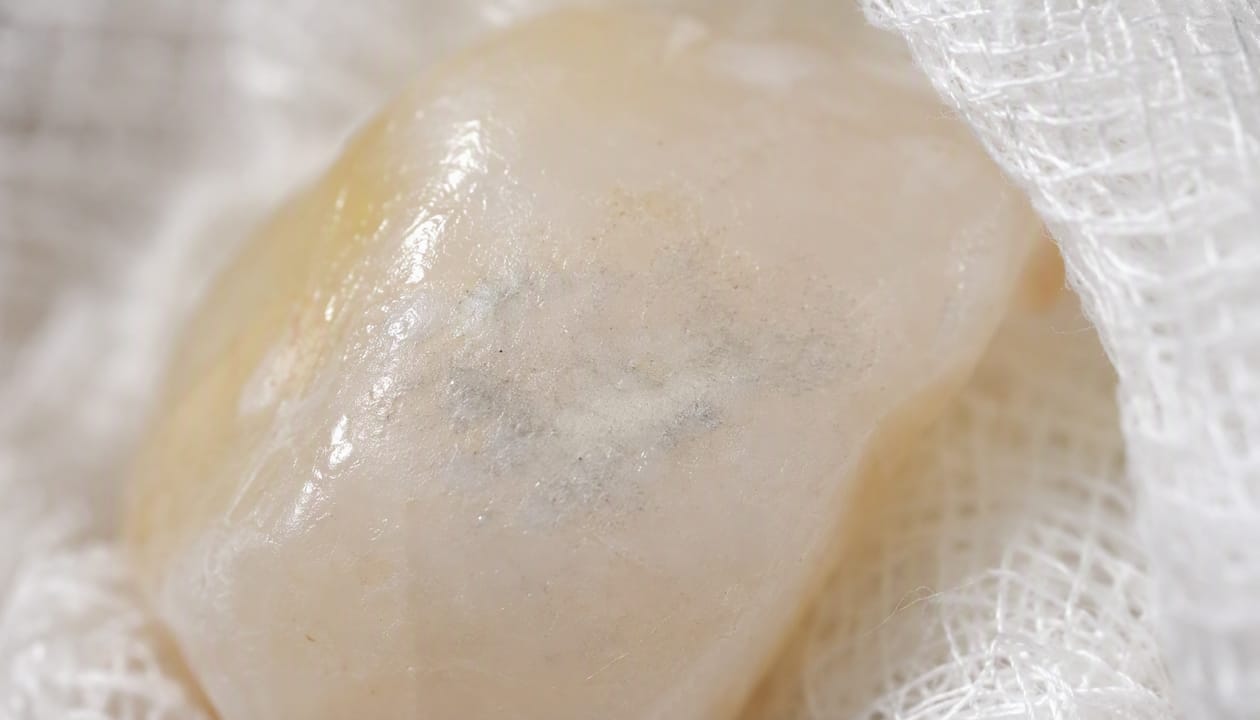
Here is the part that surprises most people: the calcium in that same hard water is often doing your teeth a favor. Calcium supports enamel remineralization, the natural process that rebuilds mineral content lost to acid attacks from food and bacteria. A review of mineral interactions and oral health found that higher water calcium is associated with lower cavity rates in some populations, and dentists frequently point to this as a benefit rather than a risk.
What hard water does not typically do is erode enamel or reach into the tooth to cause intrinsic discoloration. Intrinsic stains come from a different set of causes entirely, things like tetracycline exposure in childhood, excess fluoride during tooth development, trauma, or aging dentin darkening from within. Hard water sits on top of the tooth. It is not getting inside it.
- Mineral film creates surface roughness that traps pigment faster.
- Calcium and magnesium support remineralization rather than erosion.
- Hard water residue is cosmetic and removable, not structural damage.
Pro Tip: If your teeth feel chalky or filmy after brushing in a hard-water area, resist the urge to scrub harder. Aggressive brushing wears down enamel and exposes the yellower dentin underneath, which makes teeth look more stained, not less. Switch to a soft-bristled brush and a gentle, mineralizing toothpaste instead of applying more pressure.
Signs That Mineral Buildup, Not Something Else, Is the Cause
A short mental checklist saves you from misdiagnosing your own mouth. Surface mineral deposits tend to feel different from other types of discoloration, and they behave differently over time.
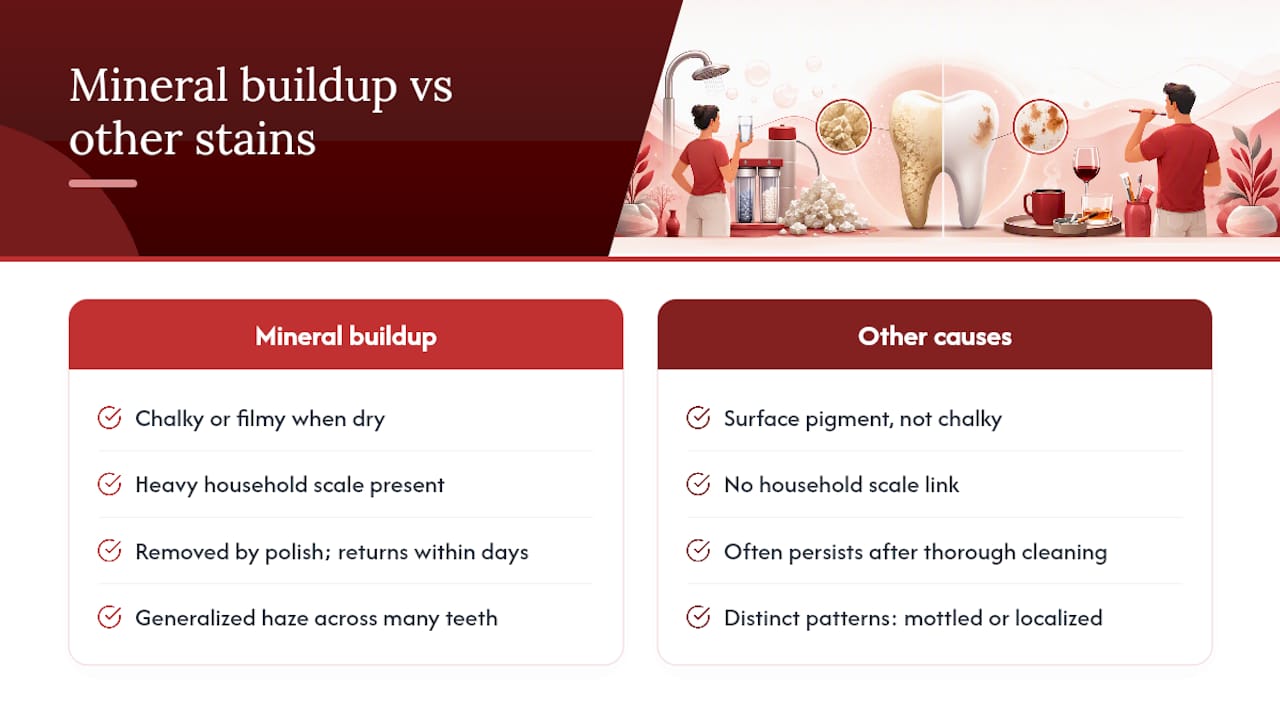
Start with texture. If your teeth feel chalky or slightly filmy right after they dry, particularly after brushing or right after you wake up, that transient feel points toward surface deposits rather than a stain baked into the tooth. Pair that with the household evidence: heavy scale on your faucets, kettle, or dishwasher confirms your water supply is the likely mineral source.
The most telling clue comes from how the discoloration behaves during and after professional cleaning. If a dental polish removes the dullness completely, or if it fades quickly and returns within days after you resume normal drinking habits, you are looking at extrinsic mineral film. Stains that persist through a thorough cleaning are a different story.
Before you settle on hard water as the culprit, rule out the usual suspects. Coffee and tea leave yellow-brown surface pigment that behaves similarly to mineral film but has an obvious dietary trigger. Tobacco leaves a denser, often darker stain. Fluorosis shows up as white or brown mottling, usually symmetrical across multiple teeth, and traces back to childhood fluoride exposure rather than your current tap water. Trauma to a single tooth produces a localized gray or dark discoloration that looks nothing like generalized haze. Each of these has a distinct pattern, and a dentist reads that pattern faster than you can from a bathroom mirror.
How Dentists Tell Extrinsic Stains From Intrinsic Ones
A dental exam for discoloration is more systematic than a quick glance. Your dentist starts with a history: when did you first notice the change, what does your diet look like, do you use tobacco, and did you take any medications like tetracycline as a child or receive excess fluoride during tooth development. That history alone narrows the list considerably.
Next comes the physical exam. The dentist probes the stain to see whether it sits on the enamel surface or appears to run deeper into the tooth structure. Extrinsic stains typically respond to a professional scaling and polishing right there in the chair, a strong diagnostic clue in itself. Intrinsic discoloration does not budge under a polishing cup because it originates below the surface.
Photographs before and after cleaning help track whether treatment is working. In cases where the cause is unclear, dentists sometimes use transillumination, shining a light through the tooth to check for internal cracks or pulp changes, or take radiographs to rule out decay or trauma-related changes inside the tooth.
| Feature | Extrinsic (surface) stain | Intrinsic (internal) discoloration |
|---|---|---|
| Common cause | Hard water residue, coffee, tea, tobacco | Fluorosis, tetracycline exposure, trauma, aging |
| Response to polishing | Often disappears or lightens significantly | Little to no change |
| Typical treatment | Cleaning, whitening toothpaste, in-office whitening | Professional whitening, microabrasion, bonding, veneers |
| Onset pattern | Gradual, tied to diet or water exposure | Often present from childhood or after a specific event |
This distinction is not academic. Clinical guidance from Cleveland Clinic is direct about it: extrinsic stains usually improve with cleaning and whitening, while intrinsic stains need cosmetic intervention because no amount of surface treatment reaches the discoloration’s source.
Pro Tip: Bring a timeline to your appointment. Noting when you first noticed the change, and whether it coincided with a move to a new water supply, a medication, or a specific habit, gives your dentist a real head start on diagnosis instead of guesswork.
Treatment Options: What Actually Removes These Stains
Treatment follows a logical order, and skipping steps rarely saves time.
- Start with a professional cleaning. Scaling and polishing removes tartar and much of the surface mineral film in a single visit. Many people are surprised how much brighter their teeth look immediately afterward, simply because the deposits causing the dullness are gone.
- Try over-the-counter whitening for mild residual staining. Whitening toothpaste or strips can lighten light extrinsic discoloration over one to four weeks of consistent use.
- Move to in-office whitening if OTC products fall short. Professional whitening delivers a stronger, faster result for surface stains that have resisted home treatment.
- Consult on cosmetic options if nothing above works. Long-standing intrinsic discoloration, especially stains set in for a decade or more, typically requires microabrasion, resin infiltration, bonding, or veneers. There is no realistic at-home fix for discoloration this deep.
A practical timeline looks like this: schedule the cleaning immediately, give whitening one to four weeks to show results, and book a cosmetic consultation if you see no meaningful change by then. Cost and effort escalate at each stage, so it makes sense to rule out the cheap, simple explanation (surface residue) before assuming you need veneers.
How to Protect Your Teeth From Mineral Buildup
Prevention here is less about eliminating hard water exposure and more about managing it intelligently. A soft-bristled brush paired with a fluoride toothpaste, or a fluoride-free mineralizing formula if you prefer to avoid fluoride, handles daily plaque without grinding away enamel. Flossing daily and using an alcohol-free mouthwash rounds out a routine that keeps mineral film from thickening into something more visible.
Rinsing strategy matters more than most people realize. After coffee, tea, or red wine, a quick rinse with plain water limits how long pigment sits on that slightly roughened enamel surface. Drinking iced coffee or soda through a straw keeps liquid off your front teeth almost entirely, a small habit that adds up over years.
The water softener question deserves a direct answer: think twice before installing one purely for your teeth. Softeners and reverse osmosis systems strip calcium and magnesium from your water, removing minerals that support remineralization in the process. Some softeners also add sodium, which offers no dental benefit whatsoever. If you are weighing a whole-house filtration system, talk to your dentist first rather than assuming softer water automatically means healthier teeth.
Regular professional cleanings, roughly every six months, keep surface mineral deposits from accumulating to the point where they become a cosmetic complaint in the first place.
Pro Tip: Choose a toothpaste built around remineralizing minerals rather than one marketed for aggressive “deep cleaning.” A formula like the ones outlined in this guide to natural remineralization supports enamel strength instead of grinding away the surface you are trying to protect.
What the Research Says About Hard Water, Calcium, and Long-Term Stains
The strongest population-level evidence actually cuts against the popular assumption that hard water damages teeth. A 2026 study examining drinking water in England found that water hardness, used as a stand-in measure for calcium content, was independently associated with lower childhood caries rates. Including hardness in statistical models even changed how researchers understood the relationship between water fluoride and cavity prevalence, suggesting calcium plays a meaningful protective role researchers had been underweighting.
| Research finding | What it shows |
|---|---|
| Water hardness and childhood caries | Higher hardness independently linked to lower caries prevalence |
| Calcium and remineralization | Calcium in water supports enamel repair after acid exposure |
| Extrinsic vs. intrinsic stain response | Extrinsic stains respond to cleaning; intrinsic stains generally do not |
That protective pattern holds up across other clinical reviews as well. Research on mineral interactions in oral health consistently frames calcium exposure as beneficial for enamel strength, not damaging.
The consensus across dental sources is consistent: water hardness is not established as a cause of intrinsic tooth discoloration, and its mineral content more often helps than hurts. The stains people blame on hard water are almost always the cosmetic, removable kind. Deep-set discoloration traces back to fluorosis, medication exposure, trauma, or aging dentin, causes that have nothing to do with what comes out of your faucet.
The Practical Take: Diagnose Before You Treat
Here is where a lot of well-meaning advice online goes wrong: it treats “hard water stains” as if they are always the villain, when the research actually points the other direction. Calcium exposure from hard water is more often protective for your enamel than harmful. Treating your water supply as the enemy and scrubbing harder to compensate is, if anything, the more damaging response, because that abrasion is what actually wears down enamel and exposes the darker dentin underneath.
The checklist matters more than the water report. Check your faucets and appliances for scale, try a professional cleaning to see if the dullness lifts, and let a dentist confirm what you are actually looking at before you commit to a treatment plan. That sequence costs you one dental visit and saves you from either ignoring a real intrinsic problem or overtreating a cosmetic one.
Gentle, mineral-supporting oral care fits naturally into that sequence. A toothpaste designed to reinforce enamel rather than strip away surface film manages the chalky residue hard water leaves behind without creating the abrasion that makes discoloration worse. That is the first-line approach worth trying before reaching for anything more aggressive, and it is also the approach least likely to backfire if the real cause turns out to be something other than your water.
A Gentler Way to Handle Hard Water Residue
If your water is leaving that dull, chalky feel on your teeth, the fix is not a harsher scrub, it is a formula that works with your enamel instead of against it. Stop-oralcare’s fluoride-free toothpaste is built around hemp and Dead Sea minerals specifically to support remineralization, which matters most for people living with hard water’s mineral load rather than fighting it.

Most whitening pastes on the market rely on abrasive particles to physically scrub away surface film, the same mechanism that wears down enamel and exposes the yellow dentin underneath. A mineralizing formula takes the opposite approach: it reinforces the enamel surface while lifting extrinsic residue gently, which is exactly what dental guidance recommends for people whose discoloration turns out to be surface-level rather than intrinsic. If a full cosmetic checklist feels premature, this is the lower-effort step worth trying first.
Browse the full product lineup, including toothpaste, mouthwash, and oral spray formulated for sensitive teeth and gum health, on the Stop-oralcare site. If a professional cleaning already confirmed your discoloration is surface residue, switching your daily toothpaste is the next concrete step, not another appointment.
Frequently Asked Questions
Does hard water actually stain teeth, or does it just make them look stained? Hard water typically leaves a mineral film on the enamel surface that looks like staining but is usually removable with a professional cleaning. True intrinsic staining, the permanent kind, generally comes from other causes.
Can drinking hard water damage my enamel over time? Not directly. Calcium and magnesium in hard water tend to support remineralization rather than erode enamel, based on population research linking water calcium to lower cavity rates.
Should I install a water softener to protect my teeth? Not for that reason alone. Softeners strip out calcium and magnesium that help remineralize enamel and can add sodium with no dental benefit. Talk to your dentist before making that change.
How long does it take to remove hard water residue from teeth? A single professional cleaning often clears most surface film immediately. Mild leftover discoloration usually responds to one to four weeks of consistent whitening.
What if whitening doesn’t fix the discoloration? That is a strong signal the staining is intrinsic rather than surface-level. At that point, a dentist can discuss microabrasion, bonding, or veneers as realistic next steps.
This article is general information, not a substitute for advice from a qualified doctor. Consult a qualified healthcare professional about your own circumstances before acting on anything here.
Sources
Bringing referenced material to your dental appointment helps ground the conversation in evidence rather than guesswork. The PMC discussion of intrinsic versus extrinsic staining lays out the clinical distinction in detail, while Cleveland Clinic’s overview of tooth discoloration covers causes and treatment pathways in plain language.
For the water-mineral side of the picture, the MDPI review on mineral interactions and oral health and the Springer Nature study on water hardness and childhood caries both explain why calcium exposure tends to help rather than harm enamel. MedlinePlus’s overview of tooth discoloration rounds out the list with a general reference on common causes worth reviewing before your next cleaning.
- Intrinsic vs extrinsic tooth discoloration discussion (PMC article)
- MDPI review on mineral interactions and oral health
- Springer Nature — Drinking water hardness modifies fluoride–caries relationship (2026)
- Cleveland Clinic — Tooth discoloration: causes & treatment
- MedlinePlus — Tooth discoloration overview
Recommended
- How to Whiten Teeth Naturally at Home: Simple Steps for a Brighter Smi – Stop Oral Care
- How to Maintain Mineral-Rich Teeth: 5 Natural Steps – Stop Oral Care
- Toothpaste for Enamel Repair: A Complete Guide to Restoring Dental Hea – Stop Oral Care
- What Is Hydroxyapatite Toothpaste? A Complete Guide to Safe, Effective – Stop Oral Care