

Most people assume sustainable dental care begins and ends with switching to a bamboo toothbrush or a natural toothpaste. That assumption significantly underestimates the scope of what eco-friendly dentistry actually involves. Sustainable dental care encompasses resource efficiency, waste minimization, material selection, clinical methodology, and patient behavior, all operating as an integrated system. For consumers who prioritize natural formulations, fluoride-free products, and scientifically grounded choices, understanding this system is essential. This article examines the full scope of sustainable dental care, from foundational principles to practical application, including the ongoing science around fluoride-free alternatives.
Table of Contents
- What is sustainable dental care?
- How sustainable dental care works: 4Rs and prevention
- Science vs. nature: Materials, fluoride, and the safety debate
- Practical sustainable choices at home and the dentist
- Why most people misunderstand sustainable dental care
- Discover more ways to care sustainably
- Frequently asked questions
Key Takeaways
| Point | Details |
|---|---|
| Whole-system approach | Sustainable dental care addresses everything from products to daily habits and dental office innovations. |
| Prevention matters | Preventive routines and early care can make your dental habits greener and healthier. |
| Balance science and sustainability | The safest oral care balances scientific consensus with environmental responsibility and personal values. |
| Actionable steps | Simple swaps like modular toothbrushes and supporting educated dental care providers reduce environmental impact. |
What is sustainable dental care?
With a clear focus established, let’s clarify what sustainable dental care really means. The term is frequently used interchangeably with “green dentistry” or “eco-friendly dentistry,” but these labels describe overlapping, not identical, concepts. Sustainable dental care involves reducing the environmental impact of dental practices through resource efficiency, waste minimization, and adoption of sustainable materials and technologies, while maintaining rigorous oral health standards.
This definition is important because it places environmental responsibility alongside clinical effectiveness, not above it. A product or practice cannot be considered genuinely sustainable if it compromises oral health outcomes. The core benefits of sustainable oral care extend beyond environmental metrics to include patient safety, reduced chemical exposure, and long-term systemic health considerations.
Several distinctions are worth clarifying:
- Natural dental care refers to products formulated with plant-based, mineral, or non-synthetic ingredients. It does not automatically imply environmental sustainability.
- Eco-friendly dental care focuses on reducing ecological footprint, including packaging, water use, and waste generation.
- Green dentistry is a broader term often applied to clinical settings that adopt energy-efficient equipment, digital records, and waste-reduction protocols.
Understanding eco-friendly dental hygiene requires recognizing that these categories frequently overlap but are not synonymous. A product can be natural without being eco-friendly, and a dental practice can be operationally green while still using conventional chemical formulations.
“Sustainable dental care is not a product category. It is a systems-level commitment to aligning oral health practice with environmental and public health objectives.”
Consumers navigating this space benefit from examining natural dental care myths that conflate ingredient preference with genuine sustainability. The distinction matters for making informed, evidence-aligned choices.
How sustainable dental care works: 4Rs and prevention
Now that you know what sustainable dental care is, how do its core principles work in daily life? The FDI World Dental Federation has formalized a framework that applies directly to both clinical and home-based oral care routines.
The FDI’s 4R approach consists of four operational principles:
- Reduce consumption of single-use plastics, water, and energy in dental routines.
- Reuse durable tools where clinically appropriate, such as sterilizable instruments.
- Recycle packaging, materials, and equipment components through designated programs.
- Rethink the entire approach to oral care, from product formulation to clinical workflow.
Prevention is the fifth, often unspoken, pillar of this framework. Early intervention and consistent oral hygiene reduce the need for resource-intensive restorative procedures, which generate significantly more waste per patient than preventive care. Dental clinics generate approximately 0.5 kg of hazardous waste per patient per day, according to WHO data. Reducing treatment frequency through prevention directly reduces this figure.
Pro Tip: Scheduling biannual cleanings and addressing early-stage cavities promptly is one of the most environmentally impactful choices a patient can make, far more so than switching toothbrush materials alone.
At the product level, the 4R framework translates into selecting refillable or compostable packaging, choosing concentrated formulations that reduce shipping weight, and avoiding unnecessary chemical additives. Digital dental innovations, including digital X-rays and electronic records, further reduce chemical and paper waste within clinical settings. These operational changes, when adopted systematically, produce measurable reductions in the environmental burden of dental care delivery.

Science vs. nature: Materials, fluoride, and the safety debate
Understanding the rules is important, but which materials and methods actually support oral health and the environment? This is where the science becomes most relevant for consumers seeking fluoride-free alternatives.
Fluoride remains the most extensively studied agent for caries prevention. Research consistently shows fluoride reduces cavity risk by 20 to 40 percent, a benchmark endorsed by both the ADA and WHO. However, fluoride’s environmental profile is not without concern. Its production and disposal carry ecological costs that some consumers weigh against its clinical benefits.
| Material | Caries prevention | Environmental impact | Safety profile |
|---|---|---|---|
| Fluoride | High (20-40% reduction) | Moderate | Well-established |
| Hydroxyapatite (HAP) | Moderate (emerging data) | Low | Favorable |
| Glass ionomer cement (GIC) | Moderate | Lowest carbon footprint | Good |
| Dental amalgam | N/A (restorative) | High (mercury) | Regulated |
| Composite resin | N/A (restorative) | Moderate | Acceptable |
Hydroxyapatite (HAP) is the most studied fluoride-free remineralizing agent. It is biocompatible, naturally occurring in tooth enamel, and shows meaningful results in early-stage remineralization. However, HAP requires more long-term RCT data before it can be positioned as a direct clinical equivalent to fluoride.
For consumers pursuing fluoride-free routines, this means that dietary discipline, plaque control, and consistent hygiene habits become more critical, not less. Natural remineralizers work best in low-acid oral environments, making dietary sugar reduction a functional necessity rather than a general recommendation.
“Natural alternatives to fluoride show genuine promise, particularly HAP, but the current evidence base supports their use as complements to, rather than replacements for, established preventive protocols.”
Exploring holistic care alternatives that incorporate mineral-rich formulations alongside rigorous hygiene practices represents a scientifically defensible approach for safety-focused consumers.
Practical sustainable choices at home and the dentist
So, how can you put all this knowledge into daily practice, both at home and in the dental chair? Sustainable oral care at the consumer level involves deliberate product selection, behavioral consistency, and informed engagement with dental professionals.
At home, the following substitutions represent evidence-informed starting points:
- Replace conventional plastic toothbrushes with modular or bamboo alternatives. Modular toothbrushes reduce plastic waste significantly over a product’s lifecycle.
- Select toothpaste in recyclable or compostable packaging, prioritizing concentrated or tablet formats.
- Choose waxed silk or plant-based floss over conventional nylon options.
- Use alcohol-free mouthwash in glass or recyclable containers to reduce chemical and plastic waste.
| Home practice | Sustainability benefit | Effectiveness rating |
|---|---|---|
| Bamboo toothbrush | Reduces plastic waste | Equivalent to plastic |
| HAP toothpaste | Low ecological impact | Moderate, emerging |
| Silk floss | Biodegradable | Equivalent to nylon |
| Concentrated mouthwash | Reduces packaging/shipping | Equivalent |
| Water flosser | Reduces floss waste | High |
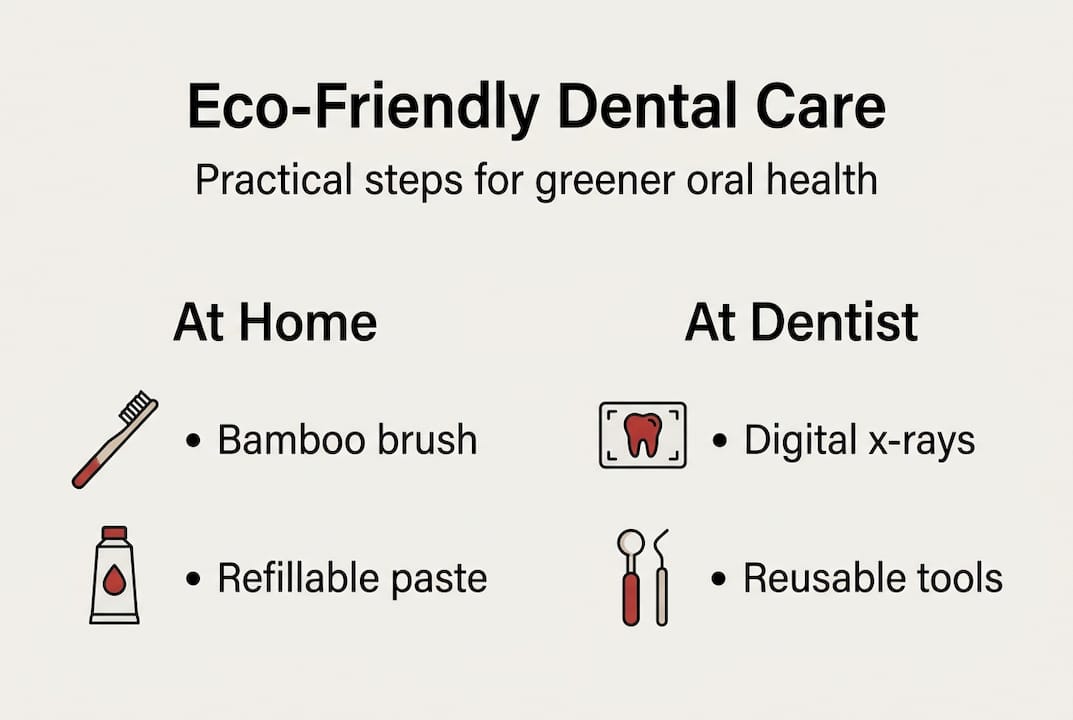
When selecting a dental provider, ask directly about their waste management protocols, whether they use digital X-rays, and whether they offer mercury-free restorative options. These questions signal informed patient engagement and often prompt more detailed clinical conversations.
Pro Tip: Education is the most underutilized sustainability tool. Understanding what holistic dental care involves before your appointment allows you to ask better questions and make more aligned treatment decisions.
Staying current with the latest dental trends in sustainable practice also helps consumers identify providers and products that align with both their health values and environmental priorities.
Why most people misunderstand sustainable dental care
Beyond tips and comparisons, there is a deeper issue that receives insufficient attention in mainstream discussions of green dental care. Most consumers approach sustainability as a product-selection problem. They swap one toothpaste for another, choose a different brush, and consider the matter resolved. This framing is incomplete and, in some cases, counterproductive.
Sustainable dental care is fundamentally a behavioral and systemic commitment. The long-term dental sustainability literature consistently shows that prevention, consistency, and informed material selection produce far greater environmental and health returns than any single product switch. A consumer who uses a bamboo toothbrush but skips flossing and avoids preventive appointments generates more clinical waste through restorative treatment than one who uses a conventional brush with rigorous preventive habits.
There is also a community dimension that is rarely discussed. Individual sustainable choices aggregate into market signals. When consumers consistently select fluoride-free, low-waste, or naturally formulated products, manufacturers respond with reformulation and packaging innovation. This feedback loop has measurable industry-level effects over time.
The uncomfortable reality is that trend-driven sustainability, choosing products because they appear green rather than because they perform and align with evidence, undermines the credibility of the entire movement. Educated, consistent action grounded in scientific understanding is what produces durable change, both in oral health outcomes and in environmental impact.
Discover more ways to care sustainably
For consumers ready to move from understanding to action, Stop Oral Care offers a curated line of fluoride-free dental products formulated with hemp and Dead Sea minerals, developed under the scientific guidance of Dr. Veronica Stahl. These formulations are designed to meet the dual standard that sustainable dental care demands: ecological responsibility and clinical effectiveness.
Exploring further reading on sustainable practices available through Stop Oral Care provides both the scientific context and the product options needed to build a genuinely sustainable oral care routine. Small, consistent steps, grounded in evidence and aligned with your values, are the foundation of meaningful change in personal and community oral health.
Frequently asked questions
What does sustainable dental care really involve?
Sustainable dental care involves eco-friendly practices, materials, and lifestyle habits focused on reducing environmental impact while maintaining oral health standards. It operates as a system, not a single product category.
Can I have fluoride-free dental care that is still effective and safe?
Fluoride-free care is clinically feasible and can be safe, but it requires more diligent oral hygiene and dietary management. HAP needs more long-term RCT data before it is considered a direct equivalent to fluoride in caries prevention.
Are eco-friendly dental materials as effective as traditional options?
Some eco-friendly materials perform comparably in specific applications, but fluoride remains superior for cavity prevention with a 20 to 40 percent reduction in caries risk, the most robust evidence base currently available.
Does sustainable dental care cost more?
Initial product costs may be higher, but prevention-focused habits reduce the frequency of resource-intensive restorative procedures. High initial costs and limited standardization remain acknowledged barriers, though long-term savings are documented for consistent preventive care.
Recommended
- Eco-Friendly Oral Hygiene: Transforming Dental Routines – Stop Oral Care
- Sustainable Oral Care: Benefits and Best Practices – Stop Oral Care
- Fluoride-free dental care workflow: natural guide 2026 – Stop Oral Care
- Dental wellness explained: Holistic care and fluoride-free solutions – Stop Oral Care
- Checklist for Buying Sustainable Dog Food