

TL;DR:
- The term “lab-tested” on oral care products lacks a regulated definition and varies widely in scientific validity. Consumers should scrutinize the specific test types, third-party endorsements, and safety and efficacy evidence behind such claims. Transparent testing practices and independent verification are essential for making informed, safe oral health choices.
The phrase “lab-tested” appears on oral care packaging with increasing frequency, yet most consumers encounter it without any clear understanding of what it actually certifies. What is lab-tested oral care, precisely? The term lacks a single regulated definition in product labeling, which means a manufacturer can apply it to a product that underwent a basic ingredient analysis just as readily as one that completed rigorous clinical trials. This article clarifies the scientific and regulatory distinctions behind that phrase, explains what credible testing programs actually require, and gives you the tools to evaluate oral care products with accuracy rather than assumption.
Table of Contents
- Key Takeaways
- What “lab-tested oral care” actually means
- The role of third-party endorsements
- Analytical validity vs. clinical validity
- Safety and efficacy concerns from lab data
- How to evaluate products as an informed consumer
- My perspective on how consumers should read these claims
- Science-backed oral care at Stop-oralcare
- FAQ
Key Takeaways
| Point | Details |
|---|---|
| No universal definition exists | “Lab-tested” carries no standardized regulatory meaning in oral care labeling, so context and scope matter. |
| Testing types vary significantly | Products may undergo ingredient analysis, antimicrobial efficacy testing, biocompatibility assessment, or clinical trials, each measuring different outcomes. |
| Third-party seals add credibility | Programs like the ADA Seal of Acceptance require independent data submission and verified manufacturing compliance. |
| Analytical vs. clinical validity differ | Accurately measuring a biomarker is not the same as proving a product prevents or treats a clinical condition. |
| Safety and efficacy are both required | Strong antimicrobial activity without confirmed tissue safety does not constitute a complete or reliable product evaluation. |
What “lab-tested oral care” actually means
The phrase “lab-tested” in the context of oral care products is a descriptive marketing term rather than a defined regulatory classification. No single federal standard mandates what type of testing qualifies a product to carry that label. As a result, the benefits of lab-tested oral care as marketed can range from genuinely rigorous scientific validation to superficial ingredient verification, depending entirely on the manufacturer’s chosen methodology.
Understanding what lab-tested oral products are requires familiarity with the primary categories of laboratory testing applied to dental formulations:
- Ingredient quantification: Analytical chemistry methods, including high-performance liquid chromatography, measure the concentration and purity of active compounds such as fluoride, cetylpyridinium chloride, or herbal extracts. This confirms that the stated ingredient is present at the labeled concentration.
- Safety and biocompatibility testing: Cell-culture assays, mucosal irritation models, and cytotoxicity panels assess whether formulation components cause harm to oral tissues under realistic exposure conditions.
- Antimicrobial efficacy testing: Minimum inhibitory concentration assays and biofilm reduction studies quantify a product’s ability to inhibit or kill oral pathogens such as Streptococcus mutans or Porphyromonas gingivalis.
- Clinical outcome studies: Randomized controlled trials and observational studies measure real-world changes in caries incidence, gingivitis scores, or plaque indices in human subjects over defined time periods.
Each test type answers a different scientific question. Ingredient quantification confirms formulation integrity. Biocompatibility data addresses tissue safety. Antimicrobial assays measure pathogen suppression in controlled conditions. Clinical trials assess whether those effects translate to measurable health benefits in actual patients. Lab-tested claims cover varied types of testing, and their credibility depends on the scope, independence, and practical relevance of the methodology applied.
Pro Tip: When you see “lab-tested” on an oral care product, look for a specification of the test type in the product literature or the manufacturer’s website. The absence of that specification is itself informative.
The role of third-party endorsements
Because the FDA does not test individual toothpaste products prior to market entry, the regulatory framework for oral care leaves a meaningful gap that third-party evaluation programs partially fill. The most recognized of these in the United States is the ADA Seal of Acceptance, which functions as an independent verification mechanism for safety and efficacy claims.
The process of earning that designation is more rigorous than many consumers realize. Consider the core requirements:
- The applicant company must submit data from independent laboratory studies and clinical trials, not internal research conducted by the manufacturer’s own team.
- Complete ingredient lists, manufacturing processes, and product specifications must be provided for review by the ADA’s Council on Scientific Affairs.
- Evidence must demonstrate that safety and efficacy data support the specific health claims the product makes, such as cavity prevention or tartar control.
- Manufacturing facilities must meet FDA Good Manufacturing Practice standards, and documentation confirming this must accompany the submission.
- The Seal is granted for five years, after which companies must renew their application to retain authorization to display it on packaging.
The submission structure is designed to reduce the risk of selective data reporting. Independent submission and verification of study data, combined with manufacturing compliance checks, makes it substantially more difficult for manufacturers to present only favorable results.
“The ADA Seal can serve as a reliable benchmark for evaluating toothpaste claims when the FDA does not test individual products.” — ADA oral health resources
The FDA’s role operates differently. Under the OTC Drug Monograph system, the FDA establishes permissible active ingredients and their concentration ranges for categories like anticavity or antigingivitis toothpastes. That regulatory framework sets the rules of ingredient inclusion, but it does not evaluate individual products against clinical outcome data. The ADA Seal, by contrast, requires that actual product performance evidence be submitted and reviewed.
Analytical validity vs. clinical validity
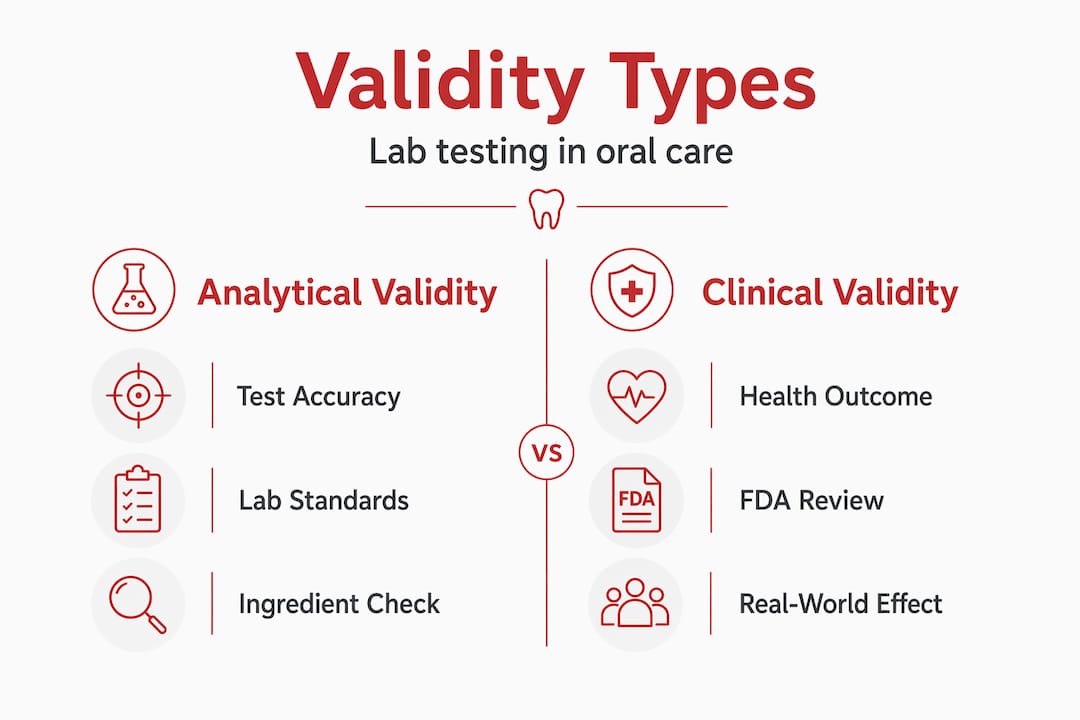
One of the most practically important distinctions in oral care quality testing is the difference between analytical validity and clinical validity. These two concepts address fundamentally different questions, yet consumer-facing “lab-tested” marketing claims frequently blur the line between them.

| Testing Concept | Question Answered | Regulatory Oversight |
|---|---|---|
| Analytical validity | Does the test accurately measure the target biomarker or compound? | CLIA (Clinical Laboratory Improvement Amendments) |
| Clinical validity | Does the measurement predict, detect, or confirm a clinical disease condition? | FDA review required |
| Clinical utility | Does acting on the test result improve patient outcomes? | Evaluated through clinical studies |
CLIA regulates laboratory quality for human specimen testing, establishing standards that help labs produce reliable, reproducible analytical results. However, CLIA certification does not address whether a test’s output carries clinical meaning. A lab can hold CLIA certification while performing a test that accurately quantifies a salivary biomarker, yet that measurement may have no validated relationship to an oral disease condition.
Clinical validity requires a separate body of evidence, typically reviewed by the FDA. FDA oversight of lab-developed tests is projected to expand substantially by 2028, with increasing requirements for diagnostic accuracy data before claims of clinical utility can be made.
Pro Tip: If a product uses saliva testing or biomarker data to support its efficacy claims, ask specifically whether that test has been validated for clinical outcomes, not merely analytical accuracy.
This distinction matters directly to consumers evaluating lab-certified oral hygiene products. A toothpaste that has been analytically verified to contain 1,450 ppm fluoride has passed one meaningful test. Whether that specific formulation reduces caries incidence in the population you belong to is a separate question requiring clinical evidence.
Safety and efficacy concerns from lab data
Laboratory testing does not always confirm that a product is safe and effective. In a number of instances, it reveals concerns that marketing language obscures. Oral care quality testing that includes biocompatibility assessment has produced findings with direct consumer relevance.
- Fluoride compounds exhibit dose-dependent cytotoxicity on gingival fibroblasts, inducing oxidative stress and apoptosis at higher concentrations or with prolonged tissue exposure. This does not mean that fluoride toothpaste used as directed is uniformly harmful, but it does establish that ingredient concentration and exposure duration are variables that safety assessments must address.
- Surfactants commonly used in toothpaste formulations, particularly sodium lauryl sulfate, have demonstrated mucosal irritation potential in controlled studies. Products that list surfactants without biocompatibility data provide an incomplete safety profile.
- Antimicrobial efficacy varies substantially among toothpaste formulations. Minimum inhibitory concentration data from in vitro studies do not automatically predict real-use performance, particularly within the complex biofilm environment of the oral cavity.
- Good safety assessment addresses mucosal tolerance under realistic consumer exposure conditions. Many product marketing claims ignore these nuanced safety evaluations, presenting antimicrobial activity data without corresponding tissue safety data.
The importance of dental testing that covers both dimensions is grounded in a basic scientific principle. Effective oral care requires assessing both antimicrobial performance and biological safety. Strong antimicrobial activity without confirmed biocompatibility does not constitute adequate product validation. A formulation that eliminates oral pathogens while also causing cellular damage to gingival tissue presents a net safety concern, not a net benefit.
“Biocompatibility and antibacterial efficacy vary among toothpaste formulations, highlighting the need for credible lab data beyond marketing terms.” — Scientific Reports, comparative toothpaste formulation research
This is precisely the gap that consumers should focus on when they see oral care quality testing referenced in product descriptions. The presence of any lab data is not equivalent to the presence of complete lab data.
How to evaluate products as an informed consumer
Knowing the scientific distinctions above is only useful if you can apply that knowledge to purchasing decisions. The following steps provide a structured approach for evaluating dental product safety standards when reviewing oral care product claims.
- Identify the type of test referenced. If a product claims to be lab-tested, the manufacturer should be able to specify whether that refers to ingredient analysis, antimicrobial efficacy, biocompatibility testing, or clinical trials. Vague references to “testing” without specifics warrant scrutiny.
- Look for recognized third-party endorsements. The ADA Seal of Acceptance, for example, requires independent study data submission and manufacturing compliance. Its presence indicates a level of external review that self-reported “lab-tested” claims do not.
- Verify both safety and efficacy evidence. A product with antimicrobial data but no biocompatibility data has an incomplete testing record. Seek products where the manufacturer provides evidence for both dimensions, or check whether available safe oral care ingredients have been independently assessed.
- Consult publicly available product databases. The ADA’s website and the FDA’s OTC drug database allow consumers to verify whether specific products have been evaluated against published standards. Manufacturer transparency about where and how testing was conducted is a reasonable expectation.
Pro Tip: A manufacturer that publishes the full text of its supporting studies or links to peer-reviewed publications is demonstrating a level of transparency that self-referential “lab-tested” labels cannot replicate.
My perspective on how consumers should read these claims
I have spent a substantial portion of my professional life at the intersection of clinical dentistry and the science of natural oral care formulations. What I consistently observe is that the phrase “lab-tested” functions more as a signal of authority than as a statement of evidence. Consumers read it and reasonably assume it means something categorical and protective. In many cases, it does not.
What I’ve found particularly problematic is the conflation of analytical and clinical validity. I’ve worked with product formulations that had excellent analytical data confirming ingredient concentrations, yet had no clinical outcome data supporting the health claims on the label. Those products were technically accurate in calling themselves lab-tested. They were also, in a meaningful sense, telling consumers less than half the story.
The limitation of current certification programs is that they are voluntary. No regulatory body compels a manufacturer to pursue ADA Seal status or to submit complete biocompatibility data. The absence of a third-party seal does not automatically mean a product is unsafe or ineffective. But it does mean the consumer has less independently verified information to work with.
What I think consumers deserve, and what I advocate for in my work, is a higher standard of transparency. That means publishing the specific tests performed, the laboratories that conducted them, and the full data set, not a curated summary. Until that becomes a standard industry expectation, critically evaluating oral health safety choices remains a skill every consumer needs to develop.
— Veronica
Science-backed oral care at Stop-oralcare
Understanding these distinctions is not academic. It changes how you shop and what you accept as evidence.
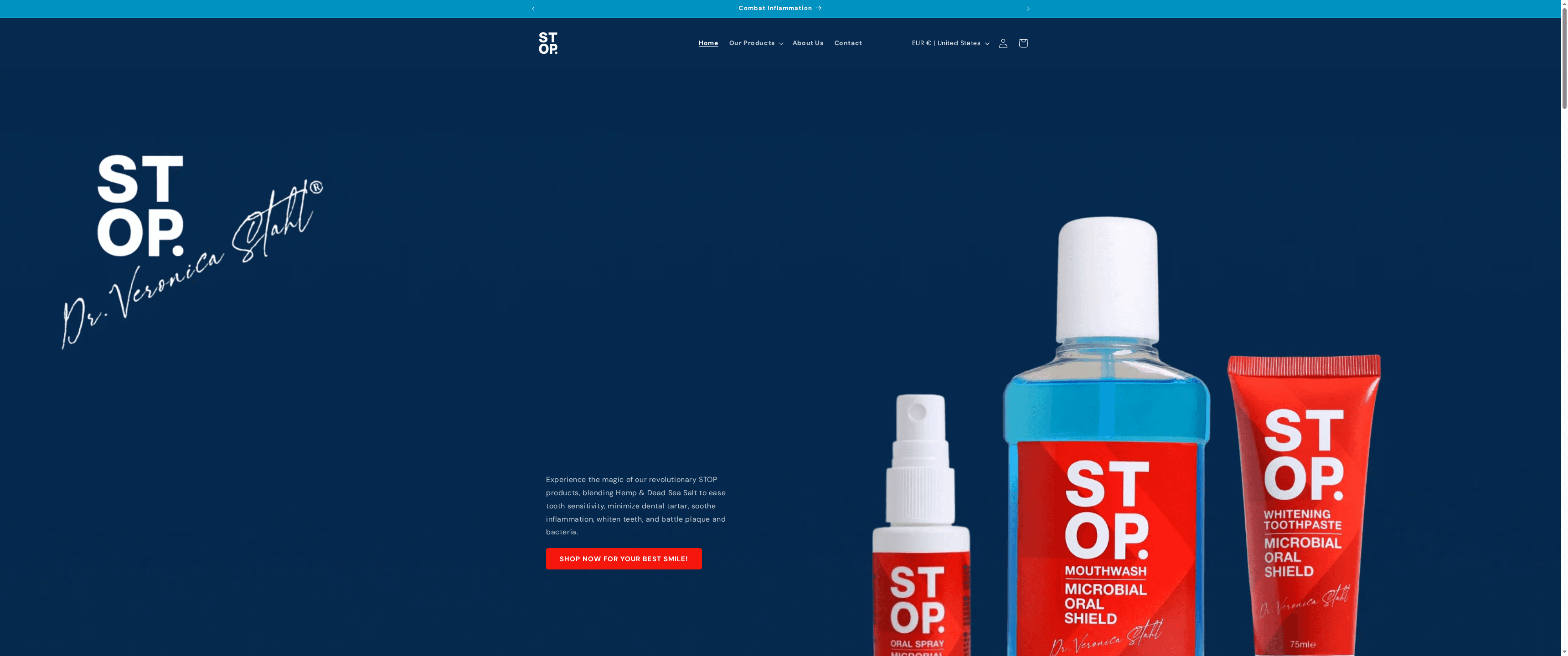
Stop-oralcare was developed with exactly this level of scrutiny in mind. The product line, formulated by Dr. Veronica Stahl and grounded in research on hemp-derived compounds and Dead Sea mineral bioactivity, prioritizes transparency over marketing shorthand. Each formulation is supported by scientific rationale addressing both antimicrobial performance and tissue safety, not one at the expense of the other. If you want to explore fluoride-free toothpaste options that specify the science behind each ingredient, or review the full product range built on this standard, visit Stop-oralcare’s product catalog directly. Informed decisions start with accurate information, and the site is designed to provide both.
FAQ
What does “lab-tested” mean on oral care products?
“Lab-tested” is a marketing term without a standardized regulatory definition. It can refer to anything from basic ingredient analysis to full clinical trials, so the testing scope and independence matter as much as the label itself.
How is oral care tested for safety and efficacy?
Oral care products undergo several types of testing including biocompatibility assays, antimicrobial efficacy studies, and clinical trials. Safety and efficacy testing must address both pathogen reduction and tissue safety under realistic use conditions to be considered complete.
What is the ADA Seal of Acceptance?
The ADA Seal is a third-party endorsement requiring companies to submit independent laboratory and clinical study data along with manufacturing compliance documentation. It is valid for five years and must be renewed to remain on product packaging.
What is the difference between analytical and clinical validity in lab testing?
Analytical validity confirms that a test accurately measures a specific compound or biomarker. Clinical validity addresses whether that measurement predicts or confirms a disease condition, and requires separate FDA review beyond standard laboratory certification.
Does the FDA test individual toothpaste products?
The FDA does not test individual toothpaste products prior to market entry. It establishes permissible active ingredient categories through the OTC Drug Monograph system, but product-level safety and efficacy data are not independently verified by the FDA for each formulation on the market.