

TL;DR:
- Antioxidants in toothpaste mainly support tissue protection and reduce inflammation by neutralizing reactive oxygen species rather than remineralizing enamel.
- Evidence shows they influence oral biochemistry positively but lack consistent proof of outperforming conventional products in clinical outcomes like cavity prevention.
Antioxidants have moved well beyond the supplement aisle and into oral care formulations, yet the role of antioxidants in toothpaste remains poorly understood by most consumers. A common misconception holds that antioxidant ingredients can substitute for fluoride in preventing cavities, which conflates two distinct biochemical mechanisms operating at different sites and scales within the oral environment. Antioxidants do not remineralize enamel. What they do, when properly formulated and supported by clinical evidence, is neutralize reactive oxygen species (ROS), reduce gingival inflammation, and disrupt conditions favorable to bacterial biofilm development. This guide examines the science precisely, so you can make evidence-based choices in a market that generates more claims than it does clinical data.
Table of Contents
- Understanding antioxidants and oxidative stress in oral health
- Scientific evidence for antioxidant toothpaste effects
- Antioxidants in fluoride-free toothpaste: formulation and clinical impact
- How antioxidant compounds work at dental tissue and material interfaces
- Choosing antioxidant toothpastes wisely: what health-conscious consumers should know
- Why antioxidant toothpaste benefits are often misunderstood
- Explore natural fluoride-free antioxidant oral care with Stop Oral Care
- Frequently asked questions
Key Takeaways
| Point | Details |
|---|---|
| Antioxidants reduce oxidative damage | Antioxidants in toothpaste neutralize harmful molecules that cause gum inflammation and tissue damage. |
| Complement fluoride use | Antioxidants support gum health but do not replace fluoride’s role in preventing tooth decay. |
| Clinical evidence is nuanced | Some trials show biochemical improvements but limited clear superiority over conventional toothpaste. |
| Formulation matters | Effectiveness depends on the specific antioxidant ingredients and their stability in the oral environment. |
| Choose wisely | Consumers should look for scientifically backed formulations and maintain realistic expectations. |
Understanding antioxidants and oxidative stress in oral health
Oxidative stress in the oral cavity occurs when the production of reactive oxygen species exceeds the capacity of local antioxidant defenses to neutralize them. Free radicals, which are chemically unstable molecules carrying an unpaired electron, attack lipid membranes, proteins, and DNA in gingival tissue, triggering a cascade of inflammatory mediators. Periodontal pathogens including Porphyromonas gingivalis and Fusobacterium nucleatum actively generate ROS as part of their metabolic activity, compounding the oxidative burden on host tissues.
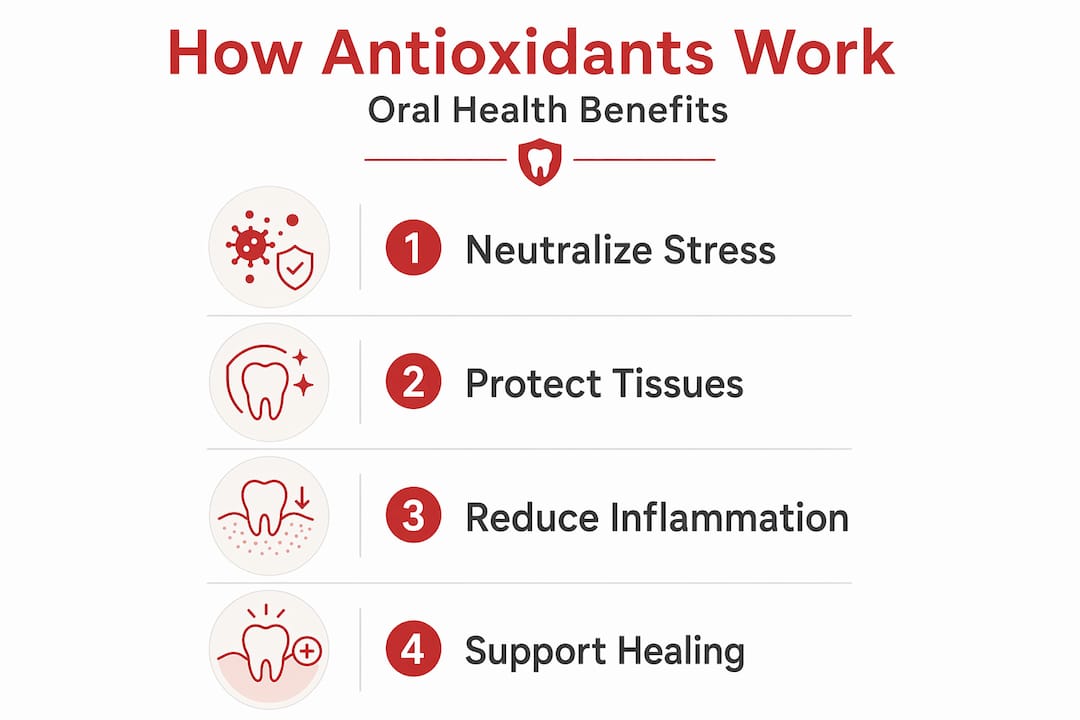
Antioxidants counteract this process by donating electrons to ROS without becoming destabilized themselves, thereby terminating the oxidative chain reaction. This mechanism reduces gingival tissue inflammation and supports cellular repair. According to tissue-level analyses, antioxidants cut gum damage by up to 40% through ROS neutralization, a magnitude that is clinically meaningful when sustained across daily use cycles.
Beyond direct neutralization, antioxidants also interfere with bacterial adhesion to the pellicle layer on tooth surfaces. By altering the redox state of the oral environment, they reduce conditions that favor the attachment and maturation of pathogenic biofilms. The following mechanisms summarize the protective actions antioxidants perform within the oral cavity:
- Electron donation: Antioxidants donate electrons to free radicals, neutralizing their reactivity and halting oxidative tissue damage.
- Inflammation reduction: By suppressing ROS-driven signaling pathways, antioxidants reduce the production of pro-inflammatory cytokines such as interleukin-1 beta and tumor necrosis factor alpha.
- Tissue repair facilitation: A reduced oxidative environment allows fibroblasts and epithelial cells to function more effectively in gingival tissue remodeling.
- Biofilm disruption: Redox modulation alters the oral microenvironment in ways that impair early colonizer adhesion and subsequent pathogenic community development.
“Antioxidants do not eliminate bacteria directly. Their primary contribution is reducing the inflammatory and oxidative context in which periodontal disease progresses, making them a critical supportive strategy rather than a standalone antimicrobial intervention.”
The benefits of antioxidants in oral care are therefore most accurately understood as tissue-protective and anti-inflammatory, not antibacterial in the conventional pharmacological sense.
Scientific evidence for antioxidant toothpaste effects
Clinical evaluation of toothpaste with antioxidants must be assessed against rigorously designed trials, not marketing claims. A 2025 single-blind randomized controlled trial enrolled 80 adolescents and examined the effects of a polyherbal antioxidant toothpaste over 30 days, measuring dental plaque, gingivitis scores, and salivary antioxidant biomarkers. The within-group results were notable: both the test and control groups demonstrated statistically significant changes in antioxidant markers.
However, no significant between-group differences were observed when comparing the polyherbal formulation directly against conventional toothpaste, which presents a critical nuance for interpretation. The data suggest that antioxidant toothpaste does influence oral redox biology, but that evidence of clinical superiority over conventional products remains limited at this stage.
| Outcome measure | Within-group change (antioxidant group) | Between-group significance |
|---|---|---|
| Salivary antioxidant capacity | Statistically significant increase | Not significant |
| Plaque index score | Significant reduction | Not significant |
| Gingivitis score | Significant reduction | Not significant |
| Oxidative stress biomarkers | Significant decrease | Not significant |
This pattern is consistent across much of the antioxidant toothpaste literature: measurable biological activity occurs, but demonstrating that this activity translates to superior clinical outcomes compared to well-formulated conventional products requires larger trials with longer follow-up periods.
The role of antioxidants in oral hygiene is therefore best framed as biochemically active and clinically supportive, pending stronger evidence from head-to-head trials of longer duration.
Key considerations when interpreting the current evidence base:
- Within-group improvements confirm that antioxidant mechanisms operate in vivo.
- Between-group parity does not mean antioxidants are ineffective; it may reflect that conventional toothpaste also reduces oxidative burden through surfactants and mechanical cleaning.
- Trial duration of 30 days may be insufficient to detect long-term tissue-level differences.
- Adolescent populations may not reflect antioxidant responses in adults with established periodontal conditions.
Pro Tip: When evaluating research on natural vs conventional toothpaste, prioritize studies that report both within-group and between-group statistics. A study showing only within-group improvements can overstate the case for a product if no comparison group is included.
Antioxidants in fluoride-free toothpaste: formulation and clinical impact
Fluoride-free formulations require a more deliberate architectural approach to active ingredient selection than fluoride-containing products, because no single compound in the fluoride-free space replicates the full scope of fluoride’s enamel-protective chemistry. Antioxidant toothpaste ingredients contribute meaningfully to overall oral tissue health, but caries prevention in these formulations depends on complementary actives, particularly remineralizing agents and antibacterial compounds.

A systematic review of clinical evidence on active ingredients in fluoride-free toothpastes concluded that caries prevention efficacy is highly formulation-specific, with remineralizers such as hydroxyapatite and ionic compounds such as arginine showing the most direct clinical evidence. Antioxidants support these outcomes by reducing the inflammatory tissue environment in which caries-associated pathogens thrive, but they do not provide direct remineralization.
| Ingredient category | Primary mechanism | Evidence for caries prevention |
|---|---|---|
| Hydroxyapatite | Enamel remineralization | Moderate to strong clinical evidence |
| Arginine | Plaque pH neutralization | Moderate clinical evidence |
| Antioxidant compounds | ROS neutralization, anti-inflammatory | Supporting evidence; not primary caries prevention |
| Antibacterial botanicals | Pathogen suppression | Variable; formulation-dependent |
| Dead Sea minerals | Trace element provision, antimicrobial | Emerging evidence; used in natural formulations |
Effective fluoride-free formulations tend to combine multiple actives in ratios and delivery systems that preserve ingredient stability through the product’s shelf life and optimize retention in the oral environment during use. Antioxidants that degrade rapidly in aqueous formulations or that are rinsed away within seconds of toothbrushing deliver minimal functional benefit regardless of their in vitro potency.
The role of botanicals in fluoride-free toothpaste is particularly relevant here, as many antioxidant compounds in natural formulations derive from plant extracts including green tea polyphenols, pomegranate ellagic acid, and resveratrol, all of which demonstrate measurable antioxidant activity in salivary assays.
Consumers exploring a remineralizing fluoride-free toothpaste should evaluate whether the formulation pairs antioxidant actives with a documented remineralizing agent, since this combination addresses both oxidative tissue damage and enamel integrity simultaneously.
How antioxidant compounds work at dental tissue and material interfaces
Beyond their systemic role in oral health, antioxidants perform distinct biochemical functions at the interface between dental tissues and restorative materials, a dimension of the role of antioxidants in dentistry that receives comparatively little attention in consumer-facing literature. Understanding this mechanism is particularly relevant for individuals who have undergone root canal treatment or who are planning restorative dental procedures.
Sodium hypochlorite (NaOCl), the standard irrigant used during root canal preparation, generates substantial oxidative species within dentinal tubules. These oxidants alter the redox state of dentin surfaces, compromising the collagen matrix and reducing the penetration depth of root canal sealers. Research demonstrates that antioxidants restore the redox state of NaOCl-treated dentin, repairing surface characteristics necessary for effective sealer adhesion and long-term restoration integrity.
The mechanism operates through the following sequence:
- NaOCl irrigation produces reactive oxygen species within dentinal tubules, oxidizing collagen cross-links and altering the surface chemistry of dentin.
- Applied antioxidants donate electrons to these oxidative species, neutralizing them before they cause further structural disruption.
- Redox balance at the dentin surface is restored, returning collagen conformation closer to its native state.
- Improved surface characteristics allow dental sealers to penetrate more effectively into tubular structures, enhancing the hermetic seal quality.
The antioxidant role in oral hygiene at tissue interfaces demonstrates that the functional utility of these compounds extends well into clinical dentistry, not merely consumer oral care. A broader discussion of how antioxidants function across biological systems, including their role as redox regulators in supplements, is also relevant to understanding their systemic and local oral activity.
Pro Tip: If you have recently undergone root canal treatment, discuss with your dental provider whether a short-term antioxidant rinse protocol is appropriate for your recovery, given that antioxidant compounds may support dentin surface restoration following NaOCl irrigation. The role of antioxidants in supplements extends the same ROS-neutralizing chemistry into systemic contexts that can complement topical oral application.
Choosing antioxidant toothpastes wisely: what health-conscious consumers should know
The market for toothpaste with antioxidants has expanded considerably across Europe, driven largely by consumer preference for natural, fluoride-free alternatives. This growth has not, however, been matched by a proportionate increase in rigorous clinical evidence. Selecting products intelligently requires treating “antioxidant” as a mechanistic descriptor rather than a quality certification.
The antioxidant label alone does not constitute reliable evidence for caries prevention; the specific compounds present, their concentrations, their stability within the formulation, and their retention time in the oral cavity all determine whether any meaningful biological effect occurs during typical two-minute brushing sessions.
Practical criteria for evaluating antioxidant toothpaste products include:
- Specific ingredient disclosure: Products should list the actual antioxidant compounds, such as coenzyme Q10, alpha-tocopherol, green tea extract, or quercetin, not merely the term “antioxidant blend.”
- Complementary active ingredients: Effective fluoride-free formulations pair antioxidants with documented remineralizing or antimicrobial agents, since antioxidants alone do not prevent enamel demineralization.
- Formulation stability data: Aqueous antioxidant formulations are prone to oxidation during storage. Seek products with stated stability testing or packaging designed to limit oxidative degradation.
- Realistic oral contact time: Given that toothpaste is rinsed from the mouth within minutes, antioxidant compounds must either achieve sufficient concentration in that window or be formulated for substantivity (binding to oral tissues for extended release).
- Clinical evidence references: Prioritize products whose manufacturers cite peer-reviewed trials rather than in vitro studies alone.
Pro Tip: Review the guide to choosing fluoride-free toothpaste to identify which antioxidant ingredients carry the most documented evidence for gum health support, and cross-reference any clinical claims against the trial populations described in the cited research.
Why antioxidant toothpaste benefits are often misunderstood
The enthusiasm surrounding antioxidant toothpaste in natural oral care markets reflects a broader pattern: compounds with well-documented systemic benefits are assumed to transfer those benefits directly into topical applications without the complexity of formulation science, dose, and delivery context. This assumption consistently overstates what current evidence supports.
Periodontal and caries biology is multifactorial. Oxidative stress is one component of a complex interplay involving microbial communities, host immune responses, diet, mechanical plaque control, and saliva composition. Antioxidant strategies, as repeatedly framed in the clinical literature, serve as supportive adjuncts to plaque control, not substitutes for it. A consumer who replaces twice-daily mechanical brushing and regular professional scaling with an antioxidant toothpaste, however well-formulated, has not made an equivalent substitution.
The marketing problem is partly one of category framing. When antioxidant toothpaste is positioned as a superior alternative to conventional products, clinical trials showing no significant between-group differences appear as failures rather than as expected results in a field where supportive interventions add incremental benefit. The more accurate framing is that antioxidants contribute meaningful, biochemically verifiable value as one element within a complete oral care regimen.
Consumer education is therefore not a peripheral concern; it is central to appropriate product use. A consumer who understands that antioxidant compounds reduce oxidative tissue burden without preventing cavities independently will integrate these products correctly and benefit from their genuine contributions. A consumer operating under inflated expectations will either over-rely on them or dismiss them entirely when unrealistic outcomes fail to materialize. Reviewing the evidence on natural vs conventional toothpaste with this calibrated perspective produces far more useful product evaluations than any single biomarker endpoint can provide.
Explore natural fluoride-free antioxidant oral care with Stop Oral Care
For consumers who have worked through the evidence and are ready to apply it practically, the formulation principles above translate directly into product criteria that natural oral care brands must meet.
Stop Oral Care offers a line of fluoride-free oral care products, including toothpaste formulated with hemp-derived compounds and Dead Sea minerals, developed under the clinical direction of Dr. Veronica Stahl. These formulations are designed with ingredient stability, active compound specificity, and oral retention in mind, precisely the factors that determine whether antioxidant oral care delivers measurable benefit or simply adds cost. If long-term gum health, evidence-aligned natural ingredients, and fluoride-free formulation are your criteria, exploring this range is a logical next step in your oral care protocol.
Frequently asked questions
Do antioxidants in toothpaste replace fluoride for cavity prevention?
Antioxidants do not replace fluoride for cavity prevention; fluoride acts through enamel remineralization, while antioxidants operate by neutralizing ROS and reducing gingival inflammation, which are complementary rather than interchangeable mechanisms.
Can antioxidant toothpaste reduce gum inflammation quickly?
Measurable gum improvements in bleeding and inflammation typically appear within 2 to 4 weeks of consistent daily use, with cumulative tissue-level benefits developing over extended application periods.
Are all antioxidant ingredients equally effective in toothpaste?
No; antioxidant performance depends on the specific compound’s stability within the formulation, its concentration, and whether it remains biochemically active in the oral environment long enough to exert meaningful ROS neutralization.
Is there strong clinical evidence that antioxidant toothpastes outperform conventional ones?
Current evidence, including a 2025 randomized controlled trial, shows that antioxidant toothpastes produce significant within-group biomarker changes but do not consistently demonstrate statistically significant advantages over conventional toothpaste in direct between-group comparisons.