

TL;DR:
- Fluoride remains the most effective agent for caries prevention, but alternatives show promising complementary benefits.
- Natural agents like xylitol, botanical extracts, nano silver, hydroxyapatite, hemp, and Dead Sea minerals are gaining scientific support.
- Choosing fluoride alternatives should consider individual risk factors and be complemented by professional dental guidance.
Fluoride has long been positioned as the singular guardian of dental health, yet a growing body of evidence suggests that other agents, including xylitol, botanical extracts, nano silver formulations, hydroxyapatite, hemp, and Dead Sea minerals, offer scientifically grounded alternatives for caries prevention and enamel remineralization. Across Europe, consumer demand for fluoride-free dental products has accelerated noticeably, driven by health-related preferences, regulatory scrutiny of fluoride concentrations, and a broader cultural shift toward ingredient transparency. This article evaluates the clinical evidence, mechanistic rationale, and practical applicability of the most significant fluoride alternatives currently available, providing a structured framework for informed decision-making regarding oral health product selection.
Table of Contents
- Why fluoride is the gold standard—and why alternatives are rising
- Xylitol and botanical agents: Evidence and efficacy in Europe
- Silver-based alternatives: Nano silver and new frontiers
- Hydroxyapatite, hemp, and Dead Sea minerals: Comparing the latest alternatives
- What most guides get wrong about fluoride-free dentistry
- Explore safer natural options with Stop Oral Care
- Frequently asked questions
Key Takeaways
| Point | Details |
|---|---|
| Fluoride alternatives work | Natural agents like xylitol and botanicals provide real benefits but don’t fully match fluoride’s proven efficacy. |
| Innovation brings choices | New ingredients such as hemp, Dead Sea minerals, and nano silver offer unique anti-inflammatory and remineralizing properties. |
| Evidence matters most | Choose oral care products based on robust data and consult professionals, especially if you’re at higher risk for tooth decay. |
| Adjunct use is safest | Alternatives should complement, not replace, proven fluoride-based care for most consumers. |
Why fluoride is the gold standard—and why alternatives are rising
Fluoride’s dominance in preventive dentistry rests on well-established mechanisms. It incorporates into enamel to form fluorapatite, a crystalline structure that is significantly more resistant to acid dissolution than native hydroxyapatite. It also inhibits glycolytic enzymes in cariogenic bacteria, reducing their capacity to produce organic acids that demineralize enamel. These dual mechanisms, operating at both the mineral and microbial levels, have made fluoride central to public health dentistry for over seven decades.
“Fluoride remains the most effective agent for caries prevention; alternatives show promise but are adjunctive.”
Despite this established record, the European market for fluoride-free oral care products has expanded substantially. Drivers include parental concern about fluoride ingestion in young children, consumer preferences for products formulated from recognizable and naturally derived compounds, and documented innovation from ingredient suppliers offering viable substitutes. The search for alternatives is not solely ideological. It reflects genuine scientific inquiry into whether specific compounds can achieve comparable outcomes through different biological pathways.
Several categories of concern motivate consumers who seek natural oral care ingredients as alternatives to conventional fluoride formulas:
- Toxicological caution: Some consumers cite research associating high systemic fluoride exposure with adverse effects, particularly in areas with naturally elevated water fluoride levels.
- Pediatric safety: Parents of young children are particularly cautious about fluoride ingestion risk during early tooth development.
- Ingredient philosophy: A preference for products whose ingredient lists derive entirely from natural or minimally processed sources.
- Clinical curiosity: An interest in whether novel compounds, including phytochemicals, minerals, and cannabinoids, may offer synergistic oral health benefits not present in fluoride alone.
Understanding these motivations is essential context for evaluating the alternatives that follow, as each is designed to address specific biological targets within the oral environment.
Xylitol and botanical agents: Evidence and efficacy in Europe
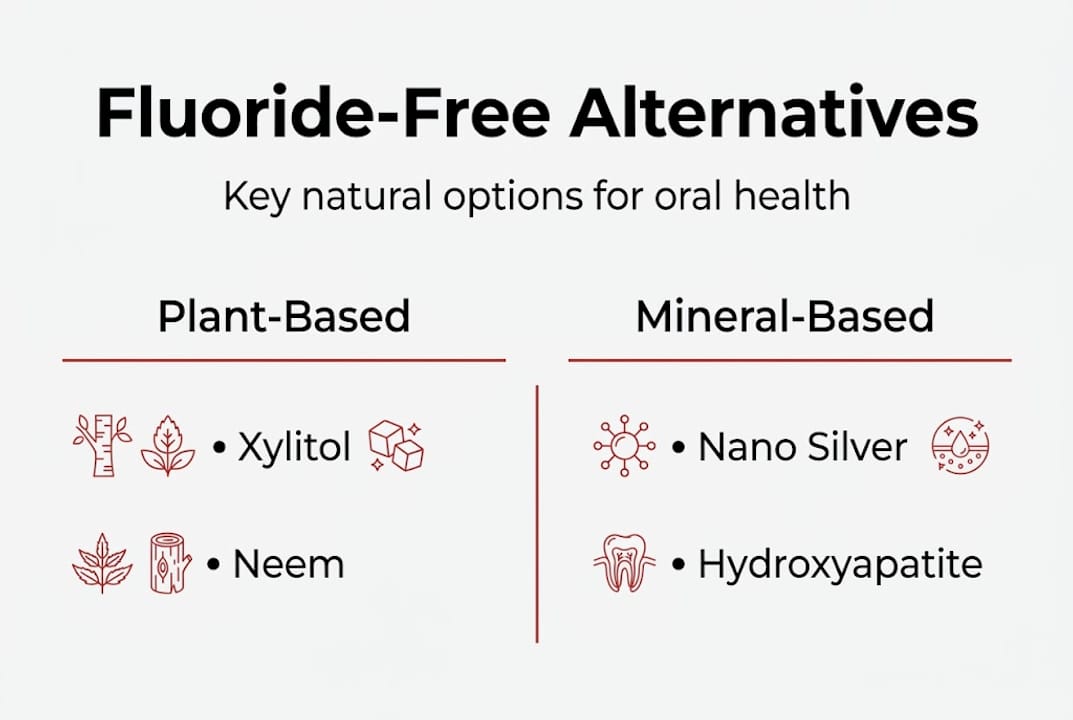
Xylitol, a five-carbon sugar alcohol derived from plant sources such as birch and corn, operates through a mechanism fundamentally distinct from that of fluoride. Streptococcus mutans, the primary cariogenic bacterium in the human oral cavity, cannot metabolize xylitol effectively. Upon uptake, xylitol disrupts bacterial energy metabolism, inhibits cell adhesion to enamel surfaces, and reduces biofilm formation. Additionally, xylitol promotes salivary flow, which facilitates calcium and phosphate ion availability for enamel remineralization. Xylitol prevents bacterial adhesion and aids remineralization in fluoride-free formulas, and it is now incorporated into numerous United Kingdom and European Union branded toothpastes.
Botanical agents represent a parallel and increasingly evidence-supported category. Neem (Azadirachta indica), clove (Syzygium aromaticum), ginger (Zingiber officinale), and maca (Lepidium meyenii) each contain phytochemically active compounds with documented antimicrobial and anti-inflammatory properties relevant to oral health. Herbal alternatives like neem and clove demonstrate antimicrobial and anti-inflammatory effects, with randomized controlled trial evidence of comparable plaque reduction relative to fluoride-containing controls.
Comparison of key fluoride-free active agents:
| Agent | Primary mechanism | Clinical evidence level | Remineralization potential |
|---|---|---|---|
| Xylitol | Bacterial inhibition, salivary stimulation | Moderate to high (RCTs) | Indirect via saliva |
| Neem extract | Antimicrobial, anti-biofilm | Moderate (RCTs, lab studies) | Limited direct evidence |
| Clove oil (eugenol) | Antimicrobial, analgesic | Moderate (clinical studies) | Limited direct evidence |
| Hydroxyapatite | Enamel matrix integration | High (multiple RCTs) | Direct, high |
| Hemp extract | Anti-inflammatory, antimicrobial | Preliminary (in vitro, limited RCT) | Indirect |
European brands formulating top natural oral ingredients into fluoride-free toothpastes frequently combine xylitol with one or more botanical extracts to achieve a broader antimicrobial spectrum. This combination strategy is scientifically rational because individual compounds may target different bacterial species or stages of biofilm development.
Pro Tip: When evaluating fluoride-free products containing botanical compounds, look for formulations that specify extract standardization, meaning the manufacturer has quantified the concentration of the active phytochemical. Unstandardized botanical products can vary considerably in potency.
The clinical literature on botanical dental products consistently indicates that short-term outcomes for plaque reduction and gingival health are favorable. Longer-term caries prevention data, however, remains less robust than the fluoride evidence base, which is an important consideration for high-risk individuals.

Silver-based alternatives: Nano silver and new frontiers
Silver has been used as an antimicrobial agent in medicine for over a century, and its application in dentistry has evolved significantly in recent decades. Silver diamine fluoride (SDF) is an established caries-arresting agent, but its characteristic side effect, permanent black staining of treated carious tissue, has limited its cosmetic acceptability, particularly for anterior teeth.
Nano silver fluoride (NSF) represents a significant advancement in this space. Comprising silver nanoparticles combined with fluoride ions and chitosan, NSF delivers antimicrobial activity through the sustained release of silver ions, which disrupt bacterial cell membranes and inhibit enzymatic activity at the cellular level. Critically, nano silver fluoride arrests caries without black staining and matches SDF efficacy, especially in pediatric populations and patients with special needs.
The following structured evidence points summarize NSF’s clinical profile:
- Efficacy against carious lesions: Clinical trials demonstrate that NSF achieves caries arrest rates comparable to those of SDF in primary dentition.
- Absence of black staining: Unlike SDF, NSF does not oxidize to silver sulfide within carious tissue, avoiding the cosmetic complication that limits SDF’s use on visible teeth.
- Pediatric and special needs applicability: NSF’s ease of application and tolerable taste profile make it particularly suitable for young children and patients for whom conventional restorative procedures are difficult to perform.
- Antimicrobial breadth: Silver nanoparticles demonstrate efficacy against a broad spectrum of oral pathogens, including S. mutans, Lactobacillus species, and Candida albicans.
NSF versus SDF: Key parameters
| Parameter | Nano silver fluoride | Silver diamine fluoride |
|---|---|---|
| Staining of treated tissue | None | Black (permanent) |
| Caries arrest efficacy | Comparable | Established |
| Antimicrobial spectrum | Broad | Broad |
| Pediatric suitability | High | Moderate |
For clinicians and consumers exploring innovative dental products, NSF illustrates how materials science is enabling meaningful improvements upon existing caries management strategies without compromising clinical outcomes.
Hydroxyapatite, hemp, and Dead Sea minerals: Comparing the latest alternatives
Hydroxyapatite (HA) is the mineral constituent of human enamel and dentin, comprising approximately 97% of mature enamel by weight. Synthetic HA, when incorporated into toothpaste at nanoscale particle sizes, integrates directly into demineralized enamel surfaces, physically repairing micro-lesions and reducing surface roughness. Multiple randomized controlled trials support its remineralization efficacy, and it is now commercially available across European markets. However, hydroxyapatite is clinically proven but not always superior to fluoride, and some evidence suggests it may reduce acid resistance compared to fluorapatite under specific dietary conditions.
Hemp-derived extracts, principally cannabidiol (CBD) and related cannabinoids, have entered the oral care space with a preliminary but scientifically interesting profile. Cannabinoids demonstrate in vitro antibacterial activity against oral pathogens and have documented anti-inflammatory properties relevant to periodontal health. However, robust, large-scale clinical trials specifically evaluating hemp-based toothpaste or mouthwash for caries prevention remain limited, a factor that must be weighed against the mechanistic plausibility.
Dead Sea minerals, particularly magnesium, calcium, potassium, and trace elements derived from Dead Sea brine concentrates, offer a mineralogically distinct approach. Their remineralizing potential derives from ion substitution within enamel crystallites, and their anti-inflammatory properties are supported by dermatological and preliminary oral health research. For consumers interested in the Dead Sea minerals guide for oral care, the mechanistic rationale is scientifically sound, though randomized clinical trial data specific to oral applications is not yet at the level of fluoride or HA evidence.
Pro Tip: If you are considering hemp or Dead Sea mineral products as part of your oral care regimen, prioritize formulations that also include better-evidenced agents such as xylitol or nano-HA. This combination approach maximizes the evidence base while allowing exploration of innovative ingredients.
Key considerations for choosing among these alternatives include:
- Caries risk assessment: High-risk individuals should rely on agents with the strongest caries-preventive evidence base.
- Ingredient compatibility: Some mineral-rich formulations may interact with other active ingredients; review product compatibility before combining products.
- Regulatory status: Verify that products comply with EU cosmetics regulation (EC 1223/2009), which governs permissible ingredient concentrations.
- Ongoing monitoring: Regardless of product choice, regular professional dental examination remains essential for tracking enamel integrity. Consult resources on oral care innovation for the latest evidence-based guidance.
What most guides get wrong about fluoride-free dentistry
The majority of consumer-facing content on fluoride-free dentistry errs in one of two directions. Either it dismisses all alternatives as clinically inferior and insufficiently evidenced, or it overstates the proven efficacy of novel compounds based on preliminary or in vitro data. Neither position accurately reflects the current scientific literature.
The more calibrated view is that fluoride alternatives are adjunctive, not a true gold standard, and high-risk individuals should not depend solely on alternatives. This does not render alternatives useless. It means they are most effective when selected according to individual risk profiles, used consistently, and monitored through regular professional review.
Consumers with low caries risk, good dietary habits, adequate salivary flow, and consistent mechanical hygiene practices may indeed maintain oral health using fluoride-free formulations. Those with active caries history, xerostomia, or orthodontic appliances face meaningfully higher risk if they abandon evidence-based agents without professional guidance. The most informed approach involves reviewing natural ingredients in dental care within the context of your own clinical history, rather than adopting any single product category as universally superior.
Explore safer natural options with Stop Oral Care
For European consumers who have reviewed the evidence and are ready to incorporate scientifically supported, fluoride-free products into their oral care regimen, Stop Oral Care offers a curated range of natural oral care products formulated with hemp, Dead Sea minerals, and other evidence-referenced ingredients.
The platform, developed under the direction of Dr. Veronica Stahl, provides not only innovative product formulations but also an extensive library of expert-authored guides. Readers seeking a detailed breakdown of active compounds can consult the natural oral ingredients guide for a structured overview of ingredients, mechanisms, and evidence levels. Stop Oral Care is designed for consumers who make evidence-informed choices and want products that reflect both scientific rigor and natural formulation principles.
Frequently asked questions
Is fluoride-free toothpaste clinically proven to prevent cavities?
Most fluoride-free toothpastes containing xylitol and botanicals show short-term efficacy for plaque reduction and remineralization, but overall caries prevention remains less robust than fluoride-based formulations. Herbal toothpastes reduce plaque comparably to fluoride in short-term randomized controlled trials, though long-term data is more limited.
Are hemp or Dead Sea minerals safe and effective for oral health?
Hemp and Dead Sea minerals are innovative ingredients with a generally favorable safety profile, but hemp and Dead Sea minerals lack large-scale clinical trials sufficient to establish long-term effectiveness for caries prevention. They are best positioned as complementary agents within a broader oral care strategy.
What should I consider when choosing a fluoride alternative?
Assess your individual caries risk level, review the clinical evidence for each active ingredient, and consult your dentist before making changes. Fluoride alternatives are adjunctive in nature and should be monitored via regular professional dental review, particularly for individuals with elevated caries risk.
Can nano silver fluoride replace traditional fluoride for children?
Nano silver fluoride matches SDF efficacy for caries arrest in primary dentition without producing black staining, making it a clinically viable option for pediatric and special needs patients in contexts where SDF aesthetics are a concern.