

TL;DR:
- Waterless, fluoride-free oral care products utilizing nanohydroxyapatite effectively remineralize enamel, challenging fluoride’s long-standing dominance. These formulations, including tablets, swabs, and powders, rely on saliva activation and target environmental sustainability by reducing packaging and water use. They are particularly beneficial for dry mouth, travelers, and eco-conscious consumers, providing a scientifically supported alternative in modern dentistry.
Modern waterless oral care formulations, particularly those incorporating nano-hydroxyapatite (nHA), a synthetic analog of the calcium phosphate mineral that constitutes approximately 97% of dental enamel, have demonstrated remineralization efficacy of 51.74%, a figure statistically comparable to the 50.56% inhibition recorded for conventional fluoride toothpaste. This finding challenges the long-standing assumption that fluoride is irreplaceable in preventive dental care. As health-conscious consumers increasingly prioritize natural ingredient profiles, reduced chemical exposure, and environmental sustainability, waterless oral care products formulated with fluoride-free, science-backed ingredients represent a clinically relevant and practically viable category within modern dentistry.
Table of Contents
- What is waterless oral care?
- How waterless oral care products work: science and evidence
- Natural fluoride-free vs. traditional: expert perspectives and comparisons
- Who benefits most from waterless oral care? Practical use cases
- Waterless oral care: a fresh perspective on modern dental routines
- Discover natural waterless oral care solutions
- Frequently asked questions
Key Takeaways
| Point | Details |
|---|---|
| Comparable efficacy | Waterless oral care products with nHA can match fluoride toothpaste in preventing enamel demineralization. |
| Natural ingredients | Formulations often use xylitol, nHA, calcium carbonate, and coconut oil for gentle cleaning and microbiome support. |
| Eco-friendly advantage | Waterless oral care suits health-conscious and sustainable lifestyles, reducing water use and plastic waste. |
| Ideal for accessibility | These products benefit those with dry mouth, the elderly, or limited water access. |
| Best as supplement | Waterless oral care works best as a supplement to regular brushing, not a full replacement. |
What is waterless oral care?
Waterless oral care refers to a category of dental hygiene products designed to clean teeth, support gum health, and maintain oral microbiome balance without requiring water as a delivery medium or formulation base. Unlike conventional toothpaste, which typically consists of 20 to 40 percent water and relies on aqueous suspension to distribute active agents, waterless formats activate through saliva interaction, mechanical contact, or lipid-based delivery systems.
The absence of water in these formulations serves multiple functional purposes. It eliminates the need for preservatives that prevent microbial contamination in water-containing products, reduces packaging weight for shipping efficiency, and enables the use of concentration-dense active ingredients. Saliva-activated products, in particular, leverage the natural enzymatic and buffering properties of saliva to initiate foaming, distribute antimicrobial agents, and facilitate remineralization at the enamel surface.
Formulations within this category depend on a defined set of active and inactive ingredients, each selected for specific oral health functions. According to peer-reviewed analysis, natural fluoride-free formulations incorporate the following compounds:
- Nano-hydroxyapatite (nHA): Remineralizes enamel by integrating calcium and phosphate ions directly into demineralized zones
- Xylitol: Reduces Streptococcus mutans colonization by inhibiting bacterial acid production, thereby lowering cariogenic (cavity-causing) activity
- Calcium carbonate: Functions as a mild abrasive to remove plaque biofilm while buffering oral pH toward neutral levels
- Baking soda (sodium bicarbonate): Neutralizes acidic pH generated by bacterial fermentation of dietary sugars
- Coconut oil: Delivers antimicrobial activity primarily through lauric acid, which disrupts bacterial cell membranes
- Silica: Provides controlled abrasion for plaque removal without excessive enamel wear, supporting enamel protection
Product formats include dissolvable tablets, chewable tabs, silicone swab applicators, dry-powder sachets, and concentrated oil-based formulations. For a broader overview of natural fluoride-free care, the mechanisms underlying each ingredient class are worth examining in detail before selecting a product format.
How waterless oral care products work: science and evidence
The functional performance of waterless oral care products depends on measurable physical and chemical properties that can be assessed through standardized laboratory testing. These properties determine whether a product will disintegrate appropriately in the oral cavity, distribute active ingredients effectively, and generate sufficient mechanical action for plaque removal.
Empirical testing of toothpaste tablets has produced the following performance data, as reported in published materials science evaluations:
| Parameter | Without fluoride (nHA) | Control (fluoride) |
|---|---|---|
| Friability | 1.46% | Comparable |
| Compressive strength | 55.24 N | Reference standard |
| Disintegration time | Short (oral-appropriate) | Short |
| Foaming index | Adequate | Standard |
| Demineralization inhibition | 51.74% | 50.56% |
These figures, drawn from tablet physical property testing, confirm that nHA-based waterless tablets achieve mechanical integrity sufficient for safe oral use, disintegrate within clinically acceptable timeframes when activated by saliva, and generate foaming adequate for distributing active ingredients across tooth surfaces.
The remineralization mechanism of nHA operates at the nanoscale. Particles measuring 20 to 100 nanometers in diameter penetrate demineralized enamel tubules, where they deposit calcium and phosphate ions in the same crystalline lattice structure as natural hydroxyapatite. This process is distinct from fluoride-mediated remineralization, which converts hydroxyapatite to fluorapatite, a structurally different mineral. Whether fluorapatite or hydroxyapatite-based remineralization confers superior long-term protection remains a subject of clinical investigation, but laboratory inhibition data show comparable outcomes.
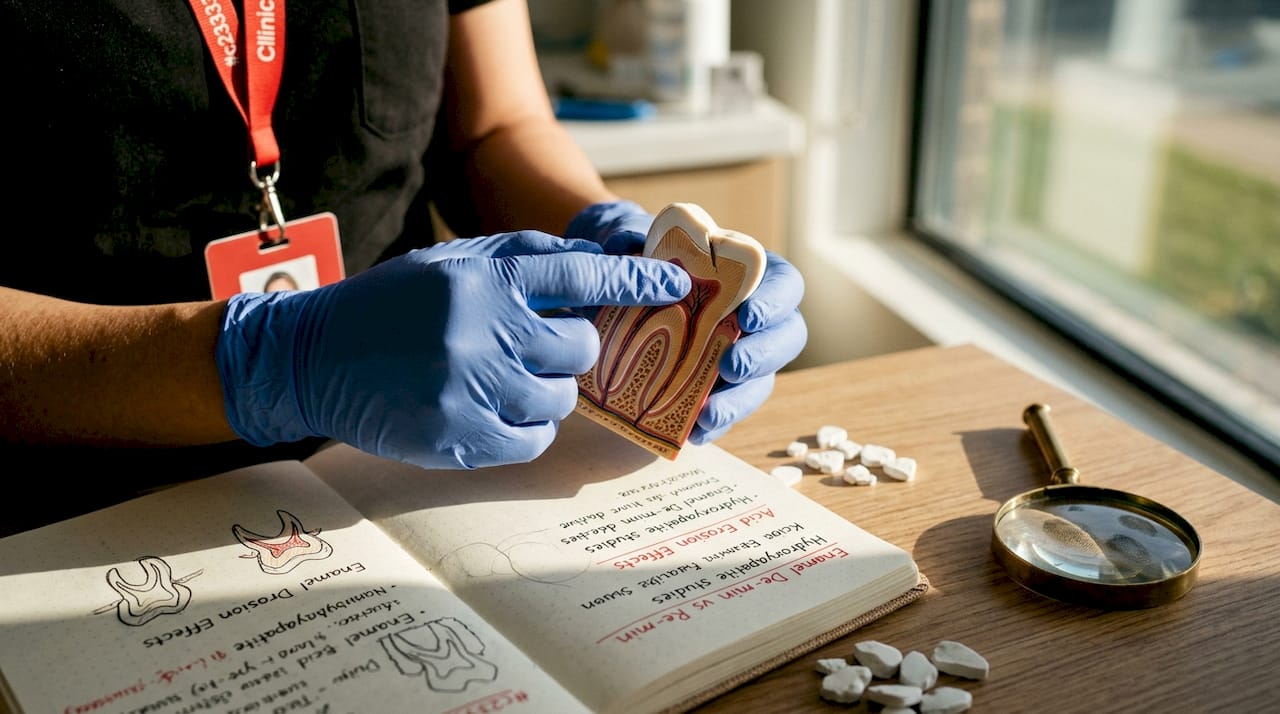
Silicone swab formats represent a specialized application of waterless oral care technology. Testing indicates that silicone swabs perform superiorly in dry plaque removal scenarios, making them particularly relevant for patients experiencing xerostomia (dry mouth) or those in clinical settings where water access is restricted. Swabs coated with oil-based or lipid formulations maintain contact time on tooth surfaces longer than water-based applications, enhancing both antimicrobial delivery and mechanical debridement.
Pro Tip: When transitioning to a waterless tablet or chewable format, allow the product to fully dissolve on the tongue before brushing. This maximizes saliva activation and ensures even distribution of nHA or other active agents across all tooth surfaces before mechanical brushing begins.
For a more detailed examination of effective natural alternatives and how these compare to standard pharmacological formulations, laboratory-validated ingredient profiles provide the most reliable basis for product selection. Practitioners and consumers interested in reducing their environmental footprint should also note that eco-friendly oral hygiene routines built around waterless formats significantly reduce plastic packaging and water consumption across the product lifecycle.
Natural fluoride-free vs. traditional: expert perspectives and comparisons
A nuanced assessment of waterless, fluoride-free oral care products relative to traditional toothpaste requires consideration of both laboratory efficacy data and clinical translation, as these two dimensions do not always align.
Pharmacists and oral health professionals have noted that while hydroxyapatite carries documented remineralization support at the bench level, clinical translation of lab results does not always match in-vitro performance precisely. Salivary flow rates, dietary acid exposure, brushing technique, and existing caries risk all modulate outcomes in ways that controlled laboratory conditions cannot fully replicate.
“Hydroxyapatite is supported for remineralization, but pharmacists note mixed evidence for fluoride-free efficacy versus traditional formulations in high-caries-risk populations. Fluoride-free options are best positioned for low-caries-risk, eco-focused individuals.” — Pharmacy Times, clinical practice guidance
This expert framing provides critical context for positioning waterless fluoride-free products appropriately within oral health routines. The comparison below summarizes key differentiators:
| Feature | Waterless fluoride-free | Traditional fluoride toothpaste |
|---|---|---|
| Remineralization mechanism | nHA, calcium carbonate | Fluorapatite formation via fluoride |
| Caries risk suitability | Best for low to moderate risk | Broad, including high-risk populations |
| Packaging sustainability | High (minimal or plastic-free) | Lower (multi-layer plastic tubes) |
| Preservative load | Minimal (no water base) | Higher (aqueous formulation requires preservation) |
| Oral microbiome impact | Targeted, microbiome-supportive | Variable, depending on formulation |
| Portability | High (tablets, swabs, powders) | Moderate (tube format) |
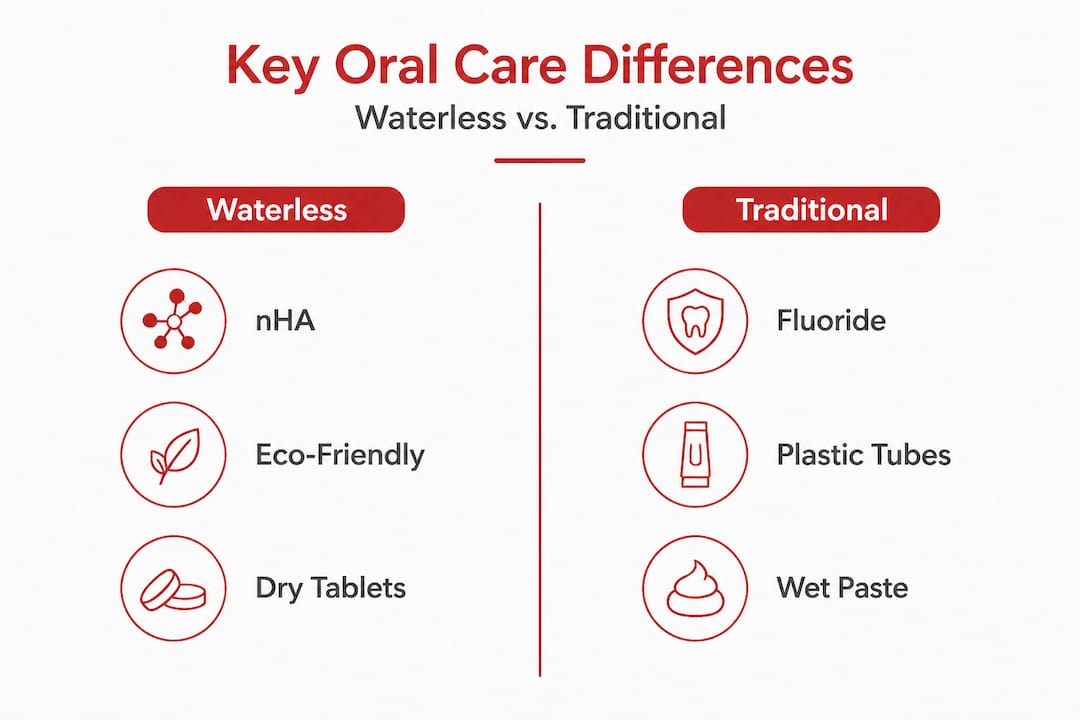
The practical advantages of waterless formats extend beyond ingredient composition. Travelers, outdoor professionals, and individuals in regions with limited clean water access benefit significantly from portable, dissolvable tablet or chew-based formats. For structured guidance on implementing these products within a clinical or personal routine, a detailed fluoride-free dental care workflow offers step-by-step integration protocols.
Key considerations for selecting fluoride-free waterless care, as identified in expert literature, include:
- Caries risk assessment: Individuals with documented low caries risk and good dietary habits are optimal candidates
- Ingredient verification: Products should contain validated actives such as nHA, xylitol, or calcium carbonate at documented concentrations
- Sustainability alignment: Fluoride-free waterless formats consistently offer superior environmental profiles compared to conventional tubes
- Microbiome sensitivity: Those with dysbiotic (imbalanced) oral microbiomes may benefit from xylitol-containing formulations that selectively suppress cariogenic bacteria
Practitioners interested in the broader environmental context of eco-friendly dental care practices will note that regulatory agencies in several European countries have already approved nHA as a recognized anti-caries agent, providing additional clinical legitimacy for this class of products.
Who benefits most from waterless oral care? Practical use cases
Waterless oral care products do not represent a universal replacement for all patients or all settings. Their clinical and practical value is highest within specific populations and contexts where their unique delivery mechanisms provide demonstrable advantages.
Research published in peer-reviewed literature confirms that for individuals experiencing dry mouth or age-related reduction in salivary gland function, dry-cleaning tools including swabs address significant access barriers. Lipid-based films in these products provide extended surface contact and antimicrobial activity compared to water-based alternatives, which tend to dissipate rapidly in low-saliva environments. For populations where caries risk remains elevated, the current evidence recommends integrating fluoride supplementation rather than replacing it entirely.
The following populations derive measurable benefit from waterless oral care formulations:
- Xerostomia patients: Individuals with clinically diagnosed dry mouth, whether from medication side effects, Sjögren’s syndrome, or radiation therapy, benefit from oil-based or silicone swab formats that function independently of salivary activation
- Elderly and mobility-limited individuals: Waterless formats, particularly pre-dosed tablets and swabs, reduce the physical complexity of oral hygiene routines for individuals with limited dexterity or mobility
- Travelers and outdoor users: Compact, water-independent formats eliminate the logistical burden of carrying toothpaste tubes and accessing clean water during travel
- Eco-conscious consumers: Individuals prioritizing reduced plastic consumption, carbon footprint, and chemical load in personal care products represent the core demographic for waterless fluoride-free formulations
- Health-focused individuals avoiding fluoride: Those who prefer to minimize pharmaceutical chemical exposure while maintaining evidence-supported oral hygiene find nHA-based products particularly well-suited to their requirements
For patients at elevated caries risk, the recommendation remains to supplement waterless oral care with a fluoride source, whether through professional application or fluoride-containing rinse, rather than relying exclusively on fluoride-free formulations. This integrated approach aligns with findings from sustainable oral care alternatives research, which identifies combination strategies as optimal for balancing efficacy with natural ingredient preferences.
Pro Tip: If you are in a high-caries-risk category and wish to incorporate waterless fluoride-free products, consider using nHA tablets as your primary brushing medium and supplementing with a fluoride varnish applied by a dental professional during routine visits. This approach preserves the benefits of natural formulations while maintaining established caries protection protocols.
The broader evidence base for sustainable oral care benefits consistently identifies waterless formats as superior in environmental outcome metrics, including packaging waste reduction, carbon emission per unit, and water resource consumption across the product lifecycle.
Waterless oral care: a fresh perspective on modern dental routines
Conventional dental practice has historically positioned fluoride as a non-negotiable component of preventive oral care, a view shaped by decades of public health research conducted largely in fluoride-deficient communities during the mid-20th century. That historical framing, while evidence-based for its time, has created a default assumption that any fluoride-free alternative is necessarily inferior. The current body of laboratory data challenges this framing in material and measurable ways.
What the evidence actually shows is that the efficacy gap between nHA and fluoride, at least at the enamel remineralization level, is negligible under controlled conditions. The practical implication is not that fluoride should be abandoned, but that it is no longer the only scientifically defensible choice. This distinction matters enormously for health-conscious individuals who have been told, often without nuance, that natural alternatives are insufficient.
What most people miss when evaluating waterless oral care is not the ingredient science, but the integration question. A waterless nHA tablet used inconsistently and with poor brushing technique will underperform a conventional toothpaste used correctly twice daily. Ingredient quality and routine consistency are not separate variables; they operate together. Selecting a botanicals-enhanced fluoride-free product formulated with validated actives is the first step. Maintaining the mechanical discipline of twice-daily brushing with adequate contact time is the second.
The sustainability dimension also deserves a more sophisticated reading than it typically receives. Waterless formats are not simply “greener” for packaging reasons. Their concentrated formulas reduce transport weight, their preservative-free profiles reduce manufacturing chemical inputs, and their saliva-activated mechanisms align with the body’s existing biochemical infrastructure. As toothpaste tablet innovation continues to advance, the convergence of ecological responsibility and clinical performance will become increasingly difficult to dismiss.
The practical recommendation is straightforward: trial a validated waterless format for a minimum of four weeks under consistent conditions, assess gum health and sensitivity response, and adjust supplementation based on individual caries risk profile. Rigid adherence to either waterless or traditional formats, without evaluating individual response, reflects a prescriptive rather than evidence-based approach to oral health.
Discover natural waterless oral care solutions
The scientific evidence reviewed in this article confirms that waterless, fluoride-free oral care is not a trend. It is a category with documented efficacy, clear sustainability advantages, and well-defined clinical applications.
If you are ready to incorporate natural, science-supported oral care products into your routine, Stop Oral Care offers a curated line of fluoride-free formulations developed by Dr. Veronica Stahl, a specialist in dentistry and natural medicine. The product range includes hemp and Dead Sea mineral formulations designed for enamel support, microbiome balance, and long-term oral health. Each product is formulated with transparency regarding ingredient sourcing and concentration, providing the evidence-based foundation that health-conscious consumers require when transitioning away from conventional dental products.
Frequently asked questions
Do waterless oral care products really work as well as traditional toothpaste?
Laboratory studies show that nHA tablets inhibit demineralization at 51.74%, compared to 50.56% for fluoride toothpaste, though clinical outcomes may vary depending on individual risk factors and brushing consistency.
Are waterless oral care products safe for people with sensitive teeth and gums?
Fluoride-free products formulated with nHA and xylitol are generally well-tolerated, supporting enamel remineralization and microbiome balance without the abrasive or chemical load associated with some conventional formulations.
Can waterless oral care replace regular brushing if water is unavailable?
Waterless tools provide clinically relevant cleaning capacity in water-restricted settings, but pharmacists and dental professionals note they function best as a supplement to, rather than a full replacement for, regular mechanical brushing.
What are the drawbacks of waterless oral care products?
The primary limitations include limited long-term clinical trial data compared to fluoride formulations, and the potential for certain alcohol-based mouthwash formulations to disrupt the oral microbiome if used without regard to product composition.
Recommended
- Eco-Friendly Oral Hygiene: Transforming Dental Routines – Stop Oral Care
- Oral care sustainability explained: Natural alternatives & science – Stop Oral Care
- Sustainable Oral Care: Benefits and Best Practices – Stop Oral Care
- Effective Natural Mouthwash for Gum Disease: 5 Home Remedies Backed by – Stop Oral Care
- Petroleum-Free & Plant-Based Wound Treatment | The Re-gen Store