

TL;DR:
- Adaptive oral care involves modifying tools, techniques, and environments to accommodate individual physical, sensory, or cognitive needs, beyond ingredient choices. It benefits a broad range of populations, including those with disabilities, sensory sensitivities, or cognitive challenges, by enabling effective oral hygiene through personalized support strategies. This approach is independent of, yet complementary to, natural or fluoride-free formulations, emphasizing the importance of tailored methods alongside ingredient considerations for optimal oral health outcomes.
The term “adaptive oral care” appears with increasing frequency in dental literature and consumer marketing alike, yet its precise meaning is frequently misunderstood. Many health-conscious individuals assume it refers to natural, fluoride-free, or alternative oral health formulations, when in fact it describes a fundamentally different dimension of dental practice. Adaptive oral care generally refers to oral-hygiene approaches that adjust to a person’s specific medical, sensory, or physical ability profile, distinct from the ingredient-based choices that define natural oral care. This article systematically clarifies the distinction and explains how both approaches can work in concert.
Table of Contents
- What does ‘adaptive oral care’ actually mean?
- Who benefits most from adaptive oral care?
- Adaptive technology in oral care: From sensing to feedback
- Adaptive vs. natural or fluoride-free: How do they relate?
- How to evaluate adaptive oral care for your needs
- Why adaptive oral care matters more than you think
- Explore advanced and natural oral care with Stop Oral Care
- Frequently asked questions
Key Takeaways
| Point | Details |
|---|---|
| Not just products | Adaptive oral care is about tools, techniques, and supports tailored to your needs, not just swapping ingredients. |
| Who benefits | People with all types of oral health needs can gain from adaptive methods—not only those with disabilities. |
| Smart technology | Adaptive technologies like sensing toothbrushes give real-time feedback to improve brushing technique. |
| Natural synergy | You can combine adaptive strategies with hemp or Dead Sea mineral pastes for best results. |
| How to choose | Assess adaptive claims by looking for proven benefits, not just buzzwords or gadget features. |
What does ‘adaptive oral care’ actually mean?
To understand its value, let’s get clear on what adaptive oral care truly means. The concept is not standardized under a single clinical definition, which accounts for much of the confusion surrounding it. Its applications range broadly across clinical dentistry, special needs care, and consumer device technology, each using the term in subtly different ways.
At its core, adaptive oral care refers to the modification of tools, techniques, environments, or feedback mechanisms to accommodate an individual’s unique physical, cognitive, or sensory profile. This stands in clear contrast to natural or fluoride-free oral care products, which primarily address what enters the oral cavity rather than how hygiene is performed. As the UCLA Special Patient Care program articulates, the concept “generally refers to oral-hygiene approaches that adjust to a person’s needs (medical, sensory, physical ability) or to real-time feedback during brushing,” reinforcing that adaptation is about method, not formulation.
What counts as adaptive oral care in practice? The following categories are recognized across clinical and consumer contexts:
- Tool adaptations: Modified toothbrush handles, extended grip attachments, angled brush heads, and weighted handles designed to assist users with limited motor control
- Sensory and environmental supports: Adjusted lighting, reduced noise environments, flavored or flavor-neutral rinses for individuals with oral sensory sensitivities
- Behavioral and routine supports: Visual schedules, task-sequencing charts, and caregiver-assisted routines structured for predictability
- Smart-feedback devices: Electronic toothbrushes with pressure sensors, timer alerts, and real-time technique feedback via companion applications
- Positioning supports: Chairs, head-support cushions, and postural aids used in clinical and home settings to facilitate safe tooth cleaning
“Adaptation in oral care is not a single intervention but a layered system of tool, behavioral, and environmental modifications calibrated to enable effective oral hygiene across diverse populations.” This framing helps distinguish adaptive care from the marketing of natural formulations, where the word “adaptive” is sometimes used loosely as a synonym for “customizable” or “gentle.”
It is worth examining the common misconception that equates “adaptive” with natural or fluoride-free products. Understanding the differences between natural and conventional toothpaste involves analyzing ingredient composition, antimicrobial mechanisms, and formulation safety, all of which are separate from whether a brushing technique, tool, or environment has been modified to suit the user.
Who benefits most from adaptive oral care?
Once we know what adaptive means, the next question is: who really needs or benefits from this approach?
Adaptive techniques for developmental and physical needs focus on tool design and environmental and support strategies to make cleaning both possible and tolerable for individuals who would otherwise be unable to maintain consistent oral hygiene. However, the beneficiaries of adaptive care extend well beyond populations with formally diagnosed disabilities.
| Need or condition | Example challenge | Adaptive intervention |
|---|---|---|
| Limited hand dexterity (e.g., arthritis) | Difficulty gripping standard toothbrush | Thicker handle, universal cuff grip, electric brush |
| Autism spectrum disorder | Sensory aversion to toothpaste texture, sound, or bristle pressure | Flavor-neutral gel, soft-bristle brush, visual schedule |
| Developmental delays | Difficulty sequencing multi-step hygiene tasks | Picture-based routine chart, one-task-at-a-time structuring |
| Post-stroke or neurological impairment | Unilateral weakness, reduced coordination | Suction toothbrush, caregiver-assisted technique |
| Pediatric patients with anxiety | Fear and avoidance behavior | Desensitization protocol, low-stimulation environment |
| Elderly individuals in care settings | Cognitive decline, reduced compliance | Simplified routines, mouth props, caregiver education |
As the data above illustrates, the range of individuals who benefit from adaptive care is significantly broader than common assumptions suggest. Caregivers, parents of children with sensory processing differences, adults managing chronic conditions affecting manual dexterity, and individuals in long-term care facilities all stand to gain from individualized approaches.
Tool adaptations represent the most frequently implemented category of adaptive intervention. These include:
- Thicker or foam-wrapped handles that reduce the grip force required for effective brushing
- Extension grips and angle adapters that allow toothbrush access for individuals who cannot raise their arms fully
- Weighted toothbrush handles that provide proprioceptive feedback, particularly useful for individuals with tremor or sensory integration challenges
- Suction toothbrushes that simultaneously clean and remove oral secretions for individuals who cannot rinse independently
Behavioral supports are equally significant. Visual schedules, laminated step-by-step charts, and caregiver training programs all represent low-cost adaptive strategies with documented impact on brushing consistency and duration.
Pro Tip: For caregivers supporting individuals with sensory sensitivities, small environmental adjustments such as dimming overhead lighting, eliminating background noise, and using a flavored or unflavored product compatible with oral health support for sensitive teeth can dramatically increase compliance and reduce distress during brushing sessions. Pairing environmental modifications with evidence-based care strategies for sensitive mouths creates a more comprehensive adaptive protocol.
Adaptive technology in oral care: From sensing to feedback
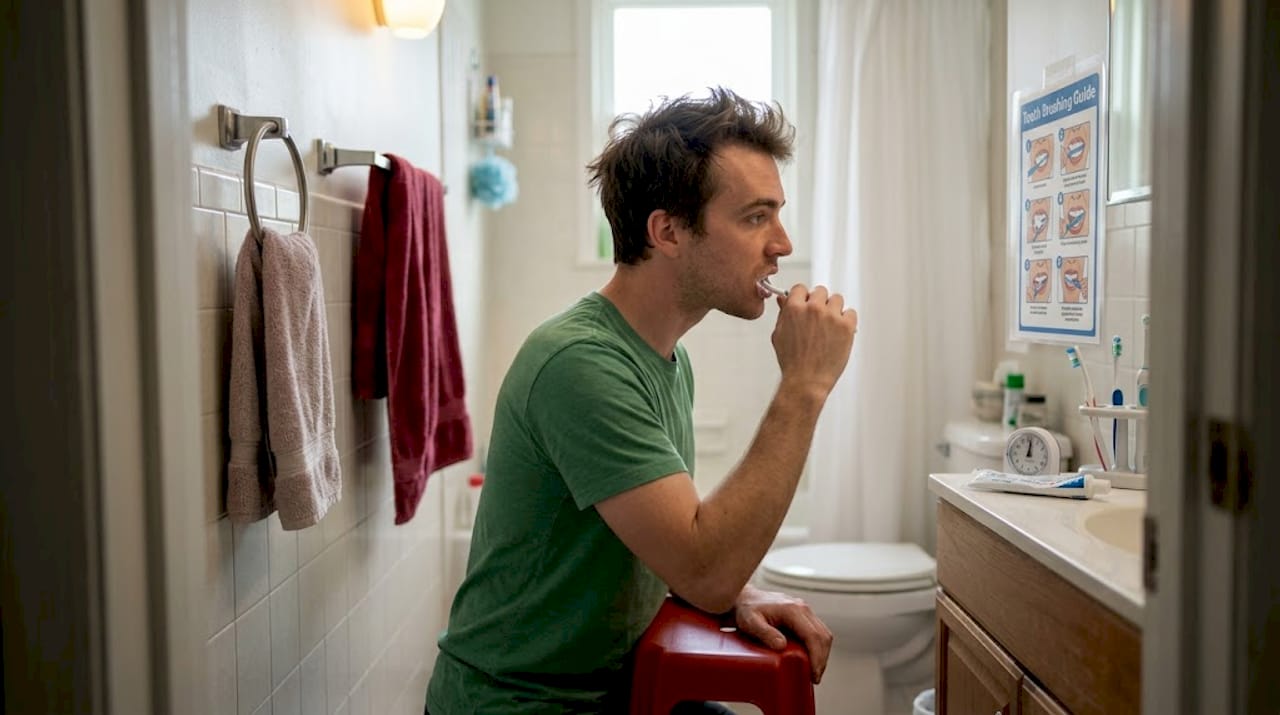
Adaptive oral care isn’t just about physical tools or environmental changes; technology plays a growing role in enabling real-time, data-driven modification of brushing behavior. Consumer-grade adaptive devices now integrate microelectronic sensors, accelerometers, and Bluetooth connectivity to provide users with immediate, actionable feedback.
In the consumer-device context, “adaptive” means real-time sensing that prompts the user to change technique, including adjusting pressure, while brushing. This represents a clinically meaningful departure from conventional toothbrushes, which provide no feedback whatsoever.
The following comparison illustrates how adaptive technology differs from standard brushing in measurable ways:
| Feature | Standard brushing | Adaptive brushing technology |
|---|---|---|
| Pressure monitoring | None | Sensor-based real-time alert |
| Technique feedback | None | App-guided zone coverage |
| Timer function | Optional (manual) | Automatic, zone-specific |
| User outcome data | None | Logged session analytics |
| Behavioral reinforcement | None | Visual/audio coaching prompts |
| Clinical plaque outcomes | Variable | Measurable improvement in studies |
How does an adaptive brushing device actually function from sensing to feedback? The process follows a structured sequence:
- Motion sensing: Accelerometers and gyroscopes detect brush orientation, speed, and coverage zone in real time.
- Pressure detection: Strain gauges measure applied force and trigger alerts when the user exceeds clinically recommended thresholds.
- Coverage mapping: Algorithms track which quadrants and tooth surfaces have been cleaned, comparing against a full-mouth protocol.
- Real-time user prompt: Audio tones, vibration patterns, or visual indicators on a paired device instruct the user to modify technique or advance to the next zone.
- Session logging: Post-brush analytics are stored, allowing the user and clinician to review trends, identify persistent coverage gaps, and adjust technique over time.
Clinical data indicates that sensor-guided brushing devices are associated with statistically significant improvements in plaque removal indices compared to manual brushing in controlled trial populations, underscoring that adaptive feedback produces measurable, not merely anecdotal, outcomes.
For those evaluating innovative dental products, the presence of a defined sensing and feedback mechanism is the critical differentiator between a genuinely adaptive device and one that simply carries “smart” branding.
Adaptive vs. natural or fluoride-free: How do they relate?
Given the popularity of natural and fluoride-free oral care, it’s important to untangle how adaptive care intersects with these preferences. The two dimensions operate along independent axes, and conflating them leads to suboptimal product and protocol decisions.
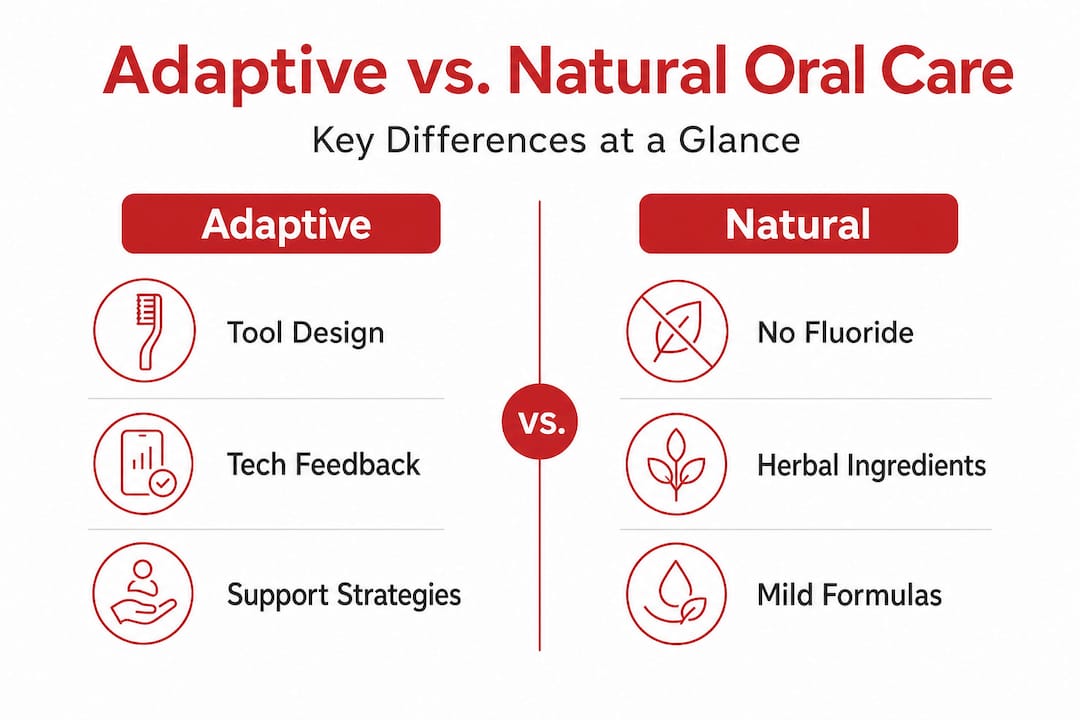
The UCLA Special Patient Care program explicitly frames this: “If you are comparing fluoride-free natural options versus ‘adaptive’ oral care, treat them as two different axes: adaptation mechanics (how care is customized to the person) versus formulation choices (like fluoride-free ingredient systems).” This distinction is foundational.
Consider the following framework for applying each axis independently or in combination:
- Prioritize adaptation when: An individual has physical limitations affecting brushing technique, sensory processing differences that interfere with routine compliance, cognitive challenges requiring environmental structuring, or requires caregiver assistance to perform oral hygiene tasks effectively.
- Prioritize natural or fluoride-free formulation when: An individual seeks to minimize synthetic chemical exposure, prefers ingredients with established natural anti-inflammatory or antimicrobial properties such as hemp-derived cannabinoids or Dead Sea mineral complexes, has known sensitivity to conventional fluoride-containing formulations, or follows a principled preference for plant-based oral care systems.
- Pursue both simultaneously when: An individual presents with high oral sensitivity, benefits from gentle sensory conditions enabled by adaptive technique modifications, and also selects ingredient-conscious formulations. This combination is especially relevant for individuals with reactive oral mucosa or documented chemical sensitivities.
Pro Tip: Combining adaptive methods with formulations specifically designed for sensitivity, such as those reviewed in choosing the best natural toothpaste resources, addresses both the mechanical and biochemical dimensions of oral health simultaneously. Those managing reactive oral tissue should also consult natural options for sensitive teeth to identify formulations with established tolerability profiles.
How to evaluate adaptive oral care for your needs
To make smart decisions for your own or your family’s oral health, you need a clear way to judge adaptive options. The market includes genuine innovations alongside products that use adaptive terminology without substantiating their claims with measurable outcomes.
For health-conscious users, a practical evaluation framework focuses on measurable outcomes tied to the specific adaptation mechanism, rather than on marketing language alone. The following steps provide a structured approach:
- Identify the specific barrier to effective oral hygiene. Is it physical (dexterity, strength), sensory (texture, sound, taste), behavioral (routine compliance, sequencing), or technique-based (pressure, coverage)?
- Determine whether the product or method directly addresses that barrier. A pressure-sensor toothbrush addresses technique but does nothing for flavor sensitivity or routine compliance.
- Review available clinical or observational data. Products with measurable plaque reduction data, adherence improvements, or tolerability evidence in relevant populations merit greater confidence than those without.
- Assess the feedback or support mechanism. Real adaptation involves a loop: the tool or system receives information about user behavior and responds with an adjustment or prompt. Products lacking this loop are conventional, not adaptive.
- Evaluate compatibility with preferred formulations. An adaptive brushing method or tool is formulation-neutral and should integrate with any toothpaste or rinse, including natural or fluoride-free options.
- Reassess outcomes after a structured trial period. Genuine adaptive benefit manifests as improved oral health indicators, reduced caregiver burden, or enhanced user independence over weeks of consistent use.
“A key expert nuance is that adaptive care can be behavior-enabling and environment-enabling, not just ‘better products.’” This framing reminds practitioners and health-conscious users alike that training, structured support, and environmental design are as legitimate as hardware or software innovations.
Practitioners and informed consumers reviewing oral hygiene tips for sensitive care will recognize that the most effective oral hygiene protocols frequently combine evidence-based technique guidance with formulation choices optimized for individual tissue response.
Why adaptive oral care matters more than you think
Now that you’ve seen the theory and practicality, here’s what most guides miss about adaptive oral care’s real potential. The prevailing discourse on oral health innovation focuses almost exclusively on formulation: what ingredients neutralize bacteria, remineralize enamel, or reduce inflammation. This is important, but it addresses only half of the problem.
The other half is access. Adaptive oral care is fundamentally a response to the reality that standard oral hygiene tools and protocols were designed for a narrow band of physical and cognitive profiles. Individuals who fall outside that band have historically experienced disproportionate oral disease burden, not because effective formulations were unavailable, but because the methods of delivery were never designed to include them.
Most discussions of adaptive strategies also underweight behavior-enabling and environment-enabling support. The assumption persists that adaptation means a modified product, when in reality, a well-structured visual routine chart costs nothing yet may be the single intervention that converts non-compliance into consistent daily brushing for a child with developmental delays.
True oral health innovation will fuse individualization of technique with intentional formulation, combining adaptive mechanical approaches with ingredient systems that reduce biochemical burden on already-compromised tissue. A natural routine for sensitive teeth that integrates adaptive tool selection, environmental structuring, and scientifically supported ingredient choices such as hemp or Dead Sea minerals represents this convergence in practical form. Brands and clinicians who treat adaptation as a behavior-enabling paradigm rather than a product feature will be better positioned to produce outcomes that conventional approaches alone cannot achieve.
Explore advanced and natural oral care with Stop Oral Care
Ready to upgrade your approach? See what’s possible with modern, natural oral care. The educational framework presented in this article makes clear that effective oral health management operates across two distinct but complementary dimensions: the how of adaptive technique and the what of ingredient formulation. Stop Oral Care brings both considerations to the center of product development.
At Stop Oral Care, Dr. Veronica Stahl leads a product line specifically formulated with hemp-derived cannabinoids and Dead Sea mineral complexes, offering fluoride-free toothpaste, mouthwash, and oral sprays grounded in clinical evidence. These formulations are designed to complement adaptive oral hygiene practices, providing ingredient-conscious options for individuals seeking natural solutions that work in concert with any personalized care protocol. Explore the full range to find the products that align with both your formulation preferences and your oral health profile.
Frequently asked questions
Is adaptive oral care only for people with disabilities?
No. While adaptive approaches are essential for those with physical or sensory challenges, anyone who benefits from personalized tools or structured feedback can apply adaptive oral care principles to their routine.
Can I use adaptive oral care with hemp or Dead Sea mineral toothpaste?
Absolutely. Adaptive methods are formulation-neutral, meaning they work alongside any product. Treating adaptation mechanics and formulation choices as separate axes allows you to optimize both independently.
What should I look for in an adaptive toothbrush?
Prioritize features like pressure sensors, real-time coverage feedback, ergonomic grip design, and published evidence that the device produces measurable improvements in plaque removal or technique quality.
How is adaptive oral care different from just using natural or fluoride-free products?
Adaptive care modifies the method of oral hygiene delivery, while natural or fluoride-free products modify the formulation. The two axes are independent and can be applied simultaneously for maximum clinical and personal benefit.
Recommended
- Oral care terminology explained: key terms for natural solutions – Stop Oral Care
- Therapeutic oral care: natural, fluoride-free benefits – Stop Oral Care
- Oral care ingredients guide: safe, natural solutions explained – Stop Oral Care
- Sustainable Oral Care: Benefits and Best Practices – Stop Oral Care