

TL;DR:
- Achieving optimal oral health with natural, fluoride-free methods relies more on mechanical technique than on product ingredients. Common mistakes include brushing too hard and neglecting interdental cleaning, which significantly increase disease risk despite ingredient quality. Correct technique, routine interdental cleaning, and professional checkups are essential for success in natural oral care.
Achieving genuine oral health through natural, fluoride-free methods demands more than simply replacing conventional products with plant-based alternatives. Preventable errors in technique, product selection, and routine maintenance frequently undermine otherwise well-intentioned oral care regimens. Evidence-based corrections, grounded in current dental research, enable users of natural products to optimize both safety and clinical outcomes. This article identifies the most consequential mistakes observed among natural oral care practitioners, presents corrective strategies supported by scientific literature, and clarifies how proven mechanical habits interact with ingredient-conscious product choices.
Table of Contents
- Mistake #1: Brushing too hard or with poor technique
- Mistake #2: Ignoring flossing and interdental cleaning
- Mistake #3: Choosing products based on marketing, not efficacy
- Compare: Conventional vs. natural routines and mistake risk
- The real key to natural oral health success: Mechanics over marketing
- Explore safer, natural solutions for your oral health
- Frequently asked questions
Key Takeaways
| Point | Details |
|---|---|
| Technique matters most | Brushing and flossing with proper timing and motion are crucial, no matter the product. |
| Don’t skip interdental cleaning | Daily flossing and cleaning between teeth prevents plaque buildup and gum disease. |
| Product labels are not enough | Natural or fluoride-free products require consistent evidence-based habits to be truly effective. |
| Professional care is essential | Regular dental checkups help catch issues early, supporting both natural and conventional routines. |
Mistake #1: Brushing too hard or with poor technique
Brushing technique is among the most clinically significant variables in oral hygiene, yet it is frequently overlooked by individuals who prioritize product ingredient selection. Mechanical force applied in excess during brushing accelerates enamel erosion and causes gingival recession, conditions that no natural formulation can reverse once established. According to common brushing mistakes documented by dental professionals, these errors include brushing too hard, not brushing long enough, using the wrong toothbrush, retaining a toothbrush beyond its functional lifespan, brushing too soon after consuming acidic foods, applying improper directional motions, and neglecting the gumline entirely.
Users of natural and fluoride-free toothpaste are not exempt from these technical deficiencies. A hemp-based or mineral-enriched toothpaste applied with excessive lateral scrubbing force will produce measurable damage regardless of its botanical ingredients. The abrasive quality of the paste, combined with the mechanical force of the bristles, determines the physical outcome on enamel and soft tissue. Achieving effective tooth brushing requires consistent application of gentle, circular motions oriented at a 45-degree angle to the gumline, maintained for a minimum of two minutes per session.
Key technical corrections for natural product users:
- Use a soft-bristled toothbrush and replace it every three months or after illness
- Apply no more than light pressure; the bristles should never visibly flatten against the tooth surface
- Brush for a full two minutes, dividing the mouth into four quadrants of 30 seconds each
- Wait at least 30 minutes after consuming acidic foods or beverages before brushing
- Ensure the toothbrush tip contacts the gumline on both the buccal (cheek-facing) and lingual (tongue-facing) surfaces
Pro Tip: Setting a two-minute timer or using a toothbrush with a pressure indicator removes the guesswork from technique and significantly reduces the risk of abrasion injury, regardless of toothpaste formulation.
Statistic: Research on oral hygiene behavior consistently indicates that a substantial proportion of adults apply excessive brushing force, with some estimates suggesting that more than 50% of patients show evidence of toothbrush abrasion during routine dental examinations. Natural product users should recognize that plaque removal with marine algae toothpaste and similar formulations depends on correct mechanical application, not on increased pressure or frequency alone.
With basic brushing mistakes clarified, let’s focus on where most natural routines fall short: interdental cleaning.
Mistake #2: Ignoring flossing and interdental cleaning
The limitations of toothbrush contact are well-established in dental literature. A standard toothbrush, regardless of its bristle configuration or the active ingredients in the accompanying paste, physically cannot access the proximal surfaces between adjacent teeth. Plaque accumulating in these interproximal spaces initiates the bacterial cascade that leads to caries and periodontal disease. As the Mayo Clinic documents in its clinical guidance on how to prevent gum disease, plaque forms from food residue and oral bacteria; if not mechanically disrupted and removed, it calcifies into tartar and precipitates gingivitis, a progression that underscores the clinical necessity of flossing and professional prophylaxis.
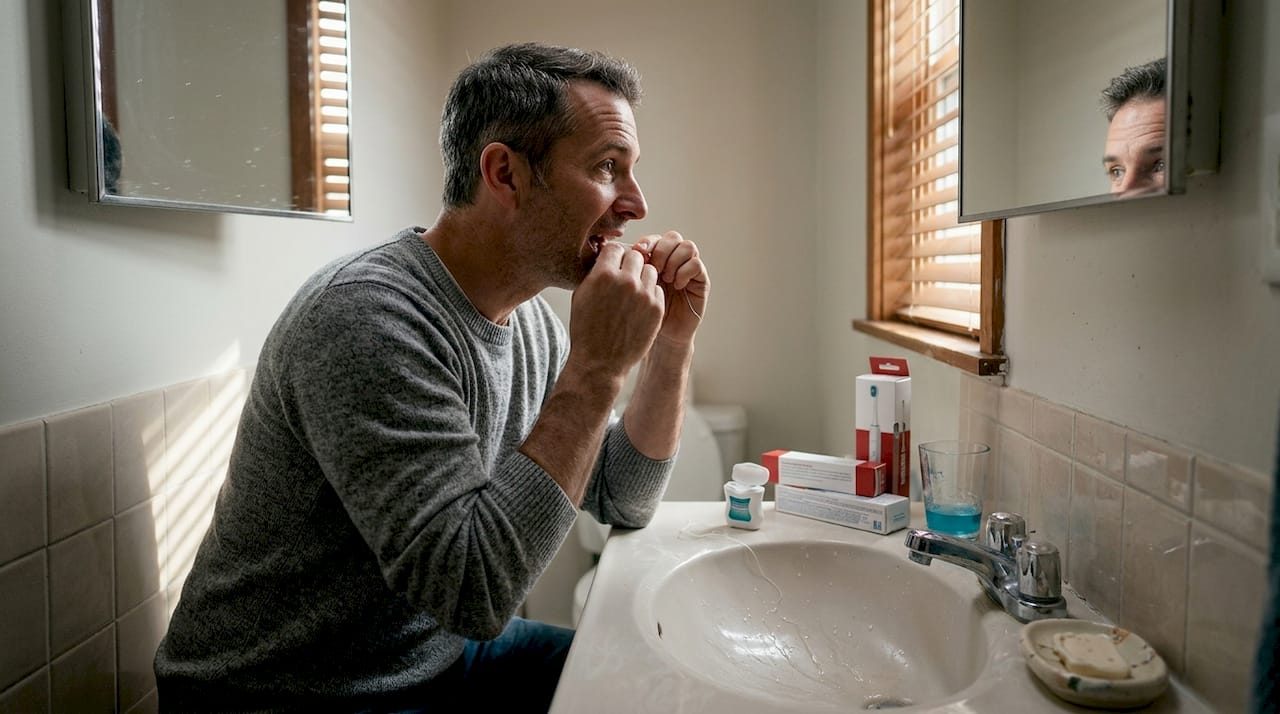
Many consumers adopting natural oral care routines incorrectly assume that superior ingredient profiles compensate for infrequent or absent interdental cleaning. This assumption is clinically unfounded. No bioactive compound, whether cannabidiol, Dead Sea mineral complex, or botanical extract, can diffuse in sufficient concentration into undisturbed subgingival biofilm without prior mechanical disruption of that biofilm. Daily interdental cleaning must therefore be regarded as non-negotiable within any fluoride-free interdental cleaning protocol.
Evidence-based interdental cleaning practices:
- Floss or use interdental brushes at least once daily, preferably before the evening brushing session
- Expect minor gingival bleeding during the first one to two weeks of initiating a consistent flossing routine; this reflects existing inflammation, not trauma from correct technique
- Persistent bleeding beyond two weeks, or bleeding accompanied by pain and swelling, warrants professional clinical assessment
- Water flossers serve as effective adjuncts but do not replace the mechanical disruption provided by traditional floss or interdental brushes
- Maintain routine dental visits every six to twelve months, regardless of natural product usage, to allow professional removal of calcified tartar deposits
Pro Tip: Incorporating flossing into the evening routine immediately before brushing, rather than after, allows the toothpaste’s active compounds to contact freshly exposed interproximal surfaces, potentially enhancing their therapeutic contact time.
“If plaque isn’t removed, it can harden into tartar and lead to gingivitis, the earliest stage of gum disease. Professional cleanings are required to remove tartar once it has formed.” — Mayo Clinic
A complete natural oral care workflow must integrate these interdental steps as a foundational element, not as an optional supplement to product application.
With flossing and interdental cleaning covered, let’s address product misconceptions that can mislead natural care seekers.
Mistake #3: Choosing products based on marketing, not efficacy
The natural oral care market presents consumers with a broad spectrum of product claims, many of which are supported by limited or non-peer-reviewed evidence. Fluoride skepticism has generated significant consumer interest in fluoride-free alternatives, but the evidence base for this skepticism is complex. As one biological dentistry source notes, consumer-facing channels have promoted narratives of fluoride toxicity, yet the clinical and toxicological evidence remains conflicted and context-dependent, with established safety profiles at regulated concentrations. This does not invalidate the personal preference for fluoride-free formulations, but it does require that consumers evaluate such choices with clear-eyed attention to the available evidence.
The critical error lies in assuming that a “natural” label or “fluoride-free” designation constitutes a clinical endorsement. Products should be evaluated based on their capacity to mechanically assist plaque removal, their antimicrobial activity as demonstrated in controlled studies, the quality of third-party testing where available, and any endorsement from recognized dental professional organizations.
Criteria for evaluating natural oral care products:
- Third-party laboratory testing for microbiological efficacy and ingredient safety
- Published in vitro or clinical trial data supporting specific health claims
- Absence of ingredients with established adverse profiles, such as certain preservatives or high-concentration abrasives
- Transparent ingredient sourcing and concentration disclosure
- Dental professional endorsements or academic institutional collaborations
“Not all natural products marketed for oral health have been rigorously tested. Consumers should prioritize products with verifiable clinical backing over those relying on ingredient trend appeal alone.” — as documented by dental professionals in leading beauty health media
Natural oral care dentists recommend generally centers on products that demonstrate measurable plaque reduction and antimicrobial activity. A comparison of natural vs. conventional toothpaste reveals that the efficacy gap is most pronounced when mechanical brushing technique is poor and interdental cleaning is absent, not when ingredient profiles differ.
Pro Tip: When evaluating a new natural oral care product, request or search for its certificate of analysis from third-party testing. Legitimate manufacturers disclose this data openly.
For those navigating the transition to natural oral care, the priority sequence should be: (1) master brushing and flossing technique, (2) select products with verifiable efficacy data, and (3) maintain professional dental supervision. Understanding fluoride-free toothpaste effectiveness in this context allows consumers to make decisions grounded in evidence rather than marketing positioning.
Knowing how to choose products wisely, it’s time to see how these mistakes stack up in a practical comparison.
Compare: Conventional vs. natural routines and mistake risk
The following comparison examines mistake prevalence and associated risk factors across conventional and natural oral care routines. The table demonstrates that the mechanical principles underlying effective oral hygiene remain constant, and that risk is primarily determined by behavioral factors rather than product ingredient category.
| Factor | Conventional routine | Natural/fluoride-free routine |
|---|---|---|
| Primary cavity prevention agent | Fluoride (strong evidence base) | Variable; often mineral or botanical compounds |
| Brushing technique adherence | Frequently poor despite product efficacy | Frequently poor; product choice prioritized over technique |
| Interdental cleaning frequency | Often neglected | Often neglected; error compounded by absent fluoride |
| Gumline attention | Frequently missed | Frequently missed |
| Risk of abrasion from over-brushing | Moderate to high | Moderate to high |
| Product efficacy verification | Regulated; clinical data required | Variable; often limited third-party evidence |
| Professional dental visit frequency | Generally maintained | Sometimes reduced due to “natural” self-sufficiency assumption |
| Tartar management | Dependent on professional cleaning | Equally dependent on professional cleaning |
As oral cleaning essentials established by clinical authorities confirm, the same core mechanics including removing plaque, brushing with care, and cleaning between teeth are essential for both natural and conventional routines. The table reinforces a critical finding: the risk profile between the two categories is remarkably similar when technique and maintenance errors are controlled. The differentiating variable is not the presence or absence of fluoride, but rather the degree to which the user adheres to established mechanical hygiene practices.
Statistic: Studies examining oral health outcomes in populations using natural vs. conventional products consistently find that natural dental care methods produce equivalent outcomes to conventional care when brushing duration, frequency, and flossing compliance are equivalent. Conversely, even the most evidence-backed conventional products fail to prevent disease progression in patients with chronically poor technique. Readers are encouraged to consult resources on debunking natural oral care myths and to review guidance on how to switch to natural oral products safely and systematically.
The comparison shows the real gap — let’s wrap up with an expert perspective on what truly counts.
The real key to natural oral health success: Mechanics over marketing
The dominant narrative within the natural oral care sector assigns exceptional weight to ingredient selection, often at the expense of the behavioral variables that clinical research consistently identifies as primary determinants of oral health outcomes. This prioritization reflects a commercially understandable emphasis on product differentiation, but it creates a significant informational gap for the consumer.
The observable clinical reality is that patients who brush for the full recommended duration, apply correct angulation and force, and perform daily interdental cleaning consistently demonstrate better periodontal and caries outcomes than patients who use premium or clinically superior products with suboptimal technique. This pattern holds across both conventional and natural product users and suggests that the behavioral substrate of oral hygiene is more consequential than any single formulation variable.
Natural oral care enthusiasts should resist the inclination to treat ingredient purity as a proxy for clinical effectiveness. Hemp-derived cannabinoids and Dead Sea mineral complexes present genuinely promising bioactive profiles, but their therapeutic potential is fully realized only when delivered to surfaces that have been mechanically prepared through correct brushing and interdental cleaning. The product is the delivery vehicle; technique is the mechanism of action.
The issue of early gingival bleeding during flossing warrants particular attention. Many natural oral care users interpret this as a sign of product incompatibility or excessive intervention, leading them to abandon interdental cleaning prematurely. This response is counterproductive. Initial bleeding reflects pre-existing gingival inflammation caused by undisturbed plaque biofilm. With consistent daily flossing, inflammatory response at the gumline typically diminishes within one to two weeks as the microbial load is reduced.
Persistent or worsening bleeding, however, signals pathology that requires professional evaluation. Self-management through product substitution alone is insufficient and potentially dangerous in this context. Detailed fluoride-free dental workflow tips that integrate proper mechanical practice with ingredient-conscious product choices represent the most defensible approach to natural oral health management.
Explore safer, natural solutions for your oral health
For those committed to evidence-informed, natural oral care, the next practical step is identifying products that combine verifiable bioactive efficacy with the mechanical support structure described throughout this article.

Stop Oral Care offers a curated line of fluoride-free formulations incorporating hemp-derived compounds and Dead Sea mineral complexes, developed under the scientific direction of Dr. Veronica Stahl, a recognized authority in dentistry and natural medicine. Each product in the Stop Oral Care catalog is developed with attention to ingredient transparency, antimicrobial efficacy, and compatibility with established mechanical hygiene routines. Educational resources on the platform provide ongoing guidance for avoiding the most consequential oral care mistakes, supporting consumers in building routines grounded in both natural ingredients and clinical best practice.
Frequently asked questions
Do fluoride-free products prevent cavities as well as conventional toothpaste?
Most clinical evidence positions fluoride as superior for cavity prevention, but technique, plaque removal frequency, and interdental cleaning are equally decisive factors; fluoride-free products can perform effectively when mechanical hygiene is consistently applied.
Is bleeding gums while flossing a sign of serious gum disease?
Initial bleeding during flossing typically reflects pre-existing gingival inflammation rather than injury or disease, and it commonly resolves within one to two weeks of consistent daily flossing; persistent or severe bleeding requires professional dental assessment to rule out pathological causes.
How often should I visit a dentist if I use natural oral care products?
Routine dental appointments every six to twelve months remain clinically advisable for all individuals, including committed users of natural and fluoride-free products, primarily to enable professional tartar removal and early disease detection.
What is the biggest mistake natural oral care enthusiasts make?
The most clinically significant error is attributing protective efficacy to product ingredient selection alone while neglecting the core mechanics of brushing duration, force control, angulation, and daily interdental cleaning that are necessary for effective plaque biofilm disruption.
Recommended
- Natural dental care myths debunked for safer smiles 2026 – Stop Oral Care
- 7-Step Oral Hygiene Checklist for Adults Seeking Natural Care – Stop Oral Care
- Best practices for sensitive mouths: natural care in 2026 – Stop Oral Care
- Guide to Safe Oral Care 2025: Achieve a Healthier Smile – Stop Oral Care